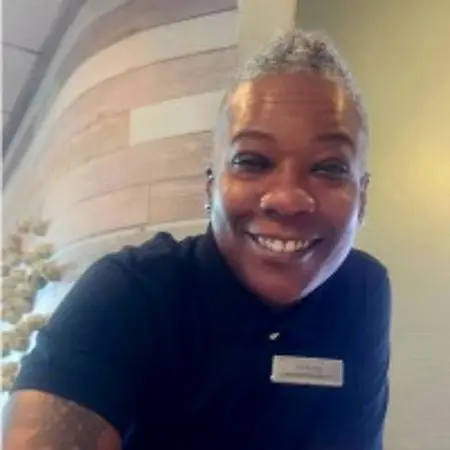
Her Story
About Kathryn
Kathryn Bradley is a hospitality operations leader, emerging learning and development professional, and passionate advocate for people-centered leadership. She serves as Task Force Operations Manager for Crestline Hotels & Resorts, where she has built a reputation for stepping into challenging environments, strengthening operations, developing teams, and helping leaders reconnect with the people behind the performance.
Since joining Crestline in 2022, Kathryn has supported the company’s expansive portfolio of approximately 110 hotels, representing major brands including Marriott, Hilton, Hyatt, Holiday Inn, and Comfort Inn. Her role requires approximately 90 percent travel, placing her inside different hotels, cultures, teams, and leadership environments across the country. That experience has given her something a traditional classroom never could: a front-row seat to how leadership directly impacts culture, employee engagement, guest experience, and ultimately, business performance.
Originally from St. Louis, Missouri, Kathryn relocated to Baltimore, Maryland, following the pandemic. After being mentored into hospitality leadership, she continued investing in her own development through the American Hotel & Lodging Association (AHLA), completing her studies with high honors. Most recently, she was awarded a scholarship to further her education in Learning and Development, an area that has become a natural extension of the work she has already been doing throughout her career.
Kathryn's approach to leadership is rooted in a simple but increasingly rare practice: listening to understand, not simply listening to reply.
Working alongside employees and leaders from different generations, backgrounds, departments, and levels of experience has shaped her belief that today's workplace requires a different kind of leadership. Employees are not only looking for a paycheck or a title. Many are looking for respect, psychological safety, connection, development, and a workplace where they can experience some sense of peace in an increasingly complicated world.
Rather than expecting people to simply adapt to leadership, Kathryn challenges leaders to become better equipped to understand their people. Her work focuses on emotional intelligence, generational understanding, vulnerability, communication, employee development, and creating environments where people feel safe enough to speak, learn, contribute, and grow.
That philosophy is now evolving into something of her own.
Kathryn is currently developing The Circle of Catalyst, an innovative leadership training experience designed to move learning away from the traditional lecture-style classroom and into a collaborative circle where leaders learn with one another rather than simply being taught at.
The Circle of Catalyst is being built around conversation, vulnerability, shared experiences, emotional intelligence, and the belief that some of the most powerful leadership lessons happen when people are willing to challenge what they have always been taught about management. Kathryn's vision is to create sessions that leave leaders questioning old habits, seeing their employees differently, and walking away thinking, “I never looked at leadership that way before.”
Her goal is not to create perfect managers.
It is to develop more aware, emotionally intelligent, human leaders.
Kathryn believes the future of hospitality will depend not only on how well organizations serve their guests, but also on how well leaders serve the people responsible for creating those experiences every day.
From hotel operations to leadership development, Kathryn Bradley is building a career around one central idea:
When you change the way leaders see people, you can change the culture of an entire workplace.
Her Interview
Ten minutes with Kathryn
01What do you attribute your success to?
I attribute my success to my willingness to enter every room as a student before trying to lead it. I’ve learned that people will often tell you exactly what an organization needs if you create a space where they feel safe enough to be honest. I listen beyond the words—to understand the person, the environment, and sometimes even what isn’t being said. I don’t believe leadership begins with having the answer; it begins with asking the right questions and having the humility to hear the response. My success has come from understanding that people are not problems to solve—they are people to understand. Once people feel seen, heard, and valued, that’s when trust begins, and real change becomes possible.
02What’s the best career advice you’ve ever received?
One of the best pieces of career advice I ever received was, ‘Kat, everything isn’t always black or white. Learn to find the gray.’ That advice changed the way I approach leadership. Early in our careers, we’re often taught to look for the right answer, follow the process, and determine who is right or wrong. But leadership has taught me that people and situations are rarely that simple. The gray area is where you find context, perspective, and understanding. It’s where you stop asking, ‘Who is wrong?’ and start asking, ‘What am I missing?’ Finding the gray doesn’t mean compromising your standards—it means having the emotional intelligence to understand the circumstances before deciding how to lead through them. Some of my greatest growth has come from realizing that the answer isn’t always on one side or the other. Sometimes, the wisdom is in having the courage to stand in the middle long enough to understand both.”
03What advice would you give to young women entering your industry?
My advice to young women entering this industry—or any industry—is to discover who you are before allowing the world to tell you who you should be.
Give yourself permission to explore. Travel if you can. Meet people who are different from you. Experience different cultures, careers, cities, successes, and even failures. The person you are at 20 may not want the same things at 25, 30, or 40—and that doesn't mean you were lost. It means you grew.
Don't box yourself into a life simply because society handed you a timeline. If college isn't right for you right now—or isn't part of your journey at all—that's okay. Education comes in many forms. If you're not ready for marriage, motherhood, or any of the traditional milestones women are often expected to pursue, don't allow someone else's expectations to make you feel behind.
You are not late to your own life.
Learn to love yourself before you start making permanent decisions based on temporary expectations. Learn what brings you peace. Discover what excites you. Find out what you're good at, what you're willing to fight for, what you're willing to walk away from, and most importantly, what you refuse to lose about yourself while pursuing success.
Be ambitious, but be kind to yourself. Take chances. Change your mind. Start over if you need to. Walk through doors you never imagined would open for you—and don't be afraid to close the ones that no longer lead where you want to go.
There is no single blueprint for becoming a successful woman.
Create a life that feels authentic to you, love the woman you're becoming, and stop shrinking yourself to fit into spaces you've already outgrown.
The world may have expectations for who you should become.
Let it adjust.
04What are the biggest challenges or opportunities in your field right now?
One of the biggest challenges in hospitality right now is that the relationship people have with work—and with one another—has fundamentally changed. COVID accelerated a shift that was already happening. We saw people reconsider what they were willing to tolerate at work, how much human interaction they wanted, and what peace, flexibility, and emotional well-being meant to them.
Hospitality, however, is built on human connection. We don't have the luxury of removing people from the equation. Our business requires us to serve people, communicate through difficult situations, manage expectations, resolve conflict, and sometimes say “no” while still making someone feel valued.
At the same time, I believe we are experiencing a broader challenge with accountability. It can be easier to deflect, disengage, or walk away from discomfort than to work through it. For leaders, that means we can no longer assume that the management styles that worked ten or twenty years ago will work with today's workforce.
But I also see that as our greatest opportunity.
This generation is forcing leadership to evolve.
Today's hospitality leaders have to understand emotional intelligence, generational differences, communication styles, boundaries, and the varying levels of tolerance people have for conflict and pressure. We have to learn how to hold people accountable without devaluing them, show empathy without eliminating expectations, and create psychologically safe environments without confusing safety with the absence of discomfort.
The opportunity is not to lower the standard. It is to become better leaders while maintaining the standard.
I believe the organizations that figure out that balance—accountability with empathy, expectations with understanding, and performance with humanity—will be the ones that attract, develop, and retain the strongest people in the future.
05What values are most important to you in your work and personal life?
Character and integrity are the values that matter most to me, both professionally and personally. I believe your character is revealed not when everything is going well, but in the moments when doing the right thing is difficult, inconvenient, or may cost you something.
Integrity, to me, is about consistency. It means being the same person in rooms where your name is celebrated as you are in rooms where no one knows your name. It means keeping your word, owning your mistakes, treating people with dignity regardless of their title, and making decisions I can stand behind even when no one is watching.
Throughout my career, I’ve learned that titles can give you authority, but they cannot give you character. People may respect your position because they have to, but they respect your integrity because you’ve earned it.
Personally, I try to live by the same standard. I don't expect perfection from myself or from others, but I do believe in accountability, honesty, compassion, and being willing to look in the mirror when I get something wrong. Growth requires that kind of self-awareness.
At the end of the day, accomplishments, positions, and recognition can change. Your character is what remains when the title is removed. Your integrity is what determines whether people can trust the person underneath it.
And for me, that will always matter more than any title I could ever hold.
Join Influential Women and start making an impact. Register now.