Her Story
About Kathy
Senior Estimating Advisor
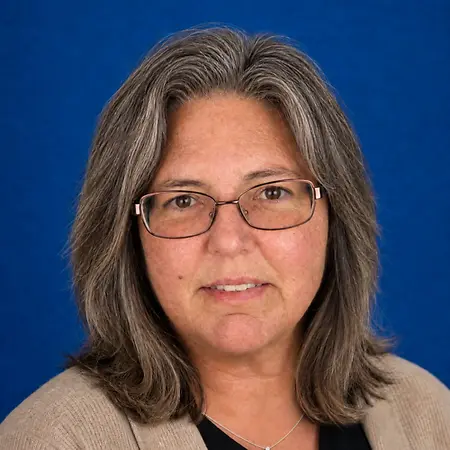
Kathy Griegeris a Senior Estimating Advisor at Hunt Electric in Eagan, Minnesota, bringing more than 30 years of electrical estimating and construction expertise to the organization. Since joining Hunt Electric in the early stages of her career, she has become one of the company's most respected leaders in estimating excellence and workforce development.
Early Career & Foundation
Kathy's journey in electrical construction began in 1984 after earning an Associate's Degree in Mechanical Drafting and Design from Ridgewater College. From the start, she developed a strong foundation in technical design, field operations, and estimating principles that would define her three-decade career with Hunt Electric. Her early years were spent as an industrial estimator, specializing in paint shop and power projects—a focus she maintained for approximately 15 to 18 years while building deep expertise in complex industrial systems.
Leadership & Growth
As her career progressed, Kathy advanced into an Estimating Manager role, leading a team of seven estimators who handled industrial facilities, battery plants, power plants, and an expanding range of project sectors. Her proven leadership and strategic vision led to her promotion to Chief Estimator, where she oversaw Hunt Electric's fully centralized estimating department. In this capacity, she managed all commercial, industrial, mission-critical, airport, and medical project estimates while playing a pivotal role in scaling the department from 18 to 35 estimators—nearly doubling its size while ensuring consistency, accuracy, and collaboration across all project types.
Current Role & Legacy
Today, as Senior Estimating Advisor, Kathy focuses on what she does best: mentoring, training, and developing the next generation of estimating professionals. She conducts bid reviews, creates comprehensive training materials and standard operating procedures, and actively prepares her successor as she transitions toward retirement. Her expertise remains rooted in industrial construction, with particular strength in automotive, power, and mission-critical projects.
Field Experience & Industry Knowledge
What sets Kathy apart is her well-rounded perspective gained through hands-on field experience. Throughout her career, she has served in roles such as assistant project manager and designer, working directly alongside electricians nationwide. This combination of field knowledge, technical expertise, and leadership experience has made her an invaluable resource and a respected voice within Hunt Electric and the broader electrical construction industry.
Her Interview
Ten minutes with Kathy
01What do you attribute your success to?
"I have to credit my parents first and foremost. When I entered the electrical construction field in the early 1980s, virtually no women were part of this industry. But my parents supported me completely—they told me I could do whatever I wanted to do. Women's liberation was emerging strong during that time, and I truly believed that women could pursue any career path they chose. My parents reinforced that belief throughout my entire life.
My husband has been equally supportive. With children at home, I could never have traveled for work without him. We had reverse roles—he was the stay-at-home parent while I was out on job sites and building my career. He took care of our kids and managed the household so I could focus on advancing in this field.
At work, I was fortunate to have Hunt Electric's past president support my career development by allowing me to go into the field. In the mid-1990s, I was one of only two females on a job site with over 100 electricians. Times were most definitely different back then—you had to prove yourself and your knowledge to be accepted or even acknowledged.
That support system—at home and at work—has been absolutely critical to everything I've been able to accomplish. My advice to anyone entering a non-traditional career path: surround yourself with people who believe in you. Find champions—whether it's family, mentors, or colleagues—who will support your ambitions and give you opportunities to prove your capabilities. Success isn't achieved alone. It takes a foundation of encouragement, flexibility, and partnership to break barriers and build a lasting career."
02What’s the best career advice you’ve ever received?
"The best advice I carry with me throughout my career is to continue learning, stay adaptable, and never stop improving your technical knowledge. The electrical construction industry is constantly evolving—new technologies, methodologies, and standards emerge regularly. If you're not committed to staying current, you'll fall behind.
I've learned that success doesn't come from resting on your accomplishments. It comes from being willing to work hard while remaining teachable at every stage of your career—whether you're just starting out or leading a department. I've had the privilege of learning from incredible mentors, and now I'm committed to passing that knowledge forward.
No matter where you are in your professional journey, approach each day with humility and curiosity. Ask questions. Seek feedback. Study new techniques. Be open to change. The people who thrive in this industry are the ones who understand that learning never stops. Your technical expertise combined with a growth mindset will set you apart and open doors throughout your career."
03What advice would you give to young women entering your industry?
"If I could offer advice to young women entering the electrical construction industry—or any non-traditional field—it would be this:
Believe in yourself, but build a support system. I was fortunate to have parents who told me I could do anything, a husband who supported my career even when it meant reversing traditional roles, and leadership at Hunt Electric who gave me opportunities to grow in the field. You can't do it alone. Surround yourself with people who believe in your potential and will champion your growth.
Get field experience, not just office experience. Some of my most valuable learning came from working alongside electricians, serving as an assistant project manager, and seeing projects from the ground up. That hands-on knowledge made me a better estimator and leader. Don't shy away from opportunities to get your boots on the ground.
Never stop learning. I've spent over 30 years in this industry, and I'm still learning. Technology changes, methods evolve, and standards improve. Stay curious, stay adaptable, and commit to continuous improvement. Your willingness to grow will set you apart at every career stage.
Work hard, but stay teachable. Confidence is important, but humility is equally valuable. Be willing to ask questions, seek mentorship, and learn from those around you—regardless of their title or background. The strongest leaders are those who remain students throughout their careers.
Your path may look different—and that's okay. My career took me from drafting to estimating, from the field to leadership, and now to mentoring. I had a stay-at-home husband while I traveled for work. There's no single blueprint for success. Define what success means for you, and don't be afraid to forge your own path.
The doors are more open today than they were in the 1980s, but there's still work to be done. Be the woman who not only walks through those doors but holds them open for others behind you. That's how we create lasting change."
04What are the biggest challenges or opportunities in your field right now?
"The biggest challenges we face today are speed and expanded expectations. Projects move faster than ever, and estimators are under intense pressure to deliver accurate bids quickly. Beyond that, the role has fundamentally changed—we're now expected to relocate to job sites and join management teams to handle change orders throughout construction, not just provide initial estimates.
On the opportunities side, artificial intelligence has tremendous potential. We've established a research committee at Hunt Electric to explore how AI and business intelligence can transform our estimating workflows. Imagine systems that recognize scope letters, analyze bid breakdowns, and draw from historical data to help generate preliminary budgets in seconds.
The promise is real, but the electrical industry lags behind. While architecture has implemented effective AI tools, electrical estimating programs remain clunky and not optimized for our specific needs. That's what we're working to solve—how to leverage AI to support our teams and streamline processes while preserving the critical human expertise that makes great estimating possible.
The future is about combining technology's speed and analytical power with the judgment that experienced professionals bring."
05What values are most important to you in your work and personal life?
"The values that guide me, both professionally and personally, center on empathy, mentorship, and believing in people's potential.
I always remind my team members—and myself—that you never know who's sitting across the table from you or what they're going through. Having strong soft skills, truly listening, and not reacting hastily during conversations is critical. What seems like a minor disruption to me might be the worst moment of someone else's day. When team members come to me with challenges, I pause and remember: this is critical for them right now, even if I've experienced it before. That perspective shifts everything.
I'm passionate about training, mentoring, and building people up. I focus on sharing stories and experiences so people understand they're not alone in their struggles. I genuinely believe that everyone can succeed if they have the correct information, the right platform to work from, and mentorship that's readily available to them. Even when someone is struggling, I give them opportunities to grow and prove what they're capable of.
At the core, my values come down to this: treat people with patience and respect, invest in their development, and believe in their ability to succeed. When you create that kind of environment, people don't just survive—they thrive."
Join Influential Women and start making an impact. Register now.