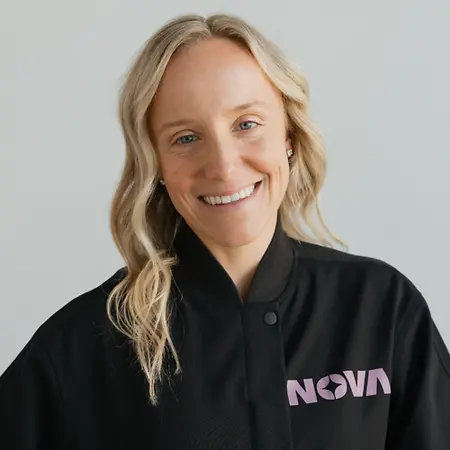
Her Story
About Katie
Katie Savarise is the Founder and CEO of NOVA Innovation Group, a woman-owned project management consulting firm specializing in large-scale venue developments and mixed-use projects surrounding major sports and entertainment destinations. Since founding NOVA in 2022, she has led the company in delivering complex, high-impact projects, including stadium renovations, new ballpark developments, and international initiatives such as MLB academies in the Dominican Republic. Known for her innovative approach, Katie combines strategic oversight with hands-on execution, serving as both project manager and owner’s representative to bring visionary concepts to life.
Prior to launching NOVA, Katie spent more than seven years at Uber, where she led the Global Event Operations team and managed a multi-million-dollar portfolio of complex venues across the United States and internationally. Her work focused on designing and optimizing mobility solutions for large-scale events, ensuring seamless operational experiences through a combination of technology and on-the-ground strategy. Earlier in her career, she co-founded Parametric LLC, a technology company focused on enhancing stadium and venue operations through mobile solutions and data analytics, further establishing her expertise at the intersection of sports, technology, and infrastructure.
In addition to her corporate leadership, Katie serves as Founding Chairman of the NOVA Foundation, a nonprofit dedicated to supporting individuals at pivotal life transitions, beginning with student-athletes navigating life after sports. She holds an MBA in Project and Sports Management from The George Washington University School of Business and a Bachelor of Science in Engineering from the University of Pennsylvania. A dynamic leader in a traditionally male-dominated industry, Katie is recognized for building high-performing teams, fostering innovation, and redefining how large-scale developments are designed and delivered.
Her Interview
Ten minutes with Katie
01What do you attribute your success to?
I attribute my success to my parents. They instilled in me from a really young age the values of being really hardworking and not accepting no as an answer. They taught me to always look for a way to solve the problem and gave me the confidence to believe in myself. I think that's what really set me up to take these big leaps into entrepreneurship and to really believe in myself. I'm very lucky to have had parents who taught me those values and gave me that foundation.
02What’s the best career advice you’ve ever received?
The best advice I've ever received came from Denzel Washington, who was our commencement speaker when I graduated from Penn in 2011. His whole speech was about falling forward. He talked about how you don't see all the failures behind the scenes - you don't see how many strikeouts Babe Ruth had or how many times Einstein failed an experiment. You just see the one time they solved the problem or set the record. But there's so much work behind the scenes to get to those successes. He framed it as always falling forward - you're always going to fall, everyone's going to fail and have challenges, but you want to be falling forward and seeing the opportunity in what that leads you to. You want to take the leap and fall forward. When I started NOVA and left my amazing job at Uber, everyone thought I was nuts. We were heading into uncertainty, and I was going into an industry I didn't know a lot about. I actually wrote an email to all my friends quoting this speech, saying this is me taking the advice and falling forward and taking the leap. That speech has stuck with me for 15 years now, and I think about it probably weekly. It's so powerful, especially with entrepreneurship - all the failures are so you can have the home run or set the record, but you've got to take these risks and fall forward to give yourself the chance to have that success.
03What advice would you give to young women entering your industry?
When I'm about to walk into a big room or a big meeting and I know I'm going to be the only woman in there, or I'm really having that imposter syndrome, there are three thoughts that come to mind. First, I ask myself, why not me? If everybody else can be in this room, why couldn't it be me? Usually I can't come up with a reason, which gives me the motivation to just go ahead and do it. Second, I think about whether every boy and man I know would walk into the room and be confident. Would they be nervous about this, or would they be confident? If the answer is no - if a man would walk in and just think that they belong - then I should too. There's no reason for me not to have that confidence. And third, I remind myself that nobody really knows what they're doing. When I got into these rooms, you give all these people all this power - they're the CEO, they're the owner, they have all this money - but they don't know either. Everyone's just doing their best and trying to make it up as they go. Life is complicated, these projects are complicated, and since nobody really knows the correct answer at the end of the day, why not me? Why can't I be a voice in that room too? I think as women, we second-guess ourselves and talk ourselves out of a lot of things. We give way too much power to other people or to roles or titles. Once you realize that everybody's struggling with confidence, and that even a CEO or a billionaire is just a person too who doesn't have all the answers - that's why they're bringing you in for a meeting or asking you a question - it feels way less intimidating and you show up in a much better space.
04What are the biggest challenges or opportunities in your field right now?
The biggest challenge right now is the legislation and funding pieces that are needed for some of these large, complex stadium projects to go through, along with city approvals. Because these projects are so significant to cities, navigating the changing landscapes in different cities and successfully moving these projects forward hand-in-hand with the cities and states is one of the biggest challenges we face day-to-day. You see certain cities have a ton of construction going on, while in others it has slowed, and a lot of that is financially driven. On the opportunity side, there's a whole generation of old stadiums that need to get renovated or rebuilt, so there are a lot of new stadiums coming in the coming years. This gives a ton of opportunity for young businesses like mine to get in the mix. I think you'll see really cool design with a focus on sustainability, which wasn't as much of a focus 30 or 40 years ago when current stadiums were built. The developments that surround the stadiums are the biggest movement right now - all these cities are taking their parking lots and building neighborhoods or districts around the stadiums. Atlanta is a great example, and now every city is following that model. You're going to see a lot of really cool districts and neighborhoods pop up. It's a really exciting time to be part of the industry because every week it seems like there's a new stadium or development being announced. And with the money going into women's sports, I foresee more facilities in that space, which is something we haven't really seen before. So there are a lot of projects coming, and it's not just going to be the NFL, NBA, NHL, and MLB - now you're going to see soccer and women's sports and everything take over as well.
05What values are most important to you in your work and personal life?
Integrity is a big one for me. In both my personal life and business, I always want to make sure that the decisions I'm making - whether it's clients I'm bringing on, how I'm managing my team, or any other aspect - are coming from a place of integrity. I feel like if I do make a misstep or something doesn't work out, at least I know I made a choice that was there and I was doing the best I could from that place of integrity. I think that allows me to feel comfortable taking risks. Authenticity is also really important to me. That's sometimes hard in the corporate world, but I want to be myself. I'm in a very corporate industry, and that's not me, as you can probably tell from talking to me. I made a choice, for example, that my brand is pink and purple colors, I have a star as my logo, and I show up the way you and I are talking - it's how I talk in whatever meeting I'm in. Showing up as myself has been important for me and doing it my way. It was scary in the beginning, but I do think it's helped me stand out a lot. For my team, we always want to be the problem solvers. That's how we approach all of our projects - we will solve the problem, and it's a yes mentality instead of a questioning or negative mentality. It's always like, yes we can, it's just a matter of how we'll do it. I think that sets us apart really uniquely as well.
Join Influential Women and start making an impact. Register now.