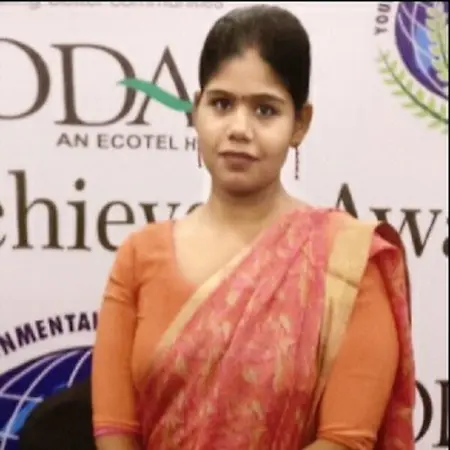
Influential Woman · Economics
Kaushiki Singh
Economist, The World Bank
Washington, DC
Her Story
About Kaushiki
My journey as an economist spans nearly 14 years across two continents. After graduating with a degree in economics in India, I joined the Reserve Bank of India, the equivalent of the Federal Reserve, where I worked for over 14 years. In 2020, at the peak of COVID, I made the bold decision to move to the United States with my son, who was only one and a half years old at the time, to pursue my PhD in economics at Iowa State University. I graduated in 2025 with a PhD in economics and a minor in statistics. After which I transitioned to the World Bank in Washinton DC. Alongside this, I've built a demanding daily routine that lets me balance a high-intensity career with raising my child as a solo parent (my spouse being based in another country). I've also stayed committed to community service and public engagement, contributing articles, publication and blogs, which I see as an extension of my professional commitment to economic policy beyond my day job. I am a firm believer that hard work is the only thing that makes you grow places, and I have been able to pull off everything I have committed to so far through persistent effort and dedication.
Her Interview
Ten minutes with Kaushiki
01What do you attribute your success to?
I attribute my success to three main things. First is my mother - she has been my constant support system, and none of what I've accomplished would have been possible without her. Second is my son - he's the reason I push myself every day to build a better future, and balancing my career with raising him as a single mother has taught me discipline and focus I don't think I would have developed otherwise. And third, hard work. I've never been someone for whom things simply fell into place - every milestone, from joining the RBI early in my career to completing my PhD while working at World Bank, has come from sustained effort and persistence. That combination of support, purpose, and hard work is what has carried me this far.
02What’s the best career advice you’ve ever received?
The best advice I received is to be patient, work hard, and stay honest and that nobody could stop me from achieving my goals if I held onto those three things. That advice stayed with me, especially during my transition from the RBI to a PhD program in a new country, where progress felt slow and uncertain. Being patient helped me trust the process even when results weren't immediate. Consistent hard work is what got me through the PhD while simultaneously working. And honesty in my analysis, in how I communicate results, and in how I deal with people has been the foundation that I believe earns trust and credibility over time. It's advice I still return to whenever I face a difficult or uncertain stretch in my career.
03What advice would you give to young women entering your industry?
My advice to young women entering this field is to be persistent, but also to be proactive; don't just wait for opportunities, seek them out and advocate for yourself. I've certainly encountered moments where I had to work harder to be heard or taken seriously. What's helped me is staying focused on building real expertise, finding mentors who believed in my potential, and not letting setbacks define the trajectory of my career. There will be difficult stretches, especially if you're also balancing family responsibilities as I have as a single mother, but persistence combined with continuously building your skills is what actually opens doors, not persistence alone. My biggest advice is: back yourself, keep learning, be persistent, be a fighter and never give up.
04What are the biggest challenges or opportunities in your field right now?
I'd point to two things - a challenge and an opportunity, and I think they're actually connected. The challenge is the level of global economic uncertainty we're operating in right now - slower growth in several major economies, persistent volatility in labor markets, and geopolitical fragmentation that makes forecasting and policy design harder than it's been in years. That uncertainty naturally creates anxiety, both for the institutions we advise and for professionals in the field who are wondering how the profession itself is evolving.
The opportunity I see is in AI and digital tools transforming how economic research and analysis are done. Rather than viewing this as a threat, I think economists who build strong AI and data fluency alongside traditional economic training will be the ones best positioned going forward - AI can dramatically speed up data processing, modeling, and forecasting, but it still requires economists who understand the underlying theory to interpret results, ask the right questions, and apply judgment. So my view is: the economists who invest now in building that hybrid skill set - strong fundamentals plus comfort working with AI tools - will be the ones who turn this uncertain moment into a real competitive advantage.
05What values are most important to you in your work and personal life?
The values I hold most important are honesty and trust and to me, they're deeply connected: trust is really what's built when honesty is practiced consistently over time. Professionally, that means being transparent in my analysis, even when the findings aren't what a stakeholder wants to hear, and being upfront about the limitations or uncertainty in any economic model or forecast I put forward. I think that kind of intellectual honesty is especially important in economics, where the temptation to shape data to fit a narrative always exists. In my personal life, the same principle holds i.e. being honest with the people around me, including my son, is something I try to model consistently, because I want him to grow up seeing that integrity in action, not just hearing about it. Ultimately, I believe honesty is what earns trust, and trust is the foundation for every meaningful relationship, whether it's with a colleague, an institution, or my family.
Join Influential Women and start making an impact. Register now.