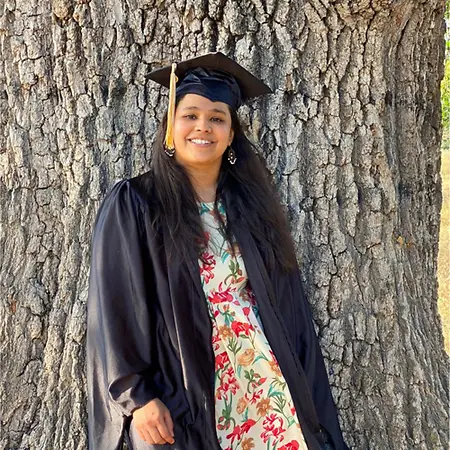
Influential Woman · Life sciences
Keerthana Nagesh Prabhu
Bioinformatics Research Analyst, Washington University in St. Louis
St. Louis, MO 63110
Her Story
About Keerthana
My journey in life sciences began with a love of biology, but it became deeply personal when I saw family members suffering from cancer and other ailments. That experience made me think about how I could contribute to bettering everyone's lives. I pursued my master's in bioinformatics and have now been in the field for about 7 years. Currently, I work on brain cancer research, which is something I've always wanted to do. The lab I'm with focuses on the diagnosis part of brain cancer, specifically non-invasive diagnosis. We're working on detecting cancer through biomarkers in the blood rather than invasive biopsies, which can actually risk spreading cancer cells when you poke a needle into a tumor. The challenge is that every patient is different, so you can't generalize your diagnosis theory. Brain tumors come in different stages and levels of aggressiveness, making it very hard to find something common between all patients. The biomarkers we work with have a half-life of only 20 minutes, which adds to the complexity. Our goal is to make detection as easy as getting a blood test, where we can tell if someone might be at risk or if cancer has started. Before this, I worked as an analyst in the agriculture field focusing on food, but when I had the opportunity to move into cancer research, I jumped at the chance. I've even attended surgeries and, without sounding too creepy, I kind of loved seeing the process firsthand.
Her Interview
Ten minutes with Keerthana
01What do you attribute your success to?
Personal growth, in other words : What I was not able to do before vs whether I am able to do it now.
02What’s the best career advice you’ve ever received?
The best career advice I've ever received is don't take things personally. My manager in my previous company told me this when I would think that if something fails, maybe it was because I failed or I wasn't good enough. He said, 'Why are you taking things personally? It happens, the data might be bad. It's not you.' That really stuck with me. The other piece of advice that's been important is don't overthink it. These two things have helped me navigate challenges in my work without getting too caught up in self-doubt.
03What advice would you give to young women entering your industry?
It's a beautiful field, and you need to do it with passion. Otherwise, it doesn't feel like you're contributing something worth full. The kind of work that I do is about making a real difference in people's lives, and that passion is what keeps you connected to the meaning behind what you do.
04What are the biggest challenges or opportunities in your field right now?
The biggest challenge in my field right now is that every patient is different, so you can't really generalize your diagnosis theory. A lot of the data I analyze can't be put into one big umbrella. Yes, there are some trends we see in cancer versus non-cancer, but it's very hard to look for something that is very common between all patients suffering from cancer. They come in different stages and different levels of aggressiveness, so it's very hard to catch it early. We're working towards detecting cancer as easily as getting a blood test, where we can tell if you might be at risk. The challenge is also that biopsies are very invasive. When you're poking a needle into something that's dormant and bringing it out, you're disrupting what's happening there, and you risk the cells spreading to other parts of the body. That's why we're working on non-invasive methods, looking at biomarkers in the blood. The biomarkers we work with have a half-life of only 20 minutes, so timing matters. As for opportunities, there are definitely a lot. We need more and more people helping because cancer is one thing where you'd think you solved it, but there's plenty more where that came from. Everything from aggressiveness to morbidity, there's so much work to be done.
05What values are most important to you in your work and personal life?
Integrity is one of the most important values to me. For example, if I take an hour or two off during the workday because I'm not feeling well, I make sure my manager knows, even though he's so busy and doesn't really need those details as long as the work gets done. He tells me to do my thing and take the breaks I need, but when it comes to integrity, I sometimes feel guilty if I'm taking breaks, even though I don't have to because that's not how my work environment operates. I've seen friends struggling in other companies where they're not given proper breaks, and that makes me feel guilty, not because my work environment is like that, but because I'm aware of how fortunate I am. 'Honesty' is another core value, which I think goes hand in hand with integrity. I also value ownership, boldness, and perseverance. These were actually the company values at my previous company that I embodied, and I received an award for encompassing them.
Join Influential Women and start making an impact. Register now.