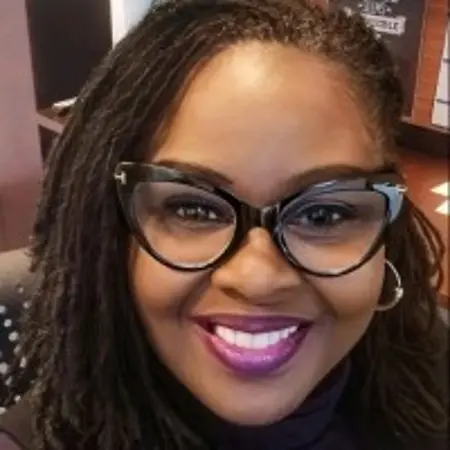
Her Story
About Keeva
Keeva Moye is the Deputy Director of the Audit Relations Office at the U.S. Department of Transportation, a position she has held since 2018. In this role, she serves as the departmental liaison for all external inquiries into DOT programs and facilitates audit engagements with agencies such as the Government Accountability Office (GAO) and the Office of Inspector General. Her office manages over 100 ongoing audits and ensures timely follow-up on more than 900 recommendations, requiring her to consult, negotiate, and coordinate with senior officials across the department. Keeva’s approach combines strategic oversight with a focus on team well-being, enabling her office to perform effectively under high-pressure, deadline-driven conditions.
Before joining the federal government, Keeva built a diverse career in media and publishing. She was the associate publisher of Washington Weddings magazine, where she oversaw publication operations, produced the radio program The Wedding Show, and managed bridal trade shows. Her entrepreneurial experience, including running a business that had to close during the 2008 housing market crash, taught her adaptability and resilience—skills she has carried into her government service. Keeva began her DOT journey as a contractor in 2008, became a federal employee in 2011, and steadily advanced through roles in audit relations and program improvement.
Keeva holds a Bachelor of Arts in Strategic Communication from American Public University and has developed extensive leadership skills through both her professional roles and volunteer work, including service as an ordained elder in her church. Her career is distinguished by her commitment to mission-driven work, her ability to navigate complex organizational challenges, and her dedication to mentoring and supporting her team. Outside of DOT, Keeva is active in initiatives that support recently incarcerated women and has been recognized for leadership and excellence by her colleagues and contracting organizations.
Her Interview
Ten minutes with Keeva
01What do you attribute your success to?
I think the work ethics of my parents play a big part in my success, along with this inner drive I've always had. My dad rarely ever called out sick and was always on time. My mom had this philosophy that you go to school, and if you're sick, you better be sick, and she'd schedule a doctor's appointment to confirm it. I think those roots have really shaped who I am. I've always had this inner drive for how to be great. Even back in high school, I was the lead in six organizations. I was in the Women's Leadership Group, editor of the literary magazine and the school newspaper, captain of mock trial. I've always been involved in a lot of things because I love seeing how things move, how decisions are made. I've always been attracted to leadership and understanding the heartbeat of a team and how to make it stronger. So I'd say it's the combination of my parents' work ethic and this inner drive that's always been inside me.
02What’s the best career advice you’ve ever received?
My mother gave me probably the best career advice, and that was, whenever you take a job, work it like you're the owner of the business. That advice has really shaped how I work. I never believe that I'm just a member of the team. I believe that I'm an owner or co-owner, so how I maneuver is as if I owned it. I never feel like I'm a volunteer, I always feel like I'm a partner or owner. That philosophy helps me become a good employee. The other career advice I received from one of my mentors was, grow steady, don't leap too fast. A lot of times, when people can identify leadership qualities within you, they want to push you, push you, push you, and sometimes you're not quite ready. It's knowing when you're ready and not being forced into leadership roles, because sometimes you don't have the grace for it. I was slighted to become director, but I knew it wasn't time. It wasn't the right time. So now, as a deputy, the next step is director, and I'm ready when that door opens.
03What advice would you give to young women entering your industry?
Always value your contributions. And remember, it's okay to lead from behind. You don't always have to be out front to make an impact. Understanding your worth and knowing that your contributions matter is so important, especially when you're navigating environments that may not always recognize or respect what you bring to the table right away.
04What are the biggest challenges or opportunities in your field right now?
One of the biggest challenges I've faced has been learning how to demand respect, regardless of people's perception of you. I look younger than I am, and my appearance has sometimes presented a challenge because people think I'm younger. I've been talked to in ways that were disrespectful. One time I was even patted on the head when I was running a whole youth program at 26, in charge of a staff of 20 and 107 children. So learning how to demand respect in those situations has been huge. The other challenge has been knowing my own strength. There's the internal challenge about my ability, the question of will they let me do it, that piece about perceived access. But once I identify that it's all me and has nothing to do with anyone else, then it's time to shake it in your boots and just press forward. Let the chips fall where they may. If it's not for you, it's not for you, but it's not because you don't lack the ability. I've even applied for positions I knew I wouldn't get just to see how well I would interview, and both times I was told if they could hire me, they really would, because I interviewed better than people at higher grades. That fortified my confidence and gave me the extra courage to move forward when faced with personal challenges.
05What values are most important to you in your work and personal life?
Integrity is huge for me. It's one of the most important values I hold. And value itself, being valued, is critical. I don't work well in situations where I'm not valued, because I don't know how to contribute if I'm not valued. My work ethic is that I'm going to work as though I'm an owner, and if I'm working as though I'm an owner but it's not valued, maybe I'm in ownership at the wrong company. People are also incredibly important to me. In the midst of all the chaos and high demands of my work, honoring people is the most important thing. My team is the most important. There's a saying from the Air Force that I embody: mission first, people always. Making sure my team is healthy so that we can continue to be the high-performing organism that we can be is what matters most. I think I've successfully been able to make people feel honored and valued in the midst of the chaos.
Join Influential Women and start making an impact. Register now.