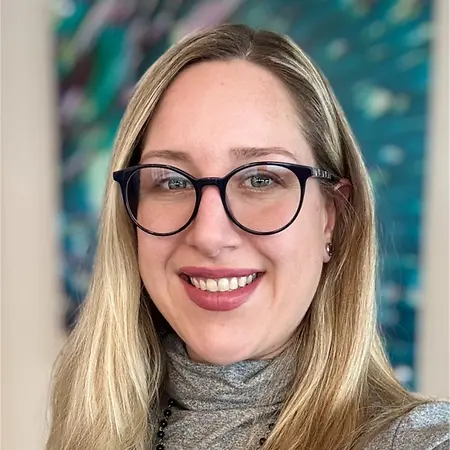
Her Story
About Kelly
I work as a Scientist in Histotechnology at AbbVie, a pharmaceutical company in Worcester. I've been in veterinary medicine for almost 20 years, histology for over 10 years, discovery research for about 3 years, starting with a contract at Sanofi before moving to my current full-time position nearly a year ago.
Histotechnology is a really niche but crucial aspect under the pathology umbrella, but like most, I didn't even know what histology was. I was first introduced to histology working as an equine vet assistant dropping off horse biopsy samples to a CRO lab whose owner (Jim Staruk) happened to be friends with my boss.
My key responsibilities as an scientist in this field at AbbVie involve handling and processing tissue samples for studies and experiments, with a specific focus on tissue integrity. The preparation of the samples I work with is critical because so much of our downstream analysis depends on it. I help determine whether the morphologies we're seeing histologically represent true biology or artifacts, which plays into our downstream data evaluation, especially of our newer models. My most notable professional achievement has been making the switch from veterinary medicine into translational human medicine. I originally went to school to be an animal nurse, and now I'm more focused on drug targets for human medicine. It wasn't in a vacuum though - the transition was really relevant, and I still get to use knowledge from my previous role as an animal nurse since we're ultimately doing animal testing.
Her Interview
Ten minutes with Kelly
01What do you attribute your success to?
My stepdad Roger Samuelson (USMC Marine, business owner) and my former employer, friend and teacher Dr. Kris Koss (equine veterinarian) have been two fundamental teachers in my early professional life. Later on I acquired what I consider a second mentor in the field of histology, Jim Staruk, who started Mass Histology, Inc. (later acquired by Horus scientific). Jim taught me histology like Wolfgang Puck teaches culinary arts. I am very grateful for all their advice, professional mentorship and understanding.
02What’s the best career advice you’ve ever received?
Don't be afraid to start over. That advice really gave me the confidence to make a switch to a somewhat lateral field. Most people don't transition out of animal nursing into a less animal-based field, and it was really scary. I didn't always have the confidence, and I'm glad that somebody told me not to be afraid to do it.
03What advice would you give to young women entering your industry?
Don't be afraid to do something because it's already "been done." It hasn't been done by YOU yet. In addition, question the assumptions that have already been made by others who have done something, as you may find something new and revolutionary.
04What are the biggest challenges or opportunities in your field right now?
Right now we're advancing the frontier of spatial biology, which is opening up new vistas of understanding tissue architecture and cellular relationships. Digital pathology capabilities are growing exponentially. There's also a major focus on complex in vitro models and non-animal models, and integrating those into our pipelines. There's a big push to step away from animal models, and we're trying to fill that role with newer technologies like tissues on a chip, organs on a chip, organoids, spheroids, air-liquid interfaces, and cell cultures. One of the biggest challenges is how to scale these processes for high throughput evaluation.
05What values are most important to you in your work and personal life?
I would have to say, first, the Lord Jesus Christ, and then a sense of community. I'm big on teamwork, empathy, and inclusion. I feel like I have so much more to add, but I think that's the most important.
Join Influential Women and start making an impact. Register now.