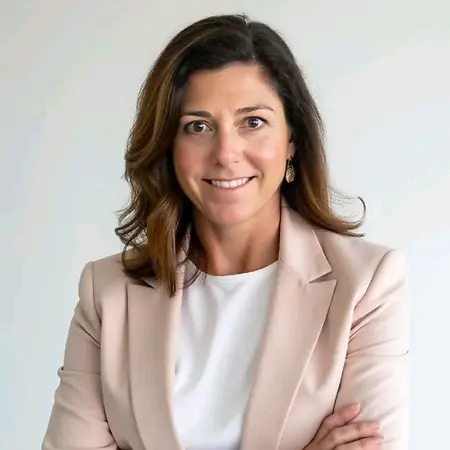
Her Story
About Kelly
Kelly Hedrick MBA is a results-driven sales operations and transformation leader with more than 20 years of experience in finance, analytics, and business strategy. She is known for combining deep analytical expertise with a people-centered leadership style, helping organizations improve profitability, streamline operations, and drive large-scale change. Currently, she leads transformation and strategy work within Schneider Electric’s federal-focused business unit, where she focuses on growth, operational excellence, and scalable process development.
Throughout her career, Kelly has held progressive leadership roles spanning business intelligence, sales operations analytics, and sales compensation management. She has been instrumental in building data-driven decision-making systems, modernizing commission structures, and improving forecasting and performance tracking across complex organizations. Her work has led to measurable financial impact, including efficiency gains and significant cost savings, while also strengthening leadership pipelines by developing talent that has advanced into senior executive roles.
Kelly holds an MBA with a focus in marketing and finance from Rutgers University and a bachelor’s degree in international business from The College of New Jersey. Beyond her corporate achievements, she is deeply engaged in community service through volunteer work, mentorship programs, and local organizations, reflecting her commitment to leadership development and service. She is widely recognized for her ability to lead transformation while maintaining a strong emphasis on collaboration, mentorship, and creating meaningful impact both inside and outside the workplace.
Her Interview
Ten minutes with Kelly
01What do you attribute your success to?
I attribute my success to three main things. First, my faith - I really feel like God has looked out for me and created this journey for me. Second, a great support system, being able to do what I do between my husband and my family has been essential. And third, I think it's my grit and continuous desire to learn and make an impact. I'm always wanting to try to do more, try to make a difference, try to fix a problem. I also have to credit the incredible mentors I've had throughout my career - people I can still call today to ask questions about processes or how to do things more efficiently. Without having those connections and that network, I might not have known about opportunities like my current role, where the man who hired me into the company in 2010 called me about his role and said I'd be the perfect fit. That kind of support and advocacy has been huge.
02What’s the best career advice you’ve ever received?
The best career advice I've received came from Amar Paul, our North America president, when he was VP of Sales and I was the controller. I was providing financial results and some of the RVPs were not exactly happy with the results, and I remember him saying something to the effect of, you know what, if you're doing your job, sometimes people won't like it, and that's okay. If you're doing your job and you're attacking the problems, then yeah, sometimes it's going to expose people and they're not going to like it, but that's okay - you're looking out for the company. The other piece of great advice I took when accepting my current role was that you don't have to keep always moving up. Sometimes it's better to just get out of a role that you're in because you're burnt out, or you're in it too long, or it's toxic, or whatever it might be. It's okay to take that lateral move and add value somewhere else. Looking back, if I had not taken this role, I don't know if I would have quit, but I might have. Sometimes you have to do what's right for you, and it might not be the plan that you originally had of going from here to here to here, but it can still be super beneficial. The impact I've been able to make in this role is way more than I ever expected, and I love working every day - it's such a different mindset.
03What advice would you give to young women entering your industry?
First and foremost, networking is key. I tell people coming into our company, which has 126,000 employees, to find someone once a month and have a one-on-one - ask them what they do, how their team is organized, what part of the business they're in, ask about their time coming up in the business. Especially today when so many people work remote, you lose some of that connection, so you have to be intentional. Second, continue to learn and stay current because it's changing so fast. When I started on the business intelligence side seven years ago, Tableau was the hottest thing, and now it's fading into the background with new technologies like Databricks. Staying current and flexing the muscle as far as technology goes is extremely important. Third, be heard. In male-dominated environments like my federal unit, sometimes you've got to kind of shout to get your word in. If you're in a toxic culture environment where it's very targeted, find the support and network to get out of it, and don't allow yourself to feel less than because someone else is trying to feel better by making you less. Find your cheerleaders - I had men in a male-dominated industry that I felt were 100 percent behind me, had my back, and keeping that network and utilizing it when you need it is key. Don't be afraid to utilize the skills that women tend to be better at - women tend to be more organized, so use that to be the person facilitating leadership calls or whatever it might be. I actually started a group called WOSEF, the Women of SE Federal, and we're doing once-a-quarter calls to get us together and talk about things like this. Don't be afraid to start something that's beneficial for you as a woman in the industry. Now I have a network of women that know the federal government better than I do, and we can talk and get to know each other. Just don't be afraid to use your skill sets.
04What are the biggest challenges or opportunities in your field right now?
I would say the ever-changing technology is the biggest challenge, and I don't want to say AI because it feels like such a trendy word right now, but it really is about technology in general. The speed of the energy field and the growth that is coming is hard to keep up with, and it requires us to be very diligent and quick on our feet. The size of some of these projects is massive - we had a record $1.9 billion contract signed this previous quarter, I think it was with NVIDIA. With my side, the federal government, they're spending tons of money on energy and data centers, and it's just rapid. Keeping current and continuous learning is necessary, but it's also probably a big challenge in the industry right now. For our company specifically, AI is actually an opportunity because we build data centers, so it's a bit of a double-edged sword. We're probably slower on the adoption side within the corporation, especially my entity, because of classified data with the federal government - we had to wait for Microsoft to build its own cloud space internet for federal government so we could jump on board. The challenge is keeping up with AI and knowing what the next thing is. It used to be 'rewrite this email,' and now it's 'act as an agent, act as a salesperson evaluating how this report looks,' and then what's the next one? Which AI tool do you use for what? That is a huge challenge for women coming up in the industry. Even Google search has evolved - your search results now come up as an AI response first, a paragraph about what you just searched and where you should go, instead of having those sites listed first.
05What values are most important to you in your work and personal life?
The values most important to me are integrity and accountability. As I tell my kids, the thing I hate the most is lying, so being honest and having integrity is huge. I try to tell my kids, whatever you do when no one's looking, make sure you would do the same thing if someone was looking. Accountability is equally important - if you mess up, you mess up. It took me a long time to be okay with making mistakes. I would be really hard on myself, and I had to question why, because no one in this universe is perfect. Everybody's going to make a mistake at some point, and I think as long as you own up to it, you are part of the solution, and you learn from it, that's what matters. Those are my two core values: integrity and accountability.
Join Influential Women and start making an impact. Register now.