I focus on observing their work, praising their approaches, and seeking their opinions, while sharing my reasoning so they know their perspective is truly valued.
Kelsey Hornicek, MPA · In Her Own Words
Her Story
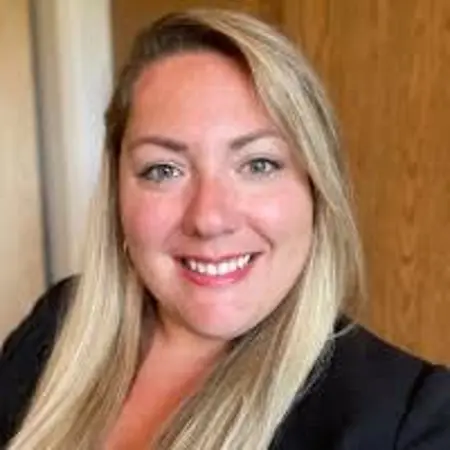
About Kelsey
Kelsey Hornicek, MPA, is a transformation and strategic program leader with over 15 years of experience building and scaling operating models across telecommunications, federal programs, infrastructure, consulting, and enterprise transformation environments. She specializes in leading complex, cross-functional initiatives that connect strategy to execution, with deep expertise in program governance, PMO development, organizational design, and delivering measurable outcomes in high-ambiguity settings. Her leadership approach focuses on creating structure, alignment, and sustainable execution systems that enable organizations to operate with clarity and scale effectively.
She began her career at The Center for Discovery as a Skills Trainer supporting individuals with developmental disabilities in residential and educational settings. That early experience shaped her leadership foundation, where she learned how to build trust, coach others, and influence outcomes without formal authority. She later transitioned into Tectonic Engineering to utilize her BS in Biology and Environmental Science from SUNY Cortland, intending to pursue environmental science. Instead, she was placed into post–Hurricane Sandy disaster recovery work in New York, where a planned short-term assignment evolved into a six-and-a-half-year tenure. After her first year, she was promoted to Senior Project Manager, ultimately leading a portfolio of 96 construction recovery projects and successfully bringing all projects into compliance and back on schedule after significant delays.
Following her work in public sector recovery and federal grant consulting, Kelsey joined Brightspeed, a fiber broadband telecommunications provider, where she led transformation and strategic program delivery for large-scale strategic initiative. In this role, she helped secure and manage more than $1.5B in capital expansion funding, built enterprise PMO governance from the ground up, and led key initiatives including greenfield software development and organizational consolidation efforts.
She earned her Master of Public Administration in Ethical Leadership from Marist College in May 2021. Outside of her professional experience, she enjoys golf, traveling, and attending concerts. She is currently not employed and is taking time to reflect, recharge, and thoughtfully explore her next leadership opportunity while continuing to build on her experience and long-term career trajectory in enterprise transformation.
Her Interview
Ten minutes with Kelsey
01What do you attribute your success to?
I always say my dad. My dad is a heavy equipment operator, or he was before he retired, and he traveled hours each way to go work on some of the largest infrastructure projects in the tri-state area around New York City. He worked incredibly hard to provide my brother and I with oppoertunities, but what we really saw was his work ethic, his dedication to be the best at his craft. He was a brilliant operator, but he never boasted about it, his collegues would though, I heard so many stories growing up from his peers, or apprentices he taught. I couldn't be more proud to be his daughter.
On top of that, he was also a volunteer fireman - he was third generation in my local community, and my brother was fourth generation. My grandfather, my father, and my brother had over 100 years of service combined. My dad would work a 10-12 hour day, hours from home, then answer the call at night, a car accident, a house fire, a barn fire (we live in rural upstate New York), then report right to work.
I really watched how my whole family gave back through the volunteer fire department. I live in a tight-knit, small community, and we are based around what we do for others. They don't do it for money, they do it because it's a service, and we need it. That's the way I was brought up, and I will always attribute my success and trajectory to that. I learned to show up at the local fundraiser and work all day to raise money for the volunteer fire department to operate, and how to have discipline for something that wasn't personally benefiting you in any way. It was just about trying to help and give back and do your part, doing it selflessly.
02What’s the best career advice you’ve ever received?
You're not going to please everybody, so you need to remain authentic to yourself and focus on what you can control. Control what you can control - that is the number one thing I tell people when I'm mentoring them.
You can control how you show up every day. You can control how you discipline yourself to stay focused. You can control how you speak to people. I talk a lot about lead by design and the process, which is a Nick Saban sports theology, but it's about controlling the mechanisms that make you great at what you do. You don't focus on the outcome, you focus every day on what you're going do today - I'm going to be accountable, I'm going to speak clearly - and you just continue to build on that. When working on cross-functional teams or strategic programs you have to realize you are a part of the bigger picture and each individual has something to contribute, focus on what you contribute well and do your part to the absolute best of your ability.
That's honestly been the advice I've compiled for myself, and then the advice that I continue to coach and mentor into other people as I work up the chain.
03What advice would you give to young women entering your industry?
You must have thick skin, because you're always going to have people that doubt you, that think you're rising too fast, or think you don't have enough experience to contribute. Say you're too "New York." Contribute anyway. Contribute thoughtfully, and that doesn't mean be the loudest in the room. You know, be thoughtful about it, be strategic about it, but know your value. Also, ensure that you keep people around you that support that confidence in you. And I don't mean people that give you a big head - I have one friend, Lois, who I treasure, and I always thank her because she doesn't ever shy away from telling me when I'm doing a great job, but she's also willing to tell me when she disagrees with me, and I love that. Not everyone's going to agree with you all the time, so having those trusted people around you that you've built that rapport with, when they'll give you the flowers when you need the flowers, but then also challenge you and say 'let me challenge you here, I don't know that I agree with your thought process there' - that's super important. I coach people to find those people and keep them around you. Culture those relationships. They are integral to your success.
04What are the biggest challenges or opportunities in your field right now?
It is a male-dominated field. I have worked mostly across construction and engineering. The hard thing that people don't like to say out loud is that there's still a lot of competition between women for the seat at the table, and I'm going to be a little ageist here and say I see it more prevalently in the generation that's two above me. They fought so hard to have that seat, and hats off to them because we wouldn't be here without them, but it's almost like they can't come back out of that sometimes. They still think you're coming for the one seat that's at the table, but I have seen that there's more seats available.
I was only the second or third woman elected to the board of the Sullivan County Partnership for Economic Development, but 3 years after me, I got to induct 3 more women. When I got nominated to that board, I was in my late 20s, I was 28, and I was sitting at the boardroom with the local male CEOs with a 30 year small business tenure under their belt. Meanwhile, they don't realize it at first, but I'm working on a $400 million program for the State of New York.
We at the Partnership started the Women in Business event annually and really worked to foster that culture of inclusion. That there are many seats at the table.
For opportunities, I say start with project coordinator and work your way up to project manager. Understand what project management actually means - it's not an admin position, it's not an overhead position, you're not tracking tasks, it is an early leadership position. Use it as such. Take up space in the room, learn how to lead without authority. Then you can take that to a lot of different places - Value Change Office, Transformation Management Office, Enterprise PMO, program management. If you're good at organizing stuff, quick decisions based on data, go to project coordination, go to project management, because that's what the nuts and bolts of that is, and there's lots of opportunities after that.
05What values are most important to you in your work and personal life?
Accountability. I will say that time and time again. Accountability is so important to me. As a leader, I believe that you show accountability first. Accountability is walking into the room and never pretending you're perfect. We are all human. We all make mistakes, we make bad decisions, and all you gotta say is, you know what, that wasn't my best, that wasn't my best that day, or I wish I went the other way, but this is what I'm going do to change it, fix it, redirect course. Say that out loud to your team, build a culture of accountability.
When someone comes into my office and they're constantly saying, oh, I can't get this done because so-and-so does this, or so and so doesn't work hard enough, or that teams just sucks, or ugh my direct report didn't do it right, again, my immediate feedback is, rephrase that, please. What can you do differently? Look to yourself first.
I've seen it firsthand where leaders allow this culture to breed, and it just spreads like a disease, and then all of a sudden people and teams won't work together. Your strategic projects aren't moving forward, ELT is down your throat, and each work session is a bunch of finger pointing, instead of action. We're all showing up as human, give people a break. We're all working really, really hard, and sometimes maybe you're just not explaining it as well as you could be, or you're just really not setting the expectation as well as you could be.
Look to yourself first, and then look to other people, because no one's perfect.
Join Influential Women and start making an impact. Register now.