Her Story
About Kelsey
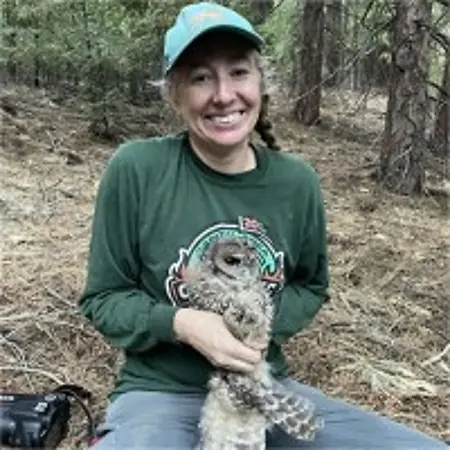
Kelsey Retich is a Senior Wildlife Biologist with Terracon Consultants Inc., where she supports private and public clients in meeting federal and state environmental regulations related to protected species. In her current role, she balances technical report writing and regulatory compliance work in the winter with hands-on field surveys in the summer, specializing in avian biology, nesting protection, and threatened and endangered species. Her work helps ensure that development and land-use projects move forward responsibly while safeguarding critical wildlife habitats. Prior to joining Terracon, Kelsey spent more than a decade with the United States Forest Service and other federal agencies, serving as a district wildlife biologist and technician across multiple states and national forests. During that time, she built deep expertise working with bird species such as spotted owls and American goshawks, as well as endangered species including the Canada lynx and even grizzly bear. Her career has taken her across diverse landscapes, where she managed long-term monitoring efforts, conducted field research, and contributed to science-based conservation decisions. Kelsey has always known she wanted a career working with animals and being outdoors, and she has remained committed to that calling despite challenges. In a male-dominated field—and as an amputee—she has had to push past assumptions and prove her capabilities through persistence, authenticity, and resilience. Above all, she sees her role as being a voice for wildlife, combining practical science with advocacy to protect species and ecosystems for the future.
Her Interview
Ten minutes with Kelsey
01What do you attribute your success to?
I attribute my success to persistence, staying true to myself, and keeping a positive attitude even when things get difficult. Making it as a wildlife biologist has been really challenging - it's a male-dominated field, and honestly, I'm quite frankly young and cute, which has made being taken seriously a huge challenge. On top of that, I'm also an amputee, which has always been looked down on when it comes to doing outdoor work, hiking, and all these crazy physical things that come with doing biological field work. But I've been able to move up and advance by staying true to myself and what I believe in, and by being the voice for the wildlife. There isn't one specific achievement that I am most proud of- it's really about being able to do all of it, to keep going despite the challenges. If I had to choose a stand out achievement though I would say being a part of the population augmentation of the Canada lynx population in northeastern Washington. I left my position there before the actual translocation of lynx happened but I was a part of a group of biologists from multiple agencies and organizations who advocated and did a lot of the front work for the population augmentation. We developed an extensive camera trapping network across the Kettle Crest, habitat assessments, snowshoe hare density studies, etc. I'm proud that my behind the scenes work and advocating for the species has lead to their now being a reestablished breeding population of Canada lynx in northeastern Washington. Another huge achievement is providing mentorship, opportunity, and seeing the future success of biological technicians that have worked for me. Several technicians whom I trained and mentored transformed into confident and successful practitioners in our field, many of them have gone on to gain permanent jobs in wildlife, which is a major achievement. Finding good mentors has been really key for my success and I'm incredibly happy to see those that I have mentored succeed. It's so important to find good mentors in this field, especially other women in the field who are willing to support you and lift you up and give you opportunities. An early career boss of mine, Robin Eliason, was incredibly supportive - she really saw me and my skill set, and she made things happen for me. She would always tell me to keep applying, keep going, that I was good and knew what I was doing, and that I would get what I wanted. So I'd say it's about persistence, trusting the process, and knowing that it will work out if you really want it.
02What’s the best career advice you’ve ever received?
The best career advice I've received came from one of my early career bosses, Robin Eliason, who was a district wildlife biologist for a forest I worked for in California. She was one of my first bosses that was incredibly supportive of me - she really saw me and my skill set when others didn't. She would tell me things like 'of course you can be a crew leader, of course you can do this' and she made opportunities happen for me, like when I wanted to do small mammal trapping. But what really stuck with me was her consistent encouragement during the tough times between jobs. I would message her asking for advice, and she always told me 'you're good, you know what you're doing, just keep applying, keep going - you will get what you want.' That advice to trust myself, stay persistent, and keep moving forward has been invaluable throughout my career. Another great piece of advice I received which really lead to much of my success and got me to where I am now came from several of my college professors whom I was close with. They told me that if I wanted to succeed in the biological field that I would have to go where the jobs are. This is exactly what I have done throughout my career so far. I've done work in Michigan, New Mexico, Nevada, Washington, Oregon, Illinois, Wisconsin, Arizona etc. it can be extremely challenging to move around so much and travel all across the country for work but it really does give you an edge in having so many different experiences and overall makes you a more well rounded biologist.
03What advice would you give to young women entering your industry?
My advice to young women entering wildlife biology is to keep going and stay persistent. Stay true to yourself and go where the opportunities take you, even if the path isn't clear. Just trust the process. This field is really hard, so I feel like finding good mentors is really key - make those connections with other women in the field who are willing to support you and lift you up and give those opportunities to you. Try to keep your head up and stick with it, and know that it will work out if you really want it. Wildlife biology is a male-dominated field and there are a lot of challenges, but if you stay persistent, maintain your confidence, and surround yourself with people who believe in you, you can make it happen. I would also say learn to really advocate for yourself. You are going to have to speak up for yourself and for the resources you are working with. It's going to be hard to speak up and you are probably going to make some people angry, but it's important that you do it anyway. A lot of people throughout my career have been dismissive of my input and opinions but if I had listened to any one of those people along the way that I "didn't know what I was talking about", or "that I just flirt with every man", or that I "was too aggressive", I wouldn't be where I am today. Don't listen to the haters that you will inevitably run into on your path.
04What are the biggest challenges or opportunities in your field right now?
The biggest challenges right now are honestly political. Not to get political, but to get political - in our current climate, a lot of regulations are being pulled back for protecting species, water, air quality, just kind of everything environmental. So trying to keep going and keep a positive attitude can be really difficult sometimes, because the world is a bit depressing right now when it comes to the natural world. One of the reasons why I made the incredibly difficult decision to leave federal service was because of this current political climate. I saw the writing on the wall that it was time to leave; the impending regulation rollbacks, upcoming layoffs, even more funding cuts, and not being able to hire technicians it was just time to pursue something outside of the federal sector. Another big challenge is that it's just really challenging to get jobs - wildlife biology is a very niche thing, and there's a lot of people who want to be a wildlife biologist, but there are very few jobs available. So the combination of regulatory rollbacks and limited job availability makes it tough, but you have to stay resilient and keep pushing forward.
05What values are most important to you in your work and personal life?
The values most important to me are staying true to myself, being the voice for wildlife, and maintaining authenticity even when it's challenging. In my work, I believe strongly in being an advocate for the animals and the natural world - that's what drives everything I do. I also value persistence and resilience, especially as someone working in a male-dominated field while being young and dealing with a physical disability as an amputee. I've had to overcome a lot of assumptions and challenges, but I've never compromised who I am or what I believe in. Outside of work, I'm deeply connected to the outdoors - I love hiking, camping, and paddleboarding with my husky, and one of my top life goals is to visit all the national parks. I try to get at least two new parks done a year, as of right now I have visited 20 of the national parks. I also value reframing negative narratives - like how I think about American goshawks not as 'aggressive' but as 'defensive' because they're just protecting their territory and babies. That kind of perspective matters to me both professionally and personally, my best friend says that justice and honesty are my two main core values, when it all comes down to it I just think you should treat others how you want to be treated and try to leave the world a better place. In my career that means protecting and preserving wildlife for our environment and future generations.
Join Influential Women and start making an impact. Register now.