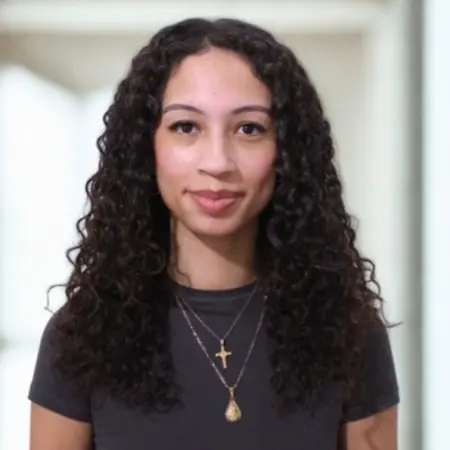
Her Story
About Kezia
By my freshman year of undergraduate, I was a biology major, and while many of my friends were doing the doctor track, nursing, or PA school, that just wasn't something I was drawn to. I was very interested in medicine, but not in that capacity. Instead, I spent a lot of time doing research and study abroad experiences that shaped my desire to be involved in medicine in a way that ties to public health and helps people on a larger platform. Biotech seemed like the perfect way I could be involved in the research and development of things while also being involved in medicine, but not necessarily doing the doctor track, because I want to help people on a larger public health scale. In my master's degree and academia, I did a lot of tissue engineering and cell culture, hands-on bench work. I also worked at a hospital for about a year and a half doing ER registration and hospital administration, which gave me personable roles and communication experience with patients and physicians. Now I'm in a project management role where I oversee different teams in the drug development pipeline, making sure all the milestones are being reached, identifying bottlenecks, and facilitating communication between protein sciences, computational biology, and administration teams to help us reach our goal of having a drug candidate by the end of the year.
Her Interview
Ten minutes with Kezia
01What advice would you give to young women entering your industry?
Ask questions. I think a big part of what made me feel held back is that as women, sometimes we're just expected to kind of sit there and observe and be quiet and not take up space, and so I would overthink asking questions for fear of looking stupid or looking like I don't belong in that room or that space. But the more confident I've gotten in myself and my abilities and my career, I've realized that asking questions is your only way to keep moving forward. You might be afraid to feel like you're not smart enough to be in the room, but smart people are always asking questions. There's always a way for you to understand further, to ask how can I get involved, or how can I get there, or do I need help. Just ask questions and don't be afraid to ask questions, because most people love answering questions. Have the courage to say that you don't know something, because there's just an opportunity for growth. People are more than happy to answer your questions most of the time.
02What are the biggest challenges or opportunities in your field right now?
I think right now the big challenge with biotech has been the integration of AI. There's a lot of exciting fronts that brings, with potential applications for good where this could help people and help streamline processes and get these innovative drugs out faster and affect more people. But with that, I think as an early career scientist, as someone who doesn't really have a lot of those networking connections because I am the first person in my family to achieve higher education and the first person to try to do a career like this, it was very difficult to get my foot in the door, to network, and to meet the right people and ask the right questions. There's one part of the job that is being a scientist and doing the science, and another part of the job is just communicating and knowing how to sell yourself and knowing how to talk to people. That has been a challenge and will continue to be one.
Join Influential Women and start making an impact. Register now.