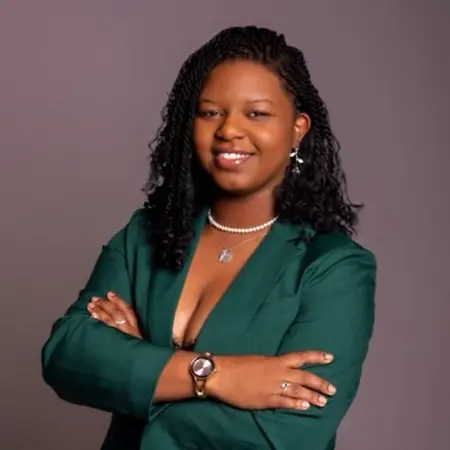
Her Story
About Khayla
I'm currently focused primarily on the creative space, where my work is very multi-layered. As the executive producer of SRA Media, I focus on telling the stories of smaller voices - local businesses and neighborhoods that are being revamped and gentrified - so that their stories don't get lost. We work with small businesses that don't have the money for advertising but want to share what's going on with their business and why they think it's important, especially if they're historical to the neighborhood. I'm also the co-founder and Chief Relations Officer for the Atlanta Book Festival, where we're planning our second festival this year. We're promoting literacy within Atlanta and creating a space for my generation and the generations that bump up against me, focusing on what we're interested in when it comes to reading and reader-adjacent activities like book clubs and craft clubs, trying to build a community and an ecosystem for that community. As Chief Operations Officer for STEM Social, I produce the summit for them - a STEM summit that promotes growth and activity within Black people in STEM. We travel the country hosting different mixers and meetups to help people connect with others in their field or different fields in STEM, learning more about different pathways. I also run a mentorship program for college students in Atlanta that focuses on underrepresented students, getting them access to different communities and people, getting them in rooms to have conversations, providing scholarships and sponsorships, and helping them become career ready and understand what life is like after graduation. On the scientific side, I've had the chance to work in infectious disease research, cancer research, bioengineering, epidemiology, and clinical trials. I'm really good at connecting people from all spaces and all things - I've done a really good job at being able to put people in certain rooms or have them join certain conversations that are helping them get to wherever they're trying to get to.
Her Interview
Ten minutes with Khayla
01What do you attribute your success to?
I feel like part of me wants to say that it varies my upbringing and just the motivation to be a symbol, I guess, with my siblings and my nieces and nephews. I'm an oldest child, so all my siblings are younger than me, so I think that definitely was my motivation, at least getting through college and trying to just do something with my life. After college, I had a year of yes - a year of just saying yes to every opportunity that came to me. I think that year kind of changed my mindset on how I operate in the world, and very much just like if I want to do something, I'm going to do it. Just go do it, talk to the right people, ask the questions, figure out what the plan is and just do it. I think I'm very self-motivated in that way. I just have a really great community. My community's like, there she goes, doing that thing again, and they're just like, okay, how can we help? Or they show up to events, or my friends are all relatively well-connected, so it's like, oh, okay, if you need this, I can reach out to so-and-so. I think I have a pretty great community.
02What’s the best career advice you’ve ever received?
When I was an undergrad, I ended up at this mentor's talk that I was not supposed to be at, and I was the only girl in the room. The speaker was basically talking to everybody about how everyone is always telling you that you need to have a backup plan, that you can't just put all your eggs in one basket. And he was like, I would beg to differ, and I would just tell you that you set your plan and then you create multiple plans to get to the same end goal. So if Plan A for Plan A doesn't work, then you have an additional route to Plan A, but Plan A is always the goal. That really motivated me. I was like, yeah, actually, regardless of how hard it gets, Plan A is always the goal. I will just find a different way to do it. There is no Plan B.
03What advice would you give to young women entering your industry?
The number one thing that helped me that I tend to always tell everyone around me is to just put yourself in a room. If that's you going to 10 mixers in a month, or randomly signing up for a class, or just joining that online group, or signing up to participate in an event - just put yourself in a room with people who are already doing those things. One example I love to give is when I graduated college, I'd always been interested in tech, but tech is something that you can teach yourself. The medical things or the scientific things, I needed a degree for, for people to trust me in that. When I graduated, there was this organization of Black women in tech, and they had a hackathon, and I had just become a beginner programmer. But I just went anyway, just to kind of check it out, and I ended up actually in the competition, and I won, which helped me kind of jump into a lot of other things that I was doing in the tech community, because that kind of got me recognized a little bit. Just putting yourself in rooms - I think you find the right people and they'll tell you what you need to do.
04What are the biggest challenges or opportunities in your field right now?
On the scientific side, I think it's the economy and where everybody's putting their funding. Most of my scientific background is research and clinical trials, so those are all heavily - you have to have funding for that to be operational. That's probably the biggest challenge, I think, in that career currently for me, since I've gotten laid off. In the creative space, I think I might also say the same thing. I think there's lots that I could get done if I just had more funding. We're moving, but maybe not as fast as I would want to. It's a good thing that I'm not an instant gratification person, so it's gonna happen, it's okay, we're getting there, step by step.
05What values are most important to you in your work and personal life?
The first word that comes to mind is consideration. I think I'm very considerate of everyone's, like, where they are, and I try to learn where they come from. I think understanding someone's past really helps understand how they're going to understand what you're saying to them. The same way everybody doesn't learn things the same way, everyone doesn't experience things the same way. I think consideration is one of my core values just across life. I would probably also say reliability and reciprocation. A lot of people like to ask me how I get into all of these spaces, or how I know these people, or how I get people to partner with me or work with me on different things, and I'm like, well, I'm reciprocal. I'm almost never gonna come to you and ask you for a favor without in the same breath letting you know what I'm gonna do for you in exchange. And I'm the same way at home - I'm very like, hey, you need to do this blah blah blah, and since you're doing that for me, I'll take this. I almost never say, hey, I need you to do X, Y, and Z, period. Reciprocity is probably one of my core values of life. And then just reliability, I think - being able to be someone who people can trust, and they're like, yeah, I know Kayla's gonna get it done, or I'm not worried, you're not really worried about how I'm getting it done, you just know that it is getting done. I'd say probably those three: consideration, reciprocity, and reliability.
Join Influential Women and start making an impact. Register now.