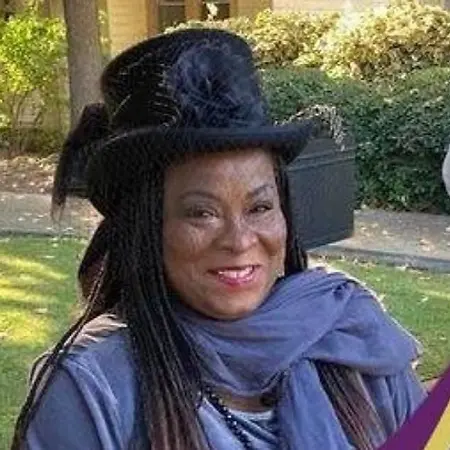
Her Story
About Kim
Kim McMillon, Ph.D., is a playwright, arts advocate, publicist, and scholar whose career spans more than four decades in theater, literature, and cultural activism. Based in Merced, California, she is the founder of Kim McMillon, Inc. and has worked extensively to connect diverse audiences with the transformative power of creative expression. Her work bridges academia and community engagement, with a strong emphasis on elevating underrepresented voices in the arts and humanities. She earned her Ph.D. from the University of California, Merced in 2019, where her research focused on the Black Arts Movement.
As a publicist and community liaison, Dr. McMillon has led publicity campaigns, organized cultural events, and developed programs that strengthen engagement between universities, artists, and local communities. Her professional work includes coordinating speaker series, managing arts programming at UC Merced, and promoting literary and performance-based initiatives. She is also an editor and contributor to major publications, including the anthology Black Fire—This Time (2022), which highlights both established and emerging Black literary voices.
In addition to her administrative and scholarly work, Dr. McMillon is an accomplished playwright and performer. Her original works include Voyages, Black Heaven, and Coming Out, which explore themes of identity, spirituality, race, and transformation. She has produced conferences and artistic events in collaboration with institutions such as UC Merced, Harvard’s Hutchins Center, Tulane University, and Dillard University. Through her writing, teaching, and artistic production, she continues to advocate for healing-centered creativity and the preservation of Black cultural history.
Her Interview
Ten minutes with Kim
01What do you attribute your success to?
My success is deeply rooted in my father, who profoundly shaped both my worldview and my artistic vision. When I was eight years old, he returned from Korea as a Buddhist and asked if I wanted him to explain reincarnation to me. At the time, I already had a sense that the earthly experience did not fully align for me. When he began speaking with me and later took me to a Buddhist temple in Hawaii, it brought me an unexpected sense of ease and a wider way of seeing life.
He introduced me to the principles of compassion, mindfulness, reincarnation, and the interconnectedness of all life. Through him, I learned to view existence through a broader lens—less confined, more expansive. I was drawn to the idea that we choose to come into life with a purpose, that we carry a life plan, and that existence continues beyond what we can immediately see. That perspective opened me to exploring love, metaphysics, identity as a Black woman, and the many paths toward healing, no matter what one encounters.
I was very fortunate to have him in my life. He supported my artistic journey and attended my productions whether I was acting in or producing them. Before he passed in 2014, he told me he believed he would die within five years—and he did, saying he had completed his work here.
That spiritual foundation, combined with my determination to create my own opportunities in the face of limited roles for African American actresses in the 1970s, allowed me to build a life in the arts spanning more than forty years. I have not pursued this work for financial gain. Instead, I have often self-funded or relied on grants, because this is the work I love—work I have never been able to walk away from.
02What’s the best career advice you’ve ever received?
The most profound guidance I received came through my father's example and teachings. When he returned from Korea as a Buddhist, he introduced me to concepts of compassion, mindfulness, reincarnation, and the deeper interconnectedness of life when I was just 8 years old. He taught me to chant when I had problems, and I remember even in my dream world, when barking dogs were coming at me, I started chanting and they all wanted to be hugged. He gave me a wider vision of life, not so limited, and helped me understand that you choose to come down, you have a life plan, and it's not over. Those teachings inspired me to use storytelling, theater, and education as tools for healing, understanding, and creating meaningful change in the world. He also taught me about being a good person and supported my unusual upbringing, taking me to Buddhist temples and to talks about aliens and metaphysical concepts. I really appreciated him because he allowed me to get an unusual look at life through him.
03What advice would you give to young women entering your industry?
My advice to a young woman entering the industry is to first figure out how you will support yourself financially, and then also define what you will do for your creative life—what you will do for your soul and its development. Do not feel you have to choose one and abandon the other.
Too many artists I have known felt they had to give up their creative work in order to live in the “real world,” as if pursuing a livelihood meant letting go of their dreams. I do not believe that is true. You can hold on to your dreams while also building a practical foundation for your life. That may include part-time or full-time work, but the goal is to create stability so you have your own space—your own “room of one’s own,” where your creative life can survive and grow.
I think this is essential because too many people give up too soon. What you need is a plan that allows you to live in the world while continuing to build your art.
I have taught theater, worked as a publicist for major events I love, and taken on projects that brought me joy, all while never abandoning my playwriting and producing. That creative life is like home to me—it brings me a deep sense of joy, and I will never give it up. As long as I am here and able to write, I will continue.
04What are the biggest challenges or opportunities in your field right now?
The biggest challenge I faced was being an African American actress in the 1970s and 1980s, when opportunities for roles were extremely limited and non-traditional casting had not yet opened doors in the way it has today. I quickly realized that if I did not write my own plays, I would be waiting for opportunities that might never come.
In college, I made a promise to myself that I would create my own work rather than wait for permission. That decision became the foundation of my artistic life. It led me to writing, producing, and building opportunities for myself and others.
I am now approaching 69, and I am deeply encouraged by how much has changed. I see the work of Mexican American, Black, Asian American, and other women playwrights being produced in ways that were rare or nearly impossible when I was starting out. The landscape has expanded significantly.
Today, there are far more openings for women in the arts. Artists are building their own platforms, telling their own stories, and no longer waiting for traditional gatekeepers to grant permission. That shift represents a profound change from the world I entered, and I am grateful to witness it.
05What values are most important to you in your work and personal life?
Love, healing, metaphysics, and spiritual growth are central to both my home life and my artistic practice. My father profoundly shaped my worldview when, after returning from Korea as a Buddhist, he introduced me to concepts of compassion, mindfulness, reincarnation, and interconnectedness when I was eight years old. Those teachings opened a lifelong inquiry into love, metaphysics, identity as a Black woman, and the process of healing.
Over time, I became deeply interested in healing practices, including Reiki and other modalities. I have spent periods of my life devoted entirely to healing work, including a summer in which I focused solely on practicing healing modalities with others.
I currently teach “The Poetry of Healing the Body” at the San Francisco Creative Writing Institute, where I use EFT tapping, visualization, and poetry to help participants engage their bodies with compassion, release emotional blocks, and offer themselves care during illness or stress with the purpose of opening themselves to their creativity and life purpose. I have practiced tapping for over twenty years and have found it to be a powerful tool for emotional and physical release.
These ideas also inform my artistic work. My plays explore reincarnation, consciousness, soul development, and the idea that embodied experience—including the experience of being Black in a society shaped by discrimination and historical inequity—can be a site of profound spiritual growth and awareness.
Ultimately, my work is about empowerment. I want to help people experience greater clarity, healing, and self-understanding. I believe that when people feel healthier and more at peace within themselves, they contribute more light to the world.
The arts are my home. I cannot imagine giving them up. I continue to create because it brings me joy and because it is my life’s purpose.
Join Influential Women and start making an impact. Register now.