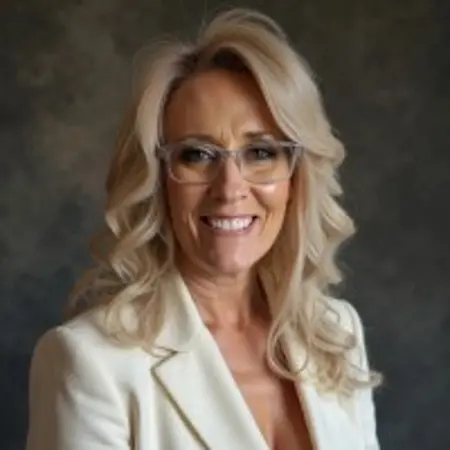
Influential Woman · Healthcare
Kimberlee Langford, BSN, RN, CCM, CRMT, CPC
Vice President Medical Management, Boon-Chapman
Meridian, ID 83642
In Conversation
Kimberlee Langford for Bold. Brilliant. Unstoppable.
Read the transcript
Kimberlee Langford, BSN, RN, CCM, CRMT, CPC: Speaker: Kimberlee Langford, BSN, RN, Nurse Executive and Healthcare StrategistWhat does being an Influential Woman mean to you?Kimberlee Langford, BSN, RN: Hey, hey, friends, it's Kimberly here. So, what does being an influential woman mean to me? To me personally, that means that I have an impact for good in the lives of those that I have the privilege of coming in contact with. Whether that's somebody in my community, whether that's a personal client, whether it's a member, a patient, a co-worker, somebody that I report to, or somebody that reports to me, or even the person I might be in a grocery checkout line, even the person who's checking out my groceries, we all have an impact, an influence on those that we come in contact with, whether you realize it or not. Driving down the road, you can make somebody's day, by simply just being polite on the road. You can also have an influence on somebody, you're driving down the road and flipping somebody off or honking at them. We don't know what life is for those people that we come into contact. We don't always know that. And I think sometimes we miss opportunities to practice. Having an influence, having an influence that's congruent with our life's purpose. And I think being an influential woman means if I want to have, an influence, I first have to know what kind of influence I want to have and on whom, right? So, for me, my life's purpose has been to, to help other people, including myself, live their very best lives. So, hopefully, in my day to day interaction with peers and, and co-workers, people that I have stewardship for, and for people that I report directly to. How I interact with those people, how I speak about them when they're not in the room, how I find opportunities to help them shine. It's an interesting paradox. That as we take the spotlight off of ourselves and we focus on somebody else, that's how you magnify your influence, is by getting out of the way and focusing on others.What's one piece of advice you would give to younger women chasing their dreams?Kimberlee Langford, BSN, RN: Probably my best piece of advice I would give to younger women who are thinking about the whole, my, my, my youngest, my daughter has just turned 21, and she has the whole world in front of her. There's so many different things she could do. She's talking about going into conservation or maybe going to beauty school or, maybe studying in, she likes to travel, so maybe going into the travel industry, she's talking about all these different things and she's so smart. The one, probably my best advice that I would give to young women is that it's so important to find work. That's fulfilling. Find work that lights you up. Find work that you totally can lose yourself in. When you do that. You will find a way to monetize that, and it will support you throughout your life because women, I think the unique thing we bring is that we, most women, we have passion to do a whole lot of good. And it's interesting, men, they go to work, they go to work. They come home, they come home. It's this or that. And for most women, it's A whole lot of things, and we have so many passions. As a matter of fact, I will tell you the best advice I ever got. I was at a really hard point in my life. And, one of my customers was, at that time, I, I was in the cosmetics industry alongside my nursing career. And I would go do deliveries and in the course of doing deliveries for, one of my, one of my customers, she's 9, 94 years old at the time, and she had just quit doing triathlons that year. Amazing woman. She'd come to the door and she'd put her wig on and she had a black leather jacket. She was an active pilot. She'd done all these amazing things in her life, and I remember asking her, I said, how did you do it all? Because I was, at that time, I was, not only was I nursing full time, I had 3 kids at home. I had, my husband, and I was volunteering in my community. I was president of the chamber of commerce in my community, the holistic Chamber of Commerce. I was holding down heavy duty callings in my church, and so I was, I was really busy. All of it, great. Doing community work and, and whatnot, and it was wonderful. Everything that. They're all good things. And she said something to me that has stuck with me for a long time. She said, I didn't do it all at the same time. She said when my kids were little, I wanted to stay home and raise my kids, so that's what I did. When my husband was sick and he had cancer, I wanted to take care of him, so that's what I did. When I wanted to learn how to be a pilot, that's what I did. She said, you don't have to do it all at the same time. So, I guess that would be my advice for young women is to find something that you really enjoy that fills you up, that makes you feel good about yourself as a person. When you do that, it doesn't matter. You can work really hard and it's still wonderful and glorious in your head, your head feels really good when you hit the pillow. But just keep in mind all the things that you have passions for. You don't have to run faster than you're able, right? You don't have to do more than, than one person can do. You can do life in seasons and chunks.
Her Story
About Kimberlee
Kimberlee Langford, BSN RN CCM CRMT CPC, is a seasoned Nurse Executive and healthcare strategist with deep expertise in medical management, utilization management, care management, and clinical innovation. In her role as Vice President of Medical Management, she partners with employers, health plans, and third-party administrators to design, implement, and scale high-performing clinical programs that reduce high-cost claims, improve population health outcomes, and elevate the overall member experience. Her clinical focus includes specialty pharmacy, infusion therapy, chronic kidney disease, dialysis, oncology, and complex chronic disease states, where she integrates evidence-based practice with advanced data analytics to drive measurable clinical and financial impact.
Throughout her more than 20-year career in healthcare, Kimberlee has led transformative initiatives across acute care, chronic care management, and value-based care environments. She is widely recognized for her ability to develop and operationalize scalable care models, predictive risk stratification tools, and upstream intervention strategies that proactively address high-cost and high-risk populations. Her leadership spans cross-functional team development, operational optimization, and health informatics, with a strong emphasis on improving clinical workflows, strengthening quality outcomes, and enabling clinicians to practice at the top of their licensure. She is equally known for building and mentoring high-performing teams that are aligned, empowered, and driven by both performance excellence and professional fulfillment.
In addition to her executive leadership, Kimberlee is a co-author, healthcare advisor, and thought leader dedicated to advancing a more human-centered and sustainable healthcare system. She brings a unique blend of clinical expertise, business acumen, and empathetic leadership to every engagement, with a focus on aligning financial stewardship with compassionate care delivery. Her work emphasizes upstream risk mitigation, innovation in care delivery, and the integration of clinical intelligence with operational strategy. Ultimately, she is committed to transforming healthcare systems in ways that improve outcomes, reduce costs, and most importantly ensure that patients remain at the center of every decision.
Her Interview
Ten minutes with Kimberlee
01What do you attribute your success to?
I’ve been deeply blessed to work with some extraordinary leaders throughout my career. I’ve also had the opportunity to work with some highly successful and well-known people in a professional capacity. Mary Kay Ash, Trudy Elliot, Cindy Wanek, and Tami Feyen have been influential mentors. But when I look back at the people who have most shaped my leadership, three stand out.
Most recently, Craig Clemente, CEO of Specialty Care Management, and his father, Bob Clemente, had a profound impact on my career growth. They helped me find my voice as a leader in a bigger way. Craig gave me the rare opportunity to lead my division almost as if it were my own company. He trusted me to run, build, create, solve, and grow. Not many leaders give that level of autonomy, and not many people get that kind of opportunity.
That season stretched me. It strengthened me. It taught me how to think like an executive, not just a clinical leader. I learned how to connect clinical strategy with business growth, how to build programs that improve outcomes and reduce cost, and how to lead with both heart and accountability.
Kari Niblack, the President of Boon-Chapman, has also been an incredible mentor and influence in my career. I’ve known Kari for many years, and I have tremendous respect for the depth of her experience. She has led some of the top TPAs in the country, mentored high-performing leaders and CEOs, and understands this industry from both a strategic and human perspective. The opportunity to work with her at Boon-Chapman has been a real thrill and a gift.
What I appreciate most about leaders like Craig, Bob, and Kari is that they do not just manage people. They develop people. They see potential. They challenge you to rise. They give you enough room to grow, enough guidance to stay grounded, and enough trust to become more than you may have realized you were capable of becoming.
That is the kind of leader I want to be, too.
Mentorship is a very sacred responsibility to me. I serve as a mentor to others through my work, especially with nurses and emerging clinical leaders. I have several graduates from the Nurse Leadership Program that I continue to mentor formally, and I consider that one of the great privileges of my career. Watching nurses find their voice, step into leadership, learn how to think strategically, and recognize the value of their clinical wisdom is deeply meaningful to me.
I am also a Reiki Master Teacher, and I mentor Reiki students as they grow not only in skill, but in self-awareness, compassion, healing, and service. Whether someone comes through my nurse leadership program or my Reiki program, I feel a lifelong sense of responsibility and connection to them.
Once you are my student, my mentee, or someone I have helped develop, you have me for life.
That is how I was mentored, and that is how I believe leadership should work. The best leaders do more than open doors. They help others discover the strength, wisdom, and courage to walk through them — and then turn around and open doors for someone else.
02What’s the best career advice you’ve ever received?
1) There is always time to do what is right. When you don't know what to do, just do the next right thing.
2) Treat everyone who comes within 3 feet of you (even virtually) as if they have an invisible sign around their neck that says "Make Me Feel Important."
3) Always play full - out!
4) When you put the member/patient in the center -- and we ALWAYS put the member/patient in the center -- everything else falls into place.
03What advice would you give to young women entering your industry?
The advice I would give to women entering my industry is this: make sure your “why” is in the right place.
If your why is rooted in service, impact, and a desire to make things better for people, you can be wildly successful. But if the only reason you are entering healthcare, leadership, or business is to chase money, you may find yourself constantly chasing it — and that is an exhausting way to build a career.
Years ago, I mentored a nurse who was really struggling in her role. When I asked her what made her want to go into nursing, she told me she hated nursing but thought she could make good money. That conversation stayed with me. Because the truth is, this work is too important and too hard to do only for a paycheck.
In healthcare, especially in medical management, utilization review, case management, disease management, and cost containment, we are dealing with people’s lives, families, employers, and futures. We are helping members navigate cancer, kidney disease, heart disease, diabetes, complex pregnancies, specialty medications, and life-changing diagnoses. This work requires skill, resilience, strategy, compassion, and a deep sense of purpose.
I believe if you are only chasing profit, profit will always stay just out of reach. But if you are chasing impact — if you are connected to a noble cause that you cannot put a dollar amount on — then the money, the opportunities, the influence, and the right doors tend to follow.That is a much more joyful way to build a life and a career.
Find work that matters to you. Find something you enjoy so much that you sometimes lose track of time. That does not mean it will be easy. I love what I do, but it is not easy. Leadership is not easy. Healthcare is not easy. Building programs, mentoring teams, reducing high-cost claims, protecting health plans, and improving outcomes is not easy.
But when you are passionate about the work, the hard things have meaning.
If you are only clocking in and clocking out, life can become very heavy. I have seen people spend their whole lives waiting to live. They work for retirement, postpone joy, ignore their gifts, and then one day realize they never built the life they actually wanted. I do not want that for women entering this industry. I want them to know they are allowed to be ambitious and purpose-driven. They are allowed to make money and make a difference. They are allowed to lead with both intelligence and heart. They are allowed to build a career that reflects who they really are.
One of the things I love most as a leader is helping people figure out what that looks like for them. What do they really want? What are they naturally gifted at? What kind of work lights them up? If they could design their dream role, what would it include?
I believe a good leader helps people get what they want out of life. Not in a transactional way. Not with the question, “What will I get back?” But because helping people rise is part of the responsibility of leadership. And what I have found is this: when you help people grow, when you serve generously, when you use your gifts in alignment with your purpose, the right things come back to you.
So my advice to women entering this industry is simple:
Know your why. Choose impact. Do excellent work. Stay curious. Find mentors. Become a mentor. And do not spend your life waiting to live. Build a career that helps you become more fully who God created you to be.
04What are the biggest challenges or opportunities in your field right now?
The biggest challenges in healthcare right now is not that we lack solutions. It is that the system is fragmented, expensive, reactive, and often poorly aligned around the people who matter most: the member, the employer, and the clinical team trying to prevent avoidable harm. - And herein lies our opportunities!
For self-funded employers, the pressure is real. Healthcare cost trend is not slowing down. Employers are looking at another very difficult renewal cycle, with Mercer projecting average employer health benefit cost to exceed $18,500 per employee in 2026, PwC projecting 8.5% medical cost trend for the group market, and Business Group on Health reporting that large employers expect a median 9% cost trend before plan design changes. That is not sustainable for employers, employees, or families.
The first major challenge is high-cost claims. Cancer, cardiovascular disease, diabetes, CKD, maternity complications, autoimmune disease, musculoskeletal conditions, and specialty pharmacy are not just clinical categories. They are financial events that can destabilize a plan when they are unmanaged, diagnosed late, treated in the wrong setting, or handled without expert navigation. Cancer remains one of the most concerning cost drivers for employers, with Business Group on Health identifying it as the top condition driving employer healthcare costs for the fourth year in a row.
The second challenge is specialty pharmacy and drug spend. GLP-1s, oncology drugs, gene therapies, biologics, immunotherapy, and complex infusion drugs are changing lives, but they are also changing plan economics. The question is no longer simply, “Is this covered?” The better question is, “Is this clinically appropriate, fiscally responsible, delivered in the right setting, and supported with the right care model?” PwC noted that pharmacy cost trend is running above medical trend, and employer surveys continue to point to GLP-1s, specialty medications, and cancer treatments as major drivers of 2026 cost pressure.
The third challenge is member affordability. We cannot pretend that shifting more cost to employees is a strategy. It is a delay tactic. In 2025, average annual employer-sponsored family premiums reached $26,993, with workers contributing an average of $6,850 toward family coverage. That is before many families even use care. When members delay care because they are afraid of the bill, we do not save money. We often create larger claims later.
The fourth challenge is too much data and not enough action. Employers have claims data, pharmacy data, UR data, vendor reports, predictive analytics, transparency tools, and dashboards. But data does not reduce risk unless someone clinically competent is looking at it, prioritizing it, and acting on it. A spreadsheet does not call the member. A dashboard does not coordinate a second opinion. An algorithm does not explain why a member with CKD, diabetes, hypertension, and rising creatinine needs intervention before dialysis becomes inevitable.
The fifth challenge is vendor fragmentation. Employers are buying point solutions for everything: diabetes, weight loss, oncology, MSK, behavioral health, imaging, specialty Rx, second opinions, fertility, navigation, and transparency. Some are excellent. Some are redundant. Some are underutilized. Some create more noise than value. The real opportunity is not adding more vendors. The opportunity is building an integrated clinical strategy where every vendor has a defined role, measurable outcomes, clear accountability, and a connection back to the plan’s total cost-of-care goals.
The sixth challenge is fiduciary responsibility and transparency. Self-funded employers can no longer afford to be passive purchasers of healthcare. PBM compensation, rebate structures, spread pricing, administrative fees, network arrangements, and vendor incentives must be understood and monitored. The Department of Labor has proposed new PBM fee disclosure rules intended to improve employer health plan fiduciary transparency into direct and indirect PBM compensation. That tells us where the industry is going: employers will be expected to know what they are paying for, who is being paid, and whether the arrangement is reasonable for the plan and its members.
The seventh challenge is clinical workforce capacity. Healthcare is asking nurses, case managers, utilization reviewers, and care navigators to do increasingly complex work in a system that is moving faster, costing more, and giving members less time with their providers. We need strong nurses at the center of this work. Not task-based nurses. Not script-reading nurses. We need clinically sharp, emotionally intelligent, financially literate nurses who can advocate for members while also protecting the health plan.
The truth is, the old model is not enough anymore.
A self-funded plan cannot simply process claims, hope the network discount is good enough, and react after the million-dollar claim arrives. That is not strategy. That is expensive hindsight.
The future belongs to employers, TPAs, clinical leaders, and advisors who can integrate utilization management, care navigation, case management, disease management, pharmacy strategy, direct contracting, site-of-care optimization, and member education into one coordinated system.
My belief is simple:
Better clinical management is one of the most powerful cost-containment strategies available.
When we identify risk early, steer care appropriately, support behavior change, reduce avoidable progression, and help members access the right care at the right time, we do more than save money. We protect families. We protect employers. We protect the plan. And we restore some humanity to a healthcare system that desperately needs it.
05What values are most important to you in your work and personal life?
The values that matter most to me, both personally and professionally, are rooted in one mission: to help people live their best lives — and I include myself in that mission.
That has really been the through-line of my life and career. Whether I am leading medical management programs, mentoring nurses, supporting members through complex health challenges, teaching Reiki, coaching, writing, or building something new, the heart of the work is the same: helping people remember their worth, reclaim their strength, and move toward a better life.
In healthcare, that mission becomes very real.
I have had the privilege of helping members and families navigate some of the hardest moments of their lives — cancer, kidney disease, heart disease, diabetes, complex pregnancies, difficult diagnoses, and overwhelming healthcare decisions. But as meaningful as that work is, one of the greatest joys of my career has been creating a place where nurses can practice their craft at the top of their licensure and find joy in the work again.
Because, truthfully, a lot of that joy has been beaten out of people. Nurses, providers, physicians, patients, and families have all been through a lot over the last several years. The system has become more complex, more expensive, more transactional, and, in many ways, more exhausting. A lot of nurses entered this profession because they wanted to help people live well. But somewhere along the way, many were told to hurry up, stay quiet, follow the task list, and stop asking hard questions. That is not what nursing was meant to be.
One of the values most important to me is helping nurses reconnect with what brought them to this work in the first place. Nurses are not just task-doers. They are critical thinkers, advocates, educators, strategists, problem-solvers, and leaders. When we give nurses the tools, trust, and support to lead from wherever they are, the impact can be profound.
When I was asked about my most notable achievement, my answer was not a title, a program, or a financial result — although I am proud of those things. My answer was the impact I have had on the nurses I have worked with. To know that my life and my work has had a positive and uplifting impact on others truly warms my heart.
One person can do a lot of good. But one person will never do as much alone as she can do by developing five, eight, ten, fifteen, or twenty nurses who are empowered, confident, clinically strong, and aligned around the same mission. At that point, you do not just have a team. You have a force for good. That is why building the Nurse Leadership Program has been one of the most heartwarming achievements of my career.
I believe leadership is not limited to a title. Leadership is a way of showing up. It is using your voice. It is taking responsibility. It is seeing what needs to be done and having the courage to do it. It is serving others without losing yourself. It is being accountable, honest, compassionate, and brave. And I believe nurses need to hear that.
For too long, too many nurses have been told to sit down, stay quiet, and know their place. But when we silence nurses, we lose clinical wisdom. We lose innovation. We lose advocacy. We lose the very people who often understand the patient, the member, the family, and the system better than anyone else.
My values are faith, service, integrity, accountability, stewardship, knowledge, freedom, beauty, and wholesome joy. In my work, those values show up as servant leadership, clinical excellence, responsible stewardship of health plan resources, and deep respect for the human beings behind every claim, every diagnosis, every team member, and every decision. At the end of the day, I want my life and work to leave people better than I found them.
If I can help a member feel less alone, help a nurse find her voice, help a leader become more courageous, help a team believe in what is possible, or help an organization do the right thing in a smarter and more sustainable way — that is meaningful work to me.
That is the kind of impact I want to have.
And that is the kind of legacy I want to build.
Join Influential Women and start making an impact. Register now.