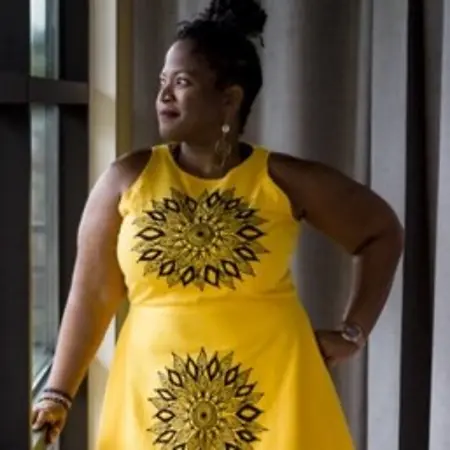
Her Story
About Kimberlee
I've been working as a DEI manager for about 10 years, and during that time I was doing public speaking on a local level because the role demanded it. Everything changed in 2022 when I published my book 'Dear White Peeps, Please Come Home.' The title was hugely controversial - the title is for white people, and what's on the inside is for everybody else. My goal was to draw folks who are white, and the content is to validate people of color, to teach white people while validating the experiences of people of color. I wrote it in a very different format than what exists in the market, and it made this huge splash, this huge controversial splash. After the book came out, the floodgates opened and my life just turned upside down overnight. I went from being a local DEI manager to being recognized everywhere I went from being on television quite a bit - national television, local television, national radio programs, local radio programs, and podcasts. I was invited to speak all over the country and through Zoom all over the world as a keynote speaker, workshop facilitator, or to do book talks. My approach to the work is humanity first, joy, and trying the path that you've never considered. People were writing me letters saying thank you for saving my marriage. I never imagined reaching people all over the world - people in Thailand were reading it, Scotland, Australia. It's been this miracle of love that has just been life-changing, with so many rewards. My network of colleagues in the field has grown exponentially, and the opportunities have been endless.
Her Interview
Ten minutes with Kimberlee
01What do you attribute your success to?
I attribute my success to being my authentic self, even when I was afraid. When I was writing my book, I was so afraid that I would lose readers by being my authentic self, and my friend kept encouraging me to just be myself. She was so right - I wouldn't have imagined that people in Australia would be reading my book. A lot of the letters come from a very angry place, and I wanted to take out the F-bombs, but she was like, no, leave them in there. If people can't read a book because of the word fuck, then they're not meant to read it. Taking those out would have made it less authentic, would have watered down my anger. It became this beautiful thing that was truly reflective of who I am and the process that I went through, and it truly connected with readers. Here I was, not listening to my own advice, hiding my own humanity because I thought it wouldn't work. My unique voice and unique approach is what draws people to the book, to my workshops, to my keynotes - it's so different from others. I faced a lot of rejection when I joined the DEI world because I wasn't doing it like everyone else, I wasn't doing it the angry way. But there is room for your voice without anyone tone-policing it. I wouldn't let anyone edit out the essence of who I am, and that authenticity is what made all the difference.
02What’s the best career advice you’ve ever received?
The best career advice I ever received was from my friend who helped me publish my book. She told me that if I lose potential readers by being myself, then they weren't meant to be my readers. She kept encouraging me to just be my authentic self. I was so afraid that I would lose readers by being authentic, and I wanted to take out the F-bombs and tone down my anger in the letters. But she said no, leave them in there - if people can't read a book because of the word fuck, then it's not for them. She was so right. Taking those things out would have made it less authentic, would have watered down my anger. It became this beautiful thing that was truly reflective of who I am and the process that I went through, and it truly connected with readers. I'm so glad that I listened to her and just stayed true to being myself.
03What advice would you give to young women entering your industry?
I would tell a young woman starting out to be true to herself and be true to her humanity, because she's the only one that can bring her voice, and her voice is different than every other voice that exists out here. Especially as women, we are prone to suppressing who we actually are to try to fit in and be liked. But I don't think our book is made to fit in - I think it's meant to stand out, because that's what draws people to the book, to your voice, to your workshop, or your keynote. It's so different from others, and that uniqueness is what matters. There is room for your voice without anyone tone-policing it. I wouldn't tell women to shy away from mentorship - I did go through a very strong editing process that taught me a lot. But I would tell them not to let anyone edit out the essence of who they are. Let your true authenticity always shine through. I faced a lot of rejection when I joined the DEI world because I wasn't doing it like everyone else, I wasn't doing it the angry way. But staying true to my unique approach is what eventually connected with people and made the difference.
04What are the biggest challenges or opportunities in your field right now?
One of the biggest challenges I faced in publication was what to name the book and how to get the name of the book to stand out among all the other DEI books. The design of the front cover was intentional - it grabs you almost like a scary movie or the tale of someone who's been kidnapped, like a true crime story. That was a challenge, to make it stand out. Another challenge was getting white people past the cover - those who noticed the word 'white' in the title. I had a TV producer tell me right before I was going on television that she couldn't read my book because the title said 'please come home' and she thought she was already home. Knowing that different people everywhere would receive it differently was challenging - that different genders would feel alienated by it because I said women instead of dear people. The financial part of publication was challenging too - the process is expensive, especially if you want to put out a quality product. You can feel the difference between a book that had some money spent on it and a book that hasn't. The coaching aspect was hard - all of a sudden you're appearing on television when you never have before, and no one's taught you, you haven't had practice sitting in front of a camera. The loss of anonymity - nobody prepared me for that, I wasn't ready. But there have been many rewards - I never imagined reaching people all over the world. It's been this miracle of love that has been life-changing, with so many rewards. My network of colleagues in the field has grown exponentially, and the opportunities have been endless.
05What values are most important to you in your work and personal life?
Joy is just a cornerstone for me in everything in my life - I would say I'm a joy chaser, I'm a joy creator. I don't believe that there is anything that we have to do that is not enjoyable. I believe that everything that we can do can be centered around joy, and I believe it's possible. If there's a way that I can turn the most boring thing that you've asked me to do, or topic, or even the darkest of topics that I have to address, I'm going to find laughter in the audience. Even if it's the darkest topic that you address, I'm gonna find a way to center joy in it. Humanity first is another core value - humanity first, always. People have challenged that, asking when do we get to get angry, when do we get to blow down the front door and cause collateral damage. And you can do that, you're allowed to do that. That is not my way, and I'm okay with us being different. My approach is humanity first, always. I can find the humanity in even the most dejected person from society. Those are my values - joy as my cornerstone, and humanity first, always.
Join Influential Women and start making an impact. Register now.