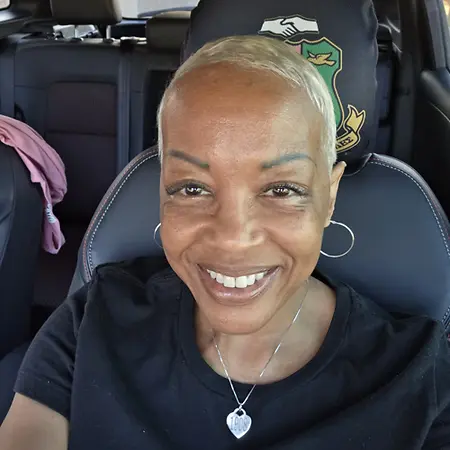
Her Story
About Dr. Kimberly
Dr. Kimberly Guess, She/Her, is a retired Professional School Counselor with Fort Worth ISD in Fort Worth, Texas, with more than two decades of experience in education, student support, and instructional leadership. She dedicated her career to education as a school counselor, driven by her own high school experience of never knowing her counselor or receiving guidance about her future. That absence became the foundation of her professional purpose, inspiring her to become the kind of counselor students could consistently turn to for direction, advocacy, and support. Throughout her career, she was committed to helping students navigate both academic decisions and personal challenges, with a strong belief that social-emotional development is just as essential as academic achievement for long-term success.
During her tenure with Fort Worth ISD, Dr. Guess served in a variety of leadership and counseling roles, including Professional School Counselor, Assistant Principal, Department Chair, and Special Education Lead Teacher. She provided comprehensive student services aligned with the ASCA National Model, including 504 coordination, ARD committee collaboration, dyslexia support, attendance interventions, credit recovery initiatives, and college readiness planning. She also contributed to districtwide programs such as College Board SSD coordination, equity initiatives, and trauma response teams, while sponsoring student leadership organizations and mentoring programs that supported student growth and engagement. Her contributions were recognized by her school board for excellence in counseling and student advocacy.
Dr. Guess holds a Doctor of Education in Organizational Leadership from Walden University and a Master of Education with Principal Certification from Concordia University Texas. Her career has been grounded in the values instilled by her parents, an Air Force veteran father and a nurse mother, who emphasized integrity, diligence, and doing everything with excellence. After retiring on December 31st, she is beginning a new chapter by establishing her own practice, where she plans to continue supporting and empowering individuals. This next phase allows her to extend her impact beyond the school system and continue her lifelong commitment to helping others achieve meaningful personal and professional growth.
Her Interview
Ten minutes with Dr. Kimberly
01What do you attribute your success to?
I would attribute my success to my parents. I have two brothers, and we were raised to always excel at whatever it was we were doing... academics, sports, etc. Do your best was something we always heard. I watched my parents very closely throughout my life. My dad was a MSGT. in the Air Force until he retired, and my mom was a registered nurse. I watched my mother go through school as we were growing up. Having those two terrific role models really shaped who I became and how I approached my career. They taught us to give 100% to everything we did, and that foundation has carried me through my entire professional life.
02What’s the best career advice you’ve ever received?
Change the things you can, and change your attitude about the things that you can't. I use this advice myself all the time. You're going to have to be a little flexible, especially in education, where things change constantly; in all jobs, things change. So you must be flexible and still give 100%. It's about accepting what you cannot control and being adaptable while maintaining your commitment to excellence.
03What advice would you give to young women entering your industry?
Take it one day at a time, and be prepared for change. You have to have someone that you can vent to - someone you trust at work who understands what you're going through. There were times when I would go into the other counselor's office, and it's like, oh, I can't, you know. And you've got to be able to work with a team as well. You must be team-oriented in anything that you do. Even if you're at the top, you still have to interact with somebody if you want business. Having that work person who lives the same day-to-day experience and knows what you're talking about or knows the situation is so important for success.
04What are the biggest challenges or opportunities in your field right now?
One of the biggest challenges, especially with being a professional school counselor right now, is that we are limited in what we can actually talk about with children. This changed just this year. Before, if a child came in and said they feel like they're going to hurt themselves, we would be able to talk to them and do an assessment. Now, we can't even do that - I've got to call your parents right away. So many things are being taken away on that counseling side, the things we actually went to school for. Really and truly, I would say counselors, at least within Texas, we are more academic counselors now. The social-emotional part has kind of been taken away. We can't talk about certain topics with students anymore - if a child comes in wanting to discuss something, I almost have to tell them, oh, I cannot talk to you about that, I'm sorry, let's just call your parents. I just feel like educators are forced to almost set our children up for failure, our students, because there's some things that we cannot do. We teach to a test, so social skills are lacking. And really, the social skills, if they don't have that when they go out into the real world, they're done. Everything you say used to be confidential unless you said you're going to hurt yourself or someone else, but that's no longer the thing anymore. That right there can cause people in general to lose trust.
05What values are most important to you in your work and personal life?
I would say being ethical and always doing what's right. You must strive to do everything correctly, because things can go badly if you don't. It's about having a moral barometer, knowing the difference between right and wrong. Things can go wrong, but if your best intentions are to do it right and you know you've got to correct the wrong, that's what matters. Ethics guide everything I do.
Join Influential Women and start making an impact. Register now.