Clarity comes through movement, not before it. Meaningful growth happened when I took the next wise step without knowing the full outcome.
When She Realized She Didn’t Need to Have Everything Figured Out
Explore more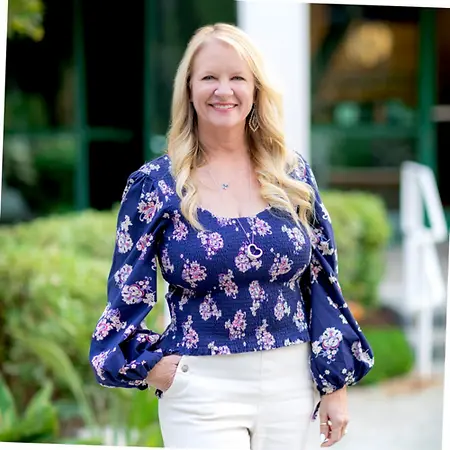
Influential Woman · Mental Health / Therapy
LMFT
Founder / Owner / LMFT, The Classy Girls Guide to Divorce™️, McNary Therapy, PC
San Diego, CA 92128
I found my confidence when I stopped asking "Will this make everyone comfortable?" and started asking "Is this true for me?" Self-trust grows when we choose ourselves with courage.
Kimberly McNary, LMFT · In Her Own Words
Clarity comes through movement, not before it. Meaningful growth happened when I took the next wise step without knowing the full outcome.
When She Realized She Didn’t Need to Have Everything Figured Out
Explore moreI grew up shrinking to keep the peace, leading to self-abandonment. Through EMDR therapy and divorce, I found my voice and now help others take up space unapologetically.
How She Learned to Be Seen Without Shrinking
Explore moreHer Story
Kimberly McNary, LMFT, is a seasoned Licensed Marriage and Family Therapist with over 17 years of experience supporting individuals and couples in strengthening their most cherished relationships. She is the founder of The Classy Girls Guide to Divorce™️, a part of her practice dedicated to empowering women through the emotional and logistical challenges of divorce while helping them retain dignity, clarity, and self-empowerment. Kimberly integrates evidence-based approaches such as Emotionally Focused Therapy (EFT), Eye Movement Desensitization and Reprocessing (EMDR), and Emotionally Focused Individual Therapy (EFIT) to help clients navigate trauma, infidelity, and relationship transitions. Kimberly’s professional journey is deeply personal. Growing up in a conflictual household inspired her lifelong passion for therapy, which she first shared with her mother at age eight. After early careers as a loan officer and pharmaceutical sales representative, Kimberly paused to raise her children and support her family before returning to school to earn her Master of Arts in Marital and Family Therapy from Bethel Seminary. Since then, she has built a thriving private practice in San Diego, California, where she works with individuals to reduce negative relationship patterns, strengthen emotional regulation, and promote secure and lasting bonds. Beyond her clinical work, Kimberly is committed to redefining divorce for high-functioning women. Through her therapeutic practice & programs and workshops, she guides women in recalibrating power, identity, and life direction and blending families, post-divorce, emphasizing practical tools and emotional regulation strategies. As a wife, mother, stepmother, and grandmother, she brings both professional expertise and lived experience to her work, offering a compassionate, strategic, and empowering approach that supports clients through life’s most challenging transitions. Kimberly also works holistically with individuals from dating, premarital, all the way through divorce and blending families.
Her Interview
01What do you attribute your success to?
I attribute my success to resilience that was forged early, mentors who refined my raw edges, and a life that kept stretching me. I grew up in an environment where performance felt like survival — I learned very young that excellence was my exit strategy. Achievement felt like oxygen.
But what I now call success isn’t about proving — it’s about building. over time, I learned how to transform that drive into purpose instead of pressure.
Raising children humbled me in all the right ways. It softened what grit alone could not. Motherhood exposed my impatience, my perfectionism, and my tenderness. Mentors invested in my skill when I didn’t yet see my own potential.
I went through my own divorce over a decade ago and I was forced to grow and stretch in areas I wasn't accustomed to. I have remarried and my husband stands behind my ambition without needing to stand in front of it.
I’ve been guided by generous mentors who helped me sharpen my craft, a husband who supports me without competition, and a circle of women who celebrate me fully — and call me forward when I can’t see my own blind spots.
My success isn’t self-made. It’s forged, supported, and continually refined through healing, humility, and community.
02What’s the best career advice you’ve ever received?
A piece of impactful advice was, “I can care, but I don’t have to carry it.”--meaning, I have empathy. I do not have ownership. I can care about your feelings without taking responsibility for fixing them. I can care about your struggle without absorbing it into my nervous system. I can care about the outcome without managing it for you.
Secondly, "You cannot take a client farther than you have gone yourself."--meaning, you can only guide someone to the edge of your own capacity for self-examination, regulation, grief, accountability, and growth. If you avoid your own anger, you’ll unconsciously steer clients away from theirs. If you haven’t faced your own shame, you may rush to soothe theirs too quickly. If you haven’t tolerated your own uncertainty, you’ll over-direct instead of holding space. Clients don’t just benefit from what you know. They benefit from what you’ve metabolized.
Personally, this has been the most impactful in my personal and professional relationships: Do you want a relationship or do you want to be right, meaning, am I trying to win this moment…
or am I trying to protect the bond? Being “right” is about proving, correcting, defending, or establishing superiority. Wanting the relationship is about understanding, repairing, and preserving trust — even if that means softening your stance.
03What advice would you give to young women entering your industry?
<ol><li>Before you build a brand, build your nervous system. Your clinical skill will grow. Your marketing will evolve. But your capacity to sit in the room without needing to rescue, impress, overperform, or avoid? That’s the foundation. </li><li>Lead by example and show that you can achieve your professional goals. I encourage focusing on building a strong career and gaining diverse life experiences before feeling pressured to rush into parenthood. </li><li>Surround yourself with women who empower and encourage you, not compete and drain your energy. You reflect what you are surrounded with.</li><li><span style="color: rgb(0, 0, 0);">You will grow faster with correction than with applause alone.</span></li><li><span style="color: rgb(0, 0, 0);">Build a life bigger than your practice. My identity is not solely wrapped up in my career. </span></li></ol>
04What are the biggest challenges or opportunities in your field right now?
A significant challenge in my field is the lack of accessible support and clear guidance for women navigating divorce and major life transitions, particularly when it comes to managing emotional regulation. This gap presents an opportunity to offer practical, nervous-system-based tools and strategies that help women navigate these experiences with dignity and empowerment.
AI also presents an ethical dilemma for many clinicians. Even if you do not use it yourself, get educated because your client's are using it without you and if you are not educated and ask about their use of AI, you could be missing out on a great deal of missed opportunities to help support them in their ethical and beneficial use of AI.
05What values are most important to you in your work and personal life?
The values most important to me in both my work and personal life are cherishing family, supporting women, preserving dignity, fostering emotional regulation, integrity, and committing to continual learning. Outside of work, I enjoy spending time with my husband, adult children, grandkids, playing pickleball, hiking, traveling, and reading. I'm an avid puzzles person and have played Words With Friends since 2011 and engage in those nerdy NYT crossword and word games daily.
Her Content Hub
Divorce activates your nervous system's survival mode, making emotional regulation not a luxury but a strategic necessity. Learn how to interrupt anxiety-driven behaviors and respond with clarity instead of panic.
How Nervous System Regulation Becomes Your Greatest Leverage in Divorce

Divorce is not just a legal process. It is a nervous system event.
Even the most capable, high-functioning women can find themselves reacting in ways that feel unfamiliar — sharp emails, sleepless nights, obsessive thinking, sudden tears in the middle of a meeting. That isn’t weakness. It’s physiology.
When attachment is threatened, the brain reads it as danger. And when the brain senses danger, it prioritizes survival — not strategy. This is why emotional regulation is not a “nice-to-have” during divorce.
It is leverage.
Emotional regulation does not mean suppressing feelings.
It means staying steady enough to respond instead of react.
It is the difference between:
Regulation is not about being calm all the time.
It’s about returning to center more quickly.
And in divorce, your ability to return to center protects everything — your finances, your parenting, your reputation, and your long-term peace.
When the nervous system feels unsafe, it looks for relief. Fast.
This often shows up as safety-seeking behaviors:
These behaviors are understandable. They temporarily reduce anxiety.
But relief is not the same as regulation.
Relief is immediate and externally sourced. Regulation is slower and internally built. Each time you act on an urgent impulse to feel better, your brain learns: I can’t tolerate uncertainty without fixing it.
Over time, that strengthens anxiety rather than calming it.
1. Name It in Real Time
Instead of “I need to know,” try:
“My nervous system is looking for certainty.”
That shift alone creates space.
2. Delay the Behavior
Give yourself a 20-minute rule before sending the text, checking the account, or calling for reassurance. Urges crest and fall if you let them.
3. Increase Tolerance, Not Control
Ask:
“What would it look like to allow this discomfort for 10 minutes without solving it?”
That builds regulation muscle.
4. Shrink Your Circle
Choose one or two grounded advisors or friends. Repeated reassurance from multiple sources keeps the anxiety loop alive.
Divorce tempts short-term wins: the perfect rebuttal, the airtight argument, the immediate answer.
But emotional steadiness protects your long game.
Women who regulate instead of react:
Calm is not passive.
Calm is strategic.
Divorce hurts. That is real.
But you do not have to let your nervous system make your decisions.
In a season where so much feels uncertain, your greatest advantage is this:
You can care deeply.
You can feel fully.
And you can still choose to move from steadiness instead of survival.
That is power.
If you need support regulating your nervous system and are in California, please reach out. If you are elsewhere, look for a trauma-informed therapist who specializes in divorce in your area for support.
Join Influential Women and start making an impact. Register now.