Her Story
About Komal
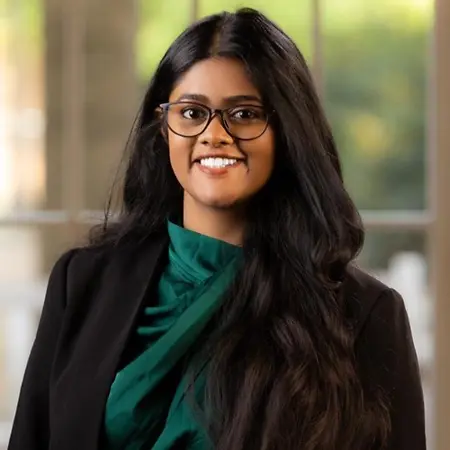
Komal Sammita is a Chartered Accountant and finance professional currently serving as a Portfolio Finance Lead at Applied Materials, where she focuses on portfolio analytics, financial modeling, and forecasting within the semiconductor industry. A Chartered Accountant, equivalent to a CPA and widely recognized across Commonwealth countries such as the UK and Canada, she began her career in audit, working with technology companies as well as tech-focused private equity, venture capital firms, and hedge funds. This early experience gave her a strong foundation in financial reporting, valuation, and investment analysis across complex, high-growth sectors.
After several years in audit, Komal transitioned into industry and joined a boutique investment banking practice, where she worked on innovative financial products including real estate-backed mortgage debentures that enabled fractional investment in commercial real estate with higher yield structures. Through this role, she recognized the growing importance of data-driven decision-making and advanced analytics in finance. To strengthen her skill set, she pursued graduate studies at the College of William & Mary – Raymond A. Mason School of Business, where she earned a Master’s in Business Analytics on scholarship. During this time, she also worked on a hedge fund capstone project, further deepening her exposure to advanced financial modeling and quantitative analysis.
Following graduate school, Komal joined Applied Materials, where she has spent the past year and seven months building her expertise in tech and corporate finance. In her current role, she applies predictive modeling, financial modeling, and macroeconomic analysis to support forecasting and strategic decision-making in a publicly traded company where earnings performance directly impacts market valuation. She works across multiple semiconductor portfolios, including Logic markets such as NVIDIA-related chips, Memory solutions for data centers and AI infrastructure, and Silicon Carbide technologies used in electric vehicles and autonomous systems. Today, her expertise lies at the intersection of finance, data analytics, and technology, where she leverages her diverse background to deliver accurate forecasts and support long-term business strategy.
Her Interview
Ten minutes with Komal
01What do you attribute your success to?
I would definitely say my curiosity. I think from the very beginning, even when I was working more in the audit side of things, whilst I was auditing a lot of tech firms, I was always very curious about what they were actually doing and how they were assessing their markets, how they were thinking ahead in the future, understanding people's needs and behavior patterns, and then forecasting the products they were creating. There was so much new tech that they were bringing, so definitely my curiosity, because that's what led me here too.
02What’s the best career advice you’ve ever received?
The best career advice I've ever received is to learn as much as I can in every different field that's out there, because the way things are evolving with AI tools, none of us are going to be subject matter experts in just one particular field. You're expected to know about every field that's out there. You're expected to know how product marketing works, you're expected to know how strategic finance works, you're expected to know accounting as well. You're just expected to know all the specs on the tool. I think it is to gain as much information as possible on every aspect there is to a business. I think we're all going to be using a lot of AI and gaining a lot more independence in our work, a lot more responsibilities.
03What advice would you give to young women entering your industry?
I think it's the same thing it's just learn about every aspect. It's not just about knowing how your tool spec works or what your energy beams are, but understanding how this tool actually brings about chips that then work as the brain for every other device, because at any given moment, any device that we're using has a chip attached to it. That's actually the brain of the tool. So understand how that works and gain a macroeconomic perspective. Understand where these chips are going, how to commercialize things, and just every aspect of a business instead of just sticking to one particular field, because if you want to grow in an organization, at least that's what I've learned over here, is that you need to understand every aspect that comes to it, especially how to commercialize things.
04What are the biggest challenges or opportunities in your field right now?
One of the biggest challenges I have encountered in my field is working in male-dominated industries, where women often face clear disadvantages and must navigate additional barriers to be heard and recognized. In my experience, having a strong network of women has been essential in overcoming these challenges, as it provides support, guidance, and encouragement in environments that can sometimes feel isolating. I have personally benefited from the support of a woman within a male-dominated organization, which reinforced for me how important it is for women to uplift and advocate for one another. At the same time, this has highlighted an important opportunity within the field: to continue building more inclusive environments where women can support each other, grow into leadership roles, and help reshape industry culture.
05What values are most important to you in your work and personal life?
The values that are most important to me in both my work and personal life are continuous learning, adaptability, a holistic understanding of my field, and giving back to others. I believe in constantly expanding my knowledge across multiple disciplines rather than limiting myself to a single area of specialization, particularly as industries continue to evolve with advancements such as AI and emerging technologies. I also value developing a well-rounded perspective that integrates both technical understanding such as how systems and components function—with broader business and macroeconomic insights, allowing me to make more informed and strategic decisions. Equally important to me is the commitment to giving back, whether by supporting others in entering the semiconductor industry or participating in community efforts such as organizing initiatives to raise funds for local food banks, as I believe success is most meaningful when it contributes to the growth and well-being of others.
Join Influential Women and start making an impact. Register now.