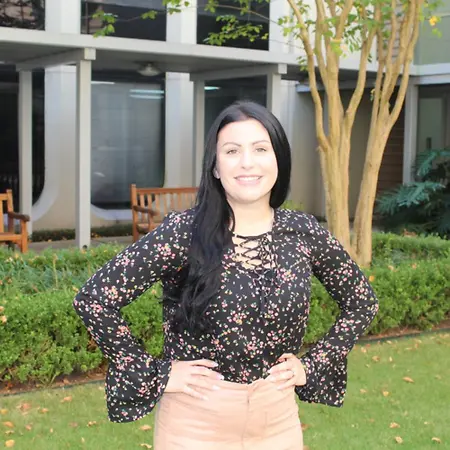
Her Story
About Kristina
My life's purpose is being a part of other people's recovery journeys. I've been working in the behavioral health field for over 7 years, and I'm a woman in long-term recovery with about 8 and a half years clean. Currently, I work as an Outreach Case Manager at the Council on Recovery, where I specifically work with justice-involved families and families who have high risks of losing custody of their children or are trying to gain custody back. On a weekly basis, I facilitate parenting and substance use education to parents who have children under a certain age or are expecting parents, and we even facilitate classes for caretakers and grandparents. What makes this work so meaningful to me is that I used to be a client of the Council on Recovery - my daughter and I received therapy here, and eventually this position opened, and now I can share my experience, strength, and hope with other families. Before joining the Council, I worked at UT Health Houston for four and a half years as a Senior Recovery Support Peer Specialist, where I worked alongside research doctors on Project Integra, a mobile unit that we parked in multiple zip codes that had shown high overdose rates and underserved populations. We provided peer support, free healthcare services, free medication maintenance, and support for individuals struggling with opiate and fentanyl addictions. Prior to that, I worked with the Houston Health Department and Fire Department at Houston Recovery Center, distributing Narcan and educating individuals who had just experienced an overdose. I would travel to the ER, sit with individuals, provide support, show them how to administer Narcan, and connect them to recovery support services. I also worked as a youth recovery coach at Unlimited Visions Aftercare for about a year and a half to two years, providing case management and recovery coaching to young adults and adolescents in the juvenile justice department. I love helping people - it's embedded in me. Being able to be a part of somebody else's journey, just like someone was a part of mine, is what drives me every day.
Her Interview
Ten minutes with Kristina
01What do you attribute your success to?
I attribute my success to my family and the support of my family. They have been my foundation throughout this journey.
02What’s the best career advice you’ve ever received?
When I was coming into this field of work in the recovery support world, I was told to be in the middle, recover out loud, and be the voice for the voiceless. I was also told to never compare myself to any other person that I look up to. When I came in, I was very quiet and timid and soft-spoken, motherly and nurturing, and when I went to try and sound like my mentors during facilitation, I learned very quickly and was given the advice: don't try to sound like me, but be yourself. Be your true, authentic self, and others will see that, and you will shine even brighter. So never dim your light and be your true, authentic self.
03What advice would you give to young women entering your industry?
Turn your pain into your life's purpose. This is speaking from a peer support point of view - we all have lived experience as part of the requirement to have this certification. I have lived experience in my own recovery journey. So my advice would be to turn that pain into your life's purpose and to stay your true, authentic selves as you are serving the community. And the biggest part is work-life balance.
04What are the biggest challenges or opportunities in your field right now?
Peer support is a rather new role, so the challenge is that we're all just starting to be seen as professionals in this field - just over the last 20 years. The challenge is when it's time to grow within this current role, we don't yet have a ladder to climb other than peer support or peer support supervisor. There's a lot of conversation within different organizations and the state certification board on how to assist us grow within this career path, because we're seen as recovery coaches, but we have a lot of the same tasks and duties as a chemical dependency counselor. Some of the challenges are not being paid as much as a counselor, but doing the work of almost the same as a counselor. So the challenges are not having that clear direction. We have peer support specialists in a bunch of different fields now - in hospitals, courtrooms, jails and institutions - so the challenge is finding that niche on where and what direction to go as far as growing within this career path.
05What values are most important to you in your work and personal life?
Boundaries and work-life balance are most important to me - not bringing work home and keeping them separate. I value growth, I value authenticity, and I value that my own lived experience is my own versus the client's is their own as well. I value confidentiality. I focus on the fact that everyone has their own path of recovery - my recovery journey is my own, just as the individual's that I'm sitting in front of is theirs. So I trust that they know their own path, and I'm here to support them through that process. Family comes first for me - family is everything.
Join Influential Women and start making an impact. Register now.