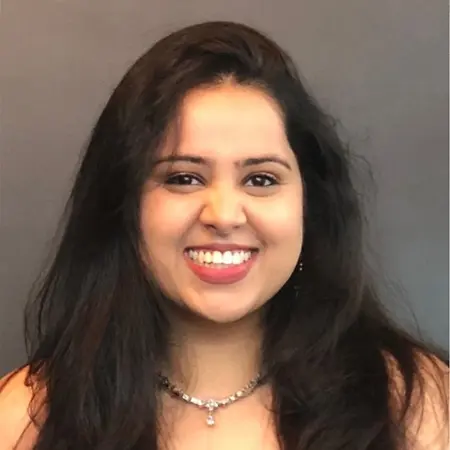
Her Story
About Kriti
Kriti Gaur, PhD, NCC, APCC, is a mental health professional, author, and speaker based in the San Francisco Bay Area, working at the intersection of grief counseling, trauma-informed care, and neurodiversity. She serves as an Associate Counselor with SPG Therapy & Education, where she provides school-based mental health support to neurodivergent and neurotypical students with IEPs, including those with autism, ADHD, learning disorders, and complex trauma histories. Her clinical approach integrates trauma-focused cognitive behavioral therapy with psychoeducational and systems-based interventions, extending support to parents and educators to improve student outcomes across home and school environments.
Dr. Gaur earned her PhD in Counselor Education and Supervision from Adler University and holds a Master of Science in Counseling from Johns Hopkins University School of Education. Her research focuses on grief, complex trauma, and multicultural counseling, culminating in her development of the Process-Oriented Meaning-Making (POMM) model, a grief framework emphasizing meaning reconstruction over stage-based interpretations. She is also the founder of MindThe Gap, a psychoeducational initiative that supports global counseling students and promotes accessible, culturally responsive mental health education.
In addition to her clinical and academic work, Dr. Gaur is an award-winning author and thought leader, recognized for publications including Buzzy’s Big Emotions and her counselor guide on grief treatment, both honored by the Counselor’s Choice Awards. She has contributed to professional organizations such as the American Counseling Association and the Women’s Indian Chamber of Commerce and Industry (WICCI), and serves as an evaluator, reviewer, and educator in counseling education spaces. Across her work, she emphasizes bridging the gap between research and practice, with a focus on culturally responsive, trauma-informed, and developmentally sensitive mental health care.
Her Interview
Ten minutes with Kriti
01What do you attribute your success to?
I attribute my success to everybody around me, honestly. I understand that a lot of the work that I do is very siloed and individual in that sense, because it's confidentiality and privacy of the client. But through my various roles, I think the support that I have from professional leaders and my supervisors and all of that around me, but also my personal family, has helped me to get to the place that I am in right now, and I'm sure it's going to even motivate me further to think of things and to do other things in the future. I attribute it to people around me and their support and their understanding for how I should go up that day.
02What’s the best career advice you’ve ever received?
The best career advice I've received has always been to work with intentionality and to never be only in one role, because it's limiting otherwise. Right now, we're in a world where mental health is such a big necessity that sometimes we have to wear a hat of a counselor, sometimes we have to wear other hats. It's always better to pull people up than pull them down, and having to do that in multiple hats and multiple roles is a skill that we can wear and really spread awareness in that sense. I've been very fortunate to have really good leaders and mentors around me, and this advice has been super interesting for me to work with.
03What advice would you give to young women entering your industry?
The advice I would definitely give young women is to follow your passion and intent within the industry as well. We don't have to go and change the whole world or every person out there, but we have to make sure that we are an expert in the small little population that we may want to work with. So really follow your intention and passion. Another piece of advice would be to study, learn more, and always better your skills from the get-go. It goes a long way when you are very researched and treatment-oriented, rather than doubting yourself on that. So really be technically very, very sound, and at the same time, be intentional with where you want to go in the future.
04What are the biggest challenges or opportunities in your field right now?
I think definitely one of the biggest challenges has been the lack of counselors. We need more counselors, we need more people who are technically aware and are professional in helping other people heal with different realities of life. We need more representation of culture, of neurodivergence, and so on in counselors as well. So that's been a big challenge, where we're seeing not enough people are taking this path or even integrating it with technology. To see the future of this field is exciting, but if I were to rephrase that, it would be a challenge right now, where we're thinking of how do we have new people in the field to continue this work. One of the opportunities that I do see in the field is definitely how to integrate technology and AI into the field of counseling, while also maintaining confidentiality and client privilege. I feel like that's the only way that we're going to leap forward with awareness of the field amongst other people.
05What values are most important to you in your work and personal life?
I think one value that is most important to me is patience. Patience is something that I find is a virtue. Another value system that I hold very closely to me is intentionality. Everybody has a voice, and everybody, if given a chance, has something that they can make their lives out of. If we all can work as catalysts to help bring everybody up, I think we'll be in a better place. It goes without saying that professionally and personally, I'm not judgmental at all. That also comes very naturally to being in the profession, but that's something that I keep reminding myself and those around me, to not be judgmental for other people's life journeys.
Join Influential Women and start making an impact. Register now.