Her Story
About Langley
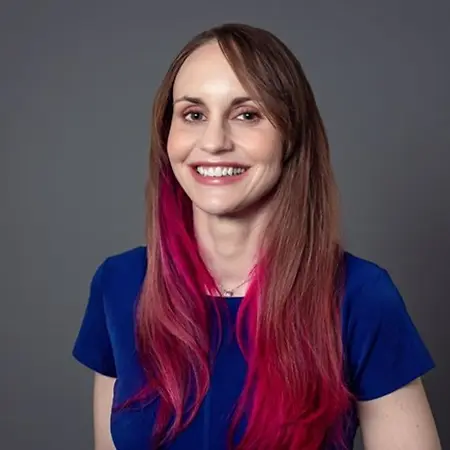
Langley Yard is a dedicated health physicist and Radiation Safety Officer at Banner University Medical Center Tucson, bringing more than 13 years of experience in healthcare radiation safety. She specializes in the oversight of radiation-generating equipment and radioactive materials, ensuring safe environments for both patients and staff while supporting complex clinical operations.
Her expertise spans diagnostic imaging, nuclear medicine, and advanced therapeutic applications such as radioembolization. Langley is recognized for her ability to balance the clinical benefits of radiation with thoughtful risk reduction, applying physics in a way that is both practical and directly relevant to patient care.
Throughout her career, she has developed and led comprehensive radiation safety programs within large, high-acuity healthcare systems. Most notably, she built a full-scale radiation safety program for a new hospital supporting approximately 1,300 radiation workers, while also supporting one of the highest-volume radioembolization programs on the West Coast. Her work integrates real-time dosimetry, procedural optimization, and hands-on education to strengthen both compliance and clinical performance.
Langley’s approach is grounded in collaboration, communication, and real-world application. She works closely with physicians, staff, and leadership to embed safety into everyday workflows, fostering a culture of shared responsibility rather than top-down enforcement.
Deeply committed to advancing the field, Langley is passionate about education, mentorship, and developing the next generation of health physics professionals. She holds a Bachelor of Science in Physiology from the University of Arizona and a Master of Science in Clinical Research Management from the Arizona State University. She is certified as a Laser Safety Officer (Medical), MRI Safety Officer, and Health Physics Qualified Expert.
Outside of her professional work, Langley can usually be found spending time with her two mastiffs and horses, exploring Arizona’s landscape and taking full advantage of its incredible ecosystem. She has a soft spot for niche DIY projects, particularly stained glass, and is always in the middle of creating something. When she’s not working or building, she enjoys getting lost in a good book or cheering on Arizona Wildcats men's basketball—sometimes with the same level of intensity she brings to her professional work.
Her Interview
Ten minutes with Langley
01What do you attribute your success to?
I attribute my success to approaching physics differently than what people often expect from the field. Rather than embodying the traditional image of physicists like Albert Einstein or Stephen Hawking, I approach health physics through a practical, real-world lens. My focus is not on positioning myself as a distant technical authority, but on being an integrated partner within the clinical environment.
I prioritize collaboration and shared responsibility. Radiation safety is not something imposed; it is something built together. My goal is to keep people safe across the board, from staff to patients to the broader community, and that requires understanding how work actually happens in practice.
Instead of relying solely on regulatory language or theoretical frameworks, I work within existing workflows to identify meaningful, sustainable improvements. I aim to translate complex physics into actionable, relevant guidance that teams can realistically implement. This approach allows safety to become part of the system, rather than an external requirement placed upon it.
Ultimately, my success comes from meeting people where they are, building trust, and creating solutions that align with both safety principles and real-world clinical operations.
02What’s the best career advice you’ve ever received?
The best career advice I’ve received is to trust your gut but also recognize that your instincts are something you have to build over time. Good judgment does not happen by accident. It comes from investing in your education, seeking out new opportunities, and taking the time to reflect on what you learn from each experience.
Early on, it can feel risky to rely on your instincts, especially in complex or high-stakes environments. However, indecision often carries a greater cost than making the wrong choice. Progress requires movement. Even when a decision is not perfect, it creates an opportunity to learn, adjust, and refine your approach.
That said, trusting your gut should not be confused with guessing. The goal is to continuously strengthen your instincts by exposing yourself to new situations, asking questions, and learning from both successes and missteps. Over time, this builds a more reliable internal compass that supports confident, thoughtful decision-making.
The balance is in acting decisively while remaining open to growth. The more you invest in developing your judgment, the more effectively you can trust it.
03What advice would you give to young women entering your industry?
My advice to young women is simple: do not let anything intimidate you. You are just as capable of developing the skills, knowledge, and expertise needed to succeed in any space you choose to enter.
There will be moments where you feel out of place or unsure, especially in environments that may not always reflect or represent you. Those moments are not a reflection of your ability. They are opportunities to grow into your confidence and claim your place.
It is also important to recognize that you bring something unique to the table. Your perspective, your approach, and your voice have value. Success is not about trying to fit into an existing mold. It is about contributing in a way that only you can.
Be willing to learn, to speak up, and to take on challenges even before you feel fully ready. Confidence is built through action. Over time, what once felt intimidating becomes familiar, and what once felt uncertain becomes your strength.
You belong in the room. Act like it.
04What are the biggest challenges or opportunities in your field right now?
The biggest challenge in my field right now is the lack of true entry-level opportunities. It is not necessarily the education that creates a barrier. Many individuals are able to obtain the necessary degrees and foundational knowledge. The difficulty comes in finding positions that allow them to gain that first layer of practical experience.
There is often an expectation that candidates already have some level of hands-on experience, yet there are limited roles designed to provide that initial exposure. As a result, breaking into the field can feel less like opening a door and more like searching for one that barely exists.
My own path began in a university-based medical center, where there was a more structured, stepwise progression into the field. That type of pathway is becoming less common, and it creates a gap for those trying to enter the profession today.
One way I have tried to address this challenge is by creating an entry-level role within my own program. I brought in someone without a traditional radiation background and have supported their development through hands-on learning and mentorship. I see this as a small but meaningful contribution to the field.
Expanding access to entry-level opportunities will be critical for the future of the profession. Without intentional pathways for new professionals, we risk limiting both growth and innovation.
05What values are most important to you in your work and personal life?
Clear, effective communication is the most important value in both my professional and personal life, but to me, communication is more than just exchanging information. It is about understanding people, adapting to how they think and process information, and meeting them where they are.
In my work, especially in a field that is centered on risk and safety, communication directly impacts outcomes. If people do not truly understand the risk, they cannot act on it. That is why I focus on translating complex concepts into something practical and meaningful, rather than relying on purely technical or regulatory language.
This also ties into how I approach relationships and teamwork. I value empathy, collaboration, and real-world application. I do not believe in pushing information from a distance. I believe in working alongside people, understanding their workflows, and building solutions that actually fit into how they operate.
Strong communication is what builds trust, and trust is what allows safety, teamwork, and progress to happen.
Join Influential Women and start making an impact. Register now.