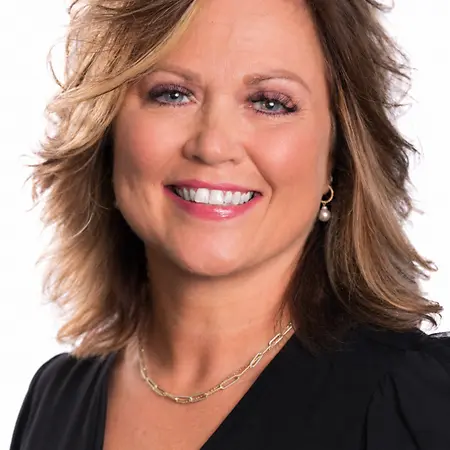
The captioners before me took me under their wings and became my mentors, giving me opportunities to learn and develop my skills. On-the-job training at its finest!
LaShae Flowers, RPR, CRR, CRC · In Her Own Words
Her Story
About LaShae
LaShae Flowers, RPR, CRR, CRC is a seasoned realtime captioning and court reporting professional with nearly four decades of experience supporting legal, educational, and accessibility-focused environments. She currently serves as a Remote Staff CART Captioner for the University of Illinois Chicago, where she provides real-time captioning for classes, meetings, events, and campus activities, ensuring access for Deaf and hard-of-hearing students, employees, and guests. Her work is grounded in precision, speed, and a strong commitment to communication accessibility.
She began her career after earning an Associate of Applied Science in Court Reporting from Southern Illinois University, Carbondale (1986–1988). Early in her professional life, she worked as a freelance court reporter in legal settings, covering civil cases, workers’ compensation matters, and depositions throughout the 1990s. After stepping away from the profession to focus on raising her children, she later returned to the field with a renewed focus on CART (Communication Access Realtime Translation) captioning, transitioning her skills toward serving the Deaf and hard-of-hearing community.
Since returning to the profession, she has built a long-standing career as a certified CART captioner, combining technical expertise with a service-driven mission centered on accessibility and inclusion. Based in Manchester, Tennessee, she has worked across educational, medical, business, and government settings, emphasizing real-time communication access and DEIA values. She is recognized for her dedication to providing accurate, meaningful captioning services that help ensure equal access to information in both academic and public environments.
Her Interview
Ten minutes with LaShae
01What do you attribute your success to?
I would say, well, in the beginning, it was the instructors I had. I mean, they were hardcore, and it was tough, and I didn't like them at the time, but now I am so glad I went through the program I did, because I have heard there's other programs that just weren't like that. They weren't keeping you focused and on track - you were kind of left to your own devices, and it's hard to make it out there if you don't have everything, the whole program, learning the whole thing, like how to deal with burnout, and also how to deal with attorneys, and how to be professional at the same time. It's a fine line. And I've just had a lot of really good people around me that were doing it before me in the captioning world, and I just cannot believe it. I know I've got really good friends that were the first ones to ever caption on TV, and she taught us everything she knows. I mean, I love that. I love that I was close to those people, and I could learn from them, because they're like the top notch, for sure. I would say that was the biggest thing, and of course, they taught me, you know, don't get burned out, don't work night and day, even though it's a lot of money. Just don't do it, because you will be sorry later, physically and mentally.
02What’s the best career advice you’ve ever received?
The biggest thing is balance. Don't pour all of your time into your career. You need a balance. You need a social life, you need a home life, you need all of those things in a balance, or you're going to get burned out. That is a big thing with court reporters and captioners - burnout. So I would say that was the biggest piece of advice I ever got, and I've tried to follow it. In the beginning, it was hard as a court reporter, but now it's easier as a captioner. But you can get burned out - like during COVID, we all got burned out because we were captioning so much, just Zoom meetings and Teams meetings and you name it. So I would say that's the piece of advice that helped me the most.
03What advice would you give to young women entering your industry?
My advice to young women entering this industry is to pursue strong, disciplined training and remain committed to continuous learning. I encourage seeking out mentors who can provide guidance, support, and perspective as you grow in your career. I also emphasize maintaining a high standard of professionalism in all aspects of your work. Finally, I believe it is essential to prioritize work–life balance in order to sustain long-term success and avoid burnout.
04What are the biggest challenges or opportunities in your field right now?
The technology has just changed so much. When I first started out, it was notes, stenographic notes, and a typewriter. You'd have to sit there and type page after page of transcripts. Where now, it just keeps getting better and better. We've got software that is fantastic. And now, we've even got an AI that's built into our software that helps us in real time while we're captioning a class. It'll pop up on the screen spellings of words or phrases that we may have misheard or didn't know how to spell, and it may not be in our dictionary, so we would have to, on the fly, try to remember how to spell that word, where this was popping up on the screen. You can mark it and just put it directly into your captioning. So it's just amazing. But that's going to be a challenge as well, because it uses AI, so it just now came out, and we're all learning right now. I actually have to go to some training soon on that. There have been trainings all through my captioning career just to keep up with the changing software, and the changing computers, the changing monitors that we projected onto, and it's just ever-changing, for sure.
05What values are most important to you in your work and personal life?
The values most important to me in both my work and personal life are service, integrity, and purpose. I have always wanted to do work that genuinely helps people, which led me to CART captioning and a lifelong commitment to supporting the disability community and advancing DEIA principles. I focus on providing meaningful access and contributing to inclusion rather than work driven solely by profit. Outside of work, I value family, balance, and well-being, and I enjoy spending time with my family and dogs, staying active through swimming, workouts, and pickleball, and traveling whenever I can.
Join Influential Women and start making an impact. Register now.