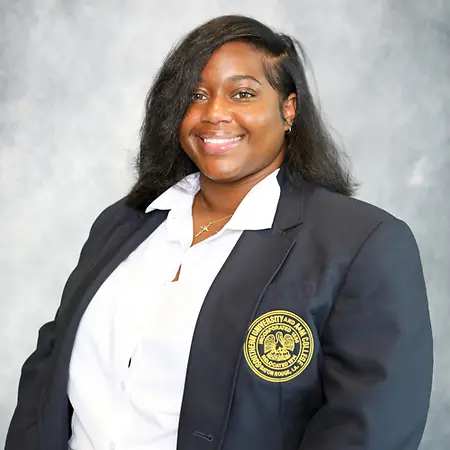
Her Story
About Latasha
Latasha Hunt is an emerging higher education and enrollment management professional whose work bridges student access, data-informed decision-making, and leadership. As an Undergraduate Admissions Counselor at Southern University and A&M College in Baton Rouge, Louisiana, she helps prospective students and families navigate the college admissions process while contributing to recruitment, enrollment, and student-success initiatives.
Since joining Southern University in 2022, Latasha has developed experience across dual enrollment and undergraduate admissions, combining her background in data management and analytics with a student-centered approach to higher education. Her professional development includes Slate Certification in Fundamentals of Admissions & Enrollment and training in data analytics, data management, and data science through organizations including IBM, Google, and Cisco.
Latasha's path to higher education has not been traditional. After stepping away from college for several years, she returned with professional experience, a renewed sense of purpose, and transferable skills developed in the workforce. She is now completing her bachelor's degree in Business Management at Southern University while building her career at the institution she attends. Rather than viewing the gap in her education as lost time, Latasha credits those years with helping shape the resilience, discipline, and perspective she brings to her work and studies today.
Her commitment to growth extends beyond the classroom and workplace. Latasha is a member of Beta Gamma Sigma and the National Society of Leadership and Success and is involved in community and service organizations. Her recent experiences include studying abroad in Ghana, participating in UNCF UNITE 2026, completing strategy and leadership development programs, and stepping outside of her comfort zone to speak on a national HBCU student panel.
At the center of Latasha's journey is a commitment to continuous learning, service, and creating pathways for others. She hopes her story encourages women and nontraditional students to recognize that success does not have one timeline. She believes the experiences gained along an unconventional path can become some of a person's greatest professional strengths.
As she continues developing as a leader, Latasha remains focused on strengthening her skills in enrollment management, data and analytics, leadership, and student success while using her experiences to help others confidently pursue opportunities of their own.
Her Interview
Ten minutes with Latasha
01What do you attribute your success to?
I attribute a lot of my success to resilience, consistency, and being willing to keep learning. My journey has not been traditional, and I’ve learned to really value that. I spent several years away from school, but during that time I was working, growing professionally, learning how to communicate with different people, manage responsibilities, solve problems, and simply navigate adulthood. When I returned to college, I came back with a completely different level of focus and appreciation for the opportunity. I’m proud of what I’ve accomplished since returning, but I’m even more proud that my story can show other nontraditional students that there is no expiration date on going back to school, changing direction, or pursuing something greater for yourself.
02What’s the best career advice you’ve ever received?
The best career advice I’ve received is to never stop learning. A degree is important, but I’ve learned that your growth cannot stop there. I try to intentionally look for opportunities to develop myself through professional development, certifications, microcredentials, conferences, leadership experiences, and simply being open to learning from the people around me. I think being teachable is one of the most valuable things you can carry throughout your career. No matter how much experience I gain, I never want to reach a point where I feel like I have nothing left to learn.
03What advice would you give to young women entering your industry?
I would tell young women not to underestimate themselves or the experiences they already bring with them. Your journey does not have to look like everyone else’s for it to be valuable. Learn your field, but also invest in your communication skills, your ability to work with people, your understanding of data, and your leadership skills. I would also encourage them to ask questions, find mentors, build genuine relationships, and apply for opportunities even when they do not feel 100 percent ready. Sometimes we wait until we feel completely qualified before stepping forward, and I’ve learned that growth often happens because you were willing to step into the opportunity and learn along the way.
04What are the biggest challenges or opportunities in your field right now?
Working in higher education and enrollment management, I think one of the biggest opportunities right now is figuring out how to use technology without losing the human side of the work. We have access to more data, CRM systems, automation, and artificial intelligence than ever before, and those tools can help us communicate with students more effectively and make better decisions. At the same time, every student is more than an application, a number, or a data point. Many of them are navigating college for the first time, returning after time away, or trying to understand systems that can feel overwhelming. I think the opportunity is learning how to use innovation to make higher education feel more accessible and personal, not more complicated.
05What values are most important to you in your work and personal life?
Integrity, service, accountability, growth, and empathy are probably the values that are most important to me. I believe in doing what I say I am going to do and treating people with respect, even when the conversation may be difficult. Service is also very important to me because I believe leadership is not only about what you accomplish personally, but also about how you help other people move forward. I value growth because I always want to keep learning and becoming better than I was before. And empathy is important because everyone is carrying a story that you may not know about. I can hold people accountable while still giving them grace, understanding, and dignity.
Join Influential Women and start making an impact. Register now.