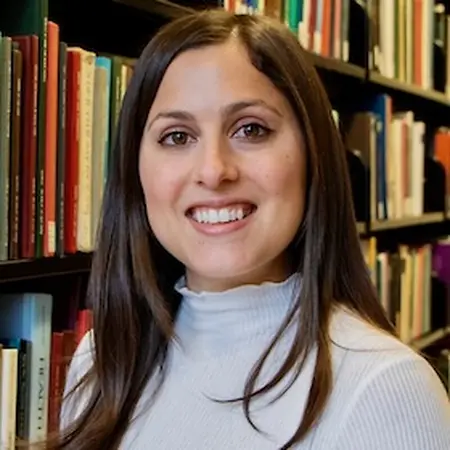
Influential Woman · Therapist and Professor
Dr. Lauren Bochicchio
PhD
Therapist and Professor
Larchmont, NY
Her Story
About Lauren
Dr. Lauren Bochicchio is a clinician-scientist, therapist, educator, and researcher whose work bridges clinical practice and academic scholarship to advance mental health and health equity. Currently a tenure-track Assistant Professor at the City University of New York (CUNY), she brings more than 12 years of experience as a practicing therapist and specializes in the treatment of trauma and post-traumatic stress disorder using evidence-based approaches, including Dialectical Behavior Therapy (DBT). Alongside her academic role, she co-founded Bell Behavioral Health, a private practice serving clients in New York and beyond.
Lauren’s research focuses on improving health outcomes for underserved populations, particularly sexual and gender minority communities. Her scholarship explores queer women’s health, substance use, trauma, and racial and health disparities, with an emphasis on developing scalable and accessible interventions that can reach people where they are. She has collaborated with leading researchers across the United States and internationally, contributing to studies on LGBTQ+ health, social support, alcohol harm reduction, and community-based approaches to improving well-being. Her recent work includes research funded through an RF CUNY grant examining innovative text-based interventions for alcohol use harm reduction among sexual minority women.
A graduate of Bryn Mawr College, Lauren earned both her Master of Social Work and Ph.D. from Columbia University, where she later completed postdoctoral research training at the Columbia University School of Nursing. Recognized for her contributions to social work and health disparities research, she is committed to translating scientific findings into practical solutions that improve lives. Lauren credits her success to a deep passion for her work and the guidance of mentors throughout her career, and she actively encourages emerging professionals—especially women—to seek mentorship, pursue meaningful collaborations, and remain committed to advancing equity through research and practice.
Her Interview
Ten minutes with Lauren
01What do you attribute your success to?
I think likely a lot of having a strong passion for what I do makes you actually want to go to work. It doesn't obviously, there are elements that you know that are hard to any job, but I think actually wanting to do the work and feeling like it's actually doing something, doing something for the world.
02What advice would you give to young women entering your industry?
I think the most important part of the career is having mentorship. Finding a mentor who can help you walk the path and I think can help you to make decisions about what is worth putting forth effort into. What are things to avoid? And so you basically don't have to make the same mistakes as the people before you. I think at any point, and I think that cuts across fields, is being able to seek out mentorship early on. And I think that those end up being my other collaborators or people that I've worked with for the past decade, so I think it's your foundation.
03What are the biggest challenges or opportunities in your field right now?
I think the biggest challenge is navigating the broader environmental context in which we're embedded, both as a professor and then also as a clinician. There's the impact. I work primarily with queer communities and people who identify as either a sexual or gender minoritized person. And so, in the community, I think navigating a kind of broader infrastructure of the world that doesn't want you to exist.
And so that has ramifications, of course, as working in the community and talking to people and how they experience day-to-day life and managing my minority stress. But then also from a clinical, from a research perspective, they guillotined our funding, and now we—and they reduced access. They basically—there's this getting funding now to be able to promote health equity research. And the type of research I do on sexual minoritized women is, even when NIH was kind of up and running, only, I believe, 0.1% of all research that's conducted in the LGBTQ. So it's such a small fraction at baseline.
And so I think that the challenge is kind of existing in an infrastructure that isn't supporting queer identities. I think definitely, I think that's our biggest challenge.
Join Influential Women and start making an impact. Register now.