Her Story
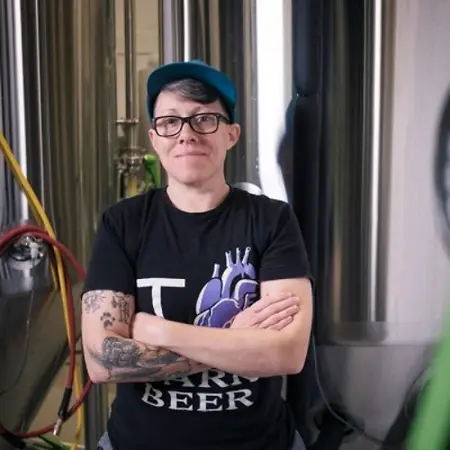
About Lauren
My brewing career began in 2010 when I volunteered at Sun King Brewery for about a year, hoping to break into the industry. That persistence paid off when they hired me to manage the taproom and do cellar work. After moving to Pittsburgh, I spent three years working in my original field - music - but realized brewing was my true calling. I threw all my eggs in that basket and started from the bottom again, working my way up through sheer determination. As head brewer at Two Frays Brewery, I wear all the hats on the production side - brewing, packaging, cellar work, dry hopping, yeast management, and lots of cleaning. I'm a perfectionist when it comes to beer, constantly focused on quality, consistency, and improvement. I've won numerous awards for my beers, which was a dream of mine since my homebrewing days. At my previous position as head brewer at Necromancer, I led the charge on diversity and inclusion initiatives, creating a welcoming space for people who wouldn't typically feel comfortable in a brewery. We had a successful queer beer club and did many partnerships to bring diverse crowds into our taproom. I'm equally proud of making great beer and creating inclusive spaces where everyone can enjoy it. I hold brewing certificates from the Master Brewers Association of the Americas and KU Leuven School, which gave me the technical foundation I needed since my three degrees are in music, not science.
Her Interview
Ten minutes with Lauren
01What do you attribute your success to?
I attribute my success to persistence and throwing all my eggs in the basket once I decided brewing was what I wanted to do. I got two brewing certificates, which were very helpful for both education and as resume boosters. But honestly, I did so much work outside of my job - research, homebrewing, practicing, trying to figure things out, asking questions, trying different beers, going to breweries. It consumed a lot of my time both outside and inside of work because I was just so hungry to be a brewer, to be a head brewer, and to make really good beer. I have ADHD, so the hyperfocus really kicked in and I went nuts with it for about 10 years. Since I have three degrees in music and didn't know the science or mechanics I needed, I did lots and lots of studying to build that knowledge base.
02What’s the best career advice you’ve ever received?
The best career advice I received came from my mentor Nick, who was the head brewer at Penn when I worked there. He was incredibly supportive at a time when I didn't feel very supported. He was always pushing us to own our successes, telling us 'yeah, you guys did that. You're doing great.' He was very encouraging and taught me a lot about how to make beer, what's good, and honestly, how to be a mentor too. He fostered a place that was creative and safe, and was always there to help, teach us, and push us in ways that we needed. It's hard to find that in brewing sometimes because it can be a little bit macho and stressful, but for him it was less about output. He'd say 'yeah, go on the pilot system and mess around and do something cool. Show me what you can do.' Having that person to push you and let you spread your wings a little bit is not something you normally get the opportunity to get.
03What advice would you give to young women entering your industry?
It's tough - it was very tough for me. But it was honestly just sheer put your nose to the grindstone and keep trying. If you want something enough, you'll figure out a way to get it. I really wanted to be a head brewer in a time where women were not head brewers, and the way I did it was just persistence and getting in everyone's face, being like 'hey, I made this homebrew, try it, tell me what you like,' trying to show people that I could do it. I was also lucky to find a close-knit group of brewer friends that were cut from a different cloth, who were super supportive and helpful. They're some of my best brewing friends to this day. Finding that is important - having people you can bounce ideas off of and not be afraid to fail in front of, who aren't an employer or someone you're trying to get a job from. For women especially, you're constantly trying to prove that you can do it and that you're good at it, and sometimes you're dealing with an audience that doesn't think you can just because of your gender. It's tough out there, but if you find the people that are supportive and want to help, and then just keep your nose to the grindstone, you can make it.
04What are the biggest challenges or opportunities in your field right now?
The opportunities are that I get to still do this every day. If I stop and think about it, I'm like, how the hell did I get here? I have a lot of that imposter syndrome where I'll be drinking one of my beers and think 'oh shit, I made this?' The opportunities are that I get to keep doing this, keep trying to make better beer, and learn more about different beers. We're leaning a little heavily into the non-alcoholic beer space, and that's a new challenge - something that before two years ago I had never even thought about doing, figuring out how to make that really good. As for challenges, keeping up the pace as you get older is one - your body starts to get tired. It's a very physical job and your body starts to yell at you. I'm 41 now, so I'm not the young whippersnapper I used to be. The craft beer space in general has seen a decline, which for me is scary because I want to keep doing this for as long as I can. The challenge is trying to find ways to get people to come into the taproom and enjoy the beer, and understand that there is this really cool thing that people were kind of nuts about for 20 years or so before it backed off a little bit. There are still people very interested in craft beer, just trying to keep that up.
05What values are most important to you in your work and personal life?
I'm such a perfectionist when it comes to beer. For me, it's just quality and consistency of the product, and always trying to improve it. Having a workplace that is safe and makes you feel happy is very important. Understanding that we're not really saving lives, we're making beer - we're making something for somebody that hopefully gets their mind off stuff or gives them something to enjoy. Taking pride in that and seeing how you can make people happier and give them a good beer and a nice space to hang out in is what matters. Work-life balance is always important. This is a very grueling industry and it can be kind of grinding at times, especially in the busy months. Being able to take a step back and actually look at what you're doing and all the good stuff that's coming out is essential.
Join Influential Women and start making an impact. Register now.