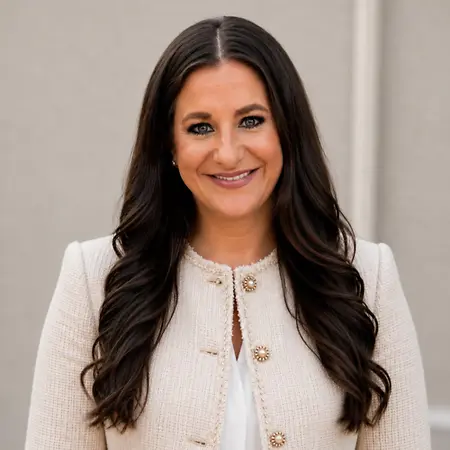
Her Story
About Lauren
Lauren Krauth is a healthcare data and analytics executive with more than 14 years of experience spanning clinical informatics, business intelligence, healthcare analytics, and enterprise data strategy. She currently serves as Head of Data Analytics at Nordic Global, where she leads global teams delivering enterprise reporting, advanced analytics, and data-driven solutions across clinical, operational, financial, and population health initiatives. Throughout her career, Lauren has advanced from clinical informatics and business intelligence roles at Geisinger to senior leadership positions at Bon Secours Mercy Health and Nordic Global. Her expertise includes enterprise analytics strategy, artificial intelligence enablement, cloud data platforms, business intelligence, data visualization, organizational transformation, and operational excellence. She is particularly passionate about using data and AI responsibly to improve healthcare outcomes and help organizations move from reactive reporting toward proactive, insight-driven decision-making. Lauren holds a Bachelor of Science in Biology from Moravian University and a Master of Science in Health Care Administration from King's College. Recognized as a Top 50 Data & Analytics Professional by OnCon in 2026, she is committed to developing high-performing teams, mentoring emerging leaders, and fostering cultures of collaboration, innovation, and continuous improvement. Her leadership approach is grounded in perseverance, adaptability, and bringing diverse perspectives together to solve meaningful challenges in healthcare.
Her Interview
Ten minutes with Lauren
01What do you attribute your success to?
I attribute my success to perseverance and a willingness to continuously evolve and grow. I've never been someone who maintains the status quo. I've always been interested in leading at the intersection of people, processes and technology; understanding why something works the way it does, where it could be better and what could be done differently to create the desired outcome. I strive to bring diverse skills and perspectives to the table, where team members can understand the "why", see themselves in the future we're building and empower them to collaborate and drive innovative solutions. Some of the most meaningful moments in my career haven been building teams, developing leaders and creating opportunities for people to grow.
02What’s the best career advice you’ve ever received?
As you progress in your career, you cannot be the expert in everything. Focus less on trying to have all of the answers and more on becoming the person people can trust to find the answers. This advice has shaped how I lead today through effectively bringing the right people together and asking the right questions to drive decisions while creating an environment where others can do their best work.
Some of the biggest opportunities in my career have come when I was asked to step into something larger or different than what I had done before. You may not have every skill on day one, but if you bring curiosity, confidence and a willingness to learn, you can grow into the opportunity.
03What advice would you give to young women entering your industry?
You do not have to wait for permission to bring your perspective to the table, ask questions, advocate for your ideas, and confidently communicate the value of the work you are doing. Data and analytics is a constantly evolving industry, and it is important to not only build technical expertise but also business acumen. You should learn the tools and technologies but also understand the problem you are trying to solve and the impact your work has on the organization. The most effective analytics professionals aren't simply the people who can produce the best analysis, they are the people who can translate the data into a story, connect it to the business objective and help leaders make better decisions.
04What are the biggest challenges or opportunities in your field right now?
Artificial Intelligence presents both significant opportunities and challenges in the data and analytics industry, particularly within healthcare. Healthcare organizations and payors have enormous amounts of data and a growing number of tools that can turn data into insights. AI has the potential to fundamentally change how analytics teams function, from how we access and interpret information to how we build reporting and identify opportunities to inform clinical and operational decision making. The challenge is making sure healthcare organizations have the data foundations, governance, process and management strategies necessary to use AI responsibly and effectively.
I see the greatest opportunities for AI when it is leveraged as an organizational transformation, not just a technology implementation. This means asking the question, "How should the work change?" as opposed to simply asking "How can we use AI to do the work we already do?". Organizations that can thoughtfully redesign their operating models around data and AI will be set up with a significant advantage to scale their strategies long-term.
For analytics leaders specifically, this is an exciting time. Our role is evolving from producing reports and answering questions to guiding organizations on how to determine which questions matter, how technology can accelerate the answer and how insights can influence better decisions and outcomes.
05What values are most important to you in your work and personal life?
Integrity and people are at the center of how I approach both work and life. I believe that integrity if the foundation of trust, and trust is essential to every meaningful relationship and successful organization. This means doing what you believe is right even when it isn't the easiest path. For me, that includes being transparent, taking accountability, keeping commitments and making decisions that align with the long-term good of the organization and the people within it. It also means being willing to have honest conversations and acknowledging when I don't have all of the answers.
People matter to me just as much as the work itself. I want the teams I lead to know that they are valued not only for what they produce, but for who they are and what they bring to the organization. Leadership is not only measured by the results achieved, but also by the relationships you build, the people you develop and the environment you create for others to collaborate and succeed.
As I have built my career, it has also been a priority to not lose sight of the life I am building outside of work. Family is incredibly important to me, and I believe success also includes being present for the people who matter most. Ambition and family do not have to be in competition; then can both be meaningful, fulfilling parts of your life.
Join Influential Women and start making an impact. Register now.