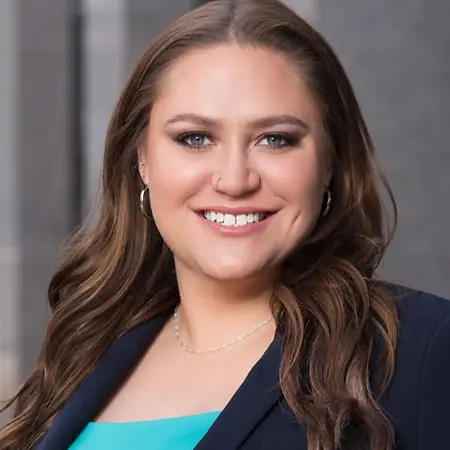
Her Story
About Lauren
Lauren Marshall is a transportation planner working with the Maricopa Association of Governments (MAG) in the United States, where she focuses on improving mobility systems and coordinating human services transportation planning across jurisdictions. In her current role, she collaborates with elected officials, agencies, and community partners to support data-informed planning efforts that improve access and efficiency in regional transportation networks. Her work blends technical planning expertise with a strong commitment to public service and community impact.
Alongside her professional career, Lauren is a dedicated advocate for individuals living with phenylketonuria (PKU), a rare metabolic disorder she was diagnosed with at birth. Her advocacy began in middle school and has grown into decades of public speaking, fundraising, and policy engagement at both state and national levels. She serves as a patient speaker for BioMarin Pharmaceutical Inc. and is a board member of PKU Northwest, where she works to advance medical nutrition equity and expand access to life-sustaining treatment.
Lauren holds dual bachelor’s degrees in Economics and International Business from Northern State University. Her career reflects a unique integration of government planning work and personal advocacy, grounded in lived experience and strengthened through public speaking and leadership development. She is known for using her voice to connect policy conversations to real human experiences, bringing both professional insight and authentic storytelling to every space she enters.
Her Interview
Ten minutes with Lauren
01What do you attribute your success to?
I attribute my success to turning a personal challenge into a lifelong purpose, starting from my diagnosis with PKU and building a 20+ year commitment to advocacy rooted in lived experience. I’ve learned how to translate that experience into meaningful policy conversations by combining storytelling with data, especially through opportunities like speaking before Congress and working on medical nutrition equity.
My professional experience has also been essential—I’ve spent eight years working with councils of governments, collaborating with elected officials and transportation agencies, which strengthened my understanding of how policy is developed and implemented. That work, along with early leadership roles like serving as treasurer for the General Federation of Women’s Clubs, helped me build the skills, discipline, and networks needed to be effective in both government and advocacy spaces.
02What advice would you give to young women entering your industry?
As far as public speaking, I would say remember that there's no wrong answer. The people are there to listen to you, to hear what you have to say. So say it with your chest. Share your story. Don't water it down, don't shy away from the not-so-pretty parts of it. Because all of it is important. You have to be comfortable with all of those parts of you and of your story and honor them specifically to be able to share them. People always aren't gonna like what you're gonna say, but you know, it's not their story, it's not their truth.
03What are the biggest challenges or opportunities in your field right now?
The biggest challenge is that if you haven't experienced rare disease, you don't really understand, so it's hard to get that point across to legislators. Unless you've experienced it to that level, you don't know. Since PKU is a rare disease affecting about 1 in every 15 to 20,000 people, when we go to legislatures, they're like, well, why should we cover all of this if it doesn't impact that many people? Having to dwindle it down to numbers is really difficult, especially for me. I'm a physical person, not a dollar. We have to come at them with the numbers and say, okay, here's the cost of covering it, and if this person is not treated, here's the cost of putting them in a care home facility, here's the cost to the taxpayers based on Medicare, because they would be grown-up toddlers needing round-the-clock care. Another challenge is changing the stigma of pageantry. It's not just girls walking around in pretty dresses with a crown. We go out and we do the work. That's the backbone of why we compete, and that's the backbone of how we're chosen, based on our personal service platform and accomplishments professionally.
04What values are most important to you in your work and personal life?
The biggest one for me is authenticity. Bringing in that not shying away from the not-so-unicorns and rainbows parts of everything. Another one is self-love, that kind of comes with that authenticity. You have to be comfortable with all of those parts of you and of your story and honor them specifically to be able to share them. And then just compassion. I think that's a big thing that a lot of people try to have, but they forget that you have to be not only compassionate to others, but to yourself. Especially with public speaking, people always aren't gonna like what you're gonna say, but you know, it's not their story, it's not their truth. Being kind to yourself is important.
Join Influential Women and start making an impact. Register now.