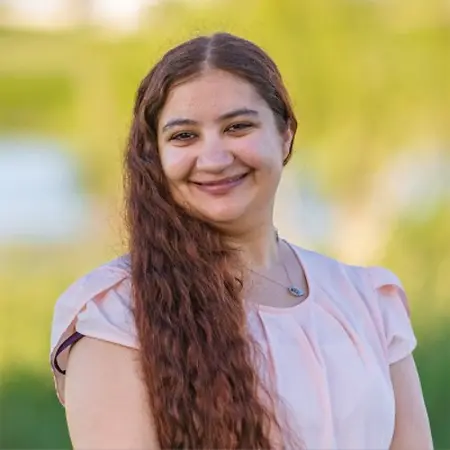
Her Story
About Laurynn
Laurynn Torres is a fifth-year PhD candidate in marine biology at Texas A&M University-Corpus Christi, where her research applies Raman spectroscopy to marine biofilms, tissue samples, and stranded marine mammal specimens. Her path into science began in 2013, when she initially aspired to become a veterinarian. However, after assisting her mentor, Dr. Victoria Kendall, with an at-home euthanasia near Pullman, Washington, she realized that veterinary practice was not the right fit for her and redirected her passion toward wildlife and marine ecology. She earned a Bachelor of Science in Wildlife Ecology and Conservation from Washington State University in 2019, followed by dual master's credentials from the University of Miami Rosenstiel School of Marine, Atmospheric and Earth Science, where she gained hands-on experience working with manatees, dolphins, and primates. Since relocating to Corpus Christi in 2022, Torres has developed a research career focused on the biochemical fingerprinting of marine organisms, including oyster biofilms, endangered deep-sea coral, and archived marine mammal tissue. A significant milestone in her academic journey was a four-month internship at NOAA's Hollings Marine Laboratory in Charleston, where she used field-based Raman instrumentation to analyze biotoxins, forensic ivory samples, and necropsy specimens. She was also one of only ten PhD students selected nationwide to attend the One Ocean Science Congress in Nice, France, where scientists from more than 150 countries gathered to contribute to a report for presentation to the United Nations. Beyond her research, Torres is active in professional and civic organizations, including the Texas Society for Women in Marine Science, the Wildlife Society, and the Society of Wetland Scientists. She also volunteers with STEM outreach initiatives such as STEM Girl Day and campus science fairs throughout the Coastal Bend region. Throughout her journey, Torres has faced a lifelong struggle with anxiety, including periods when it felt crippling. Yet her persistence, ambition, and determination to keep moving forward have helped her reach this stage of her career. She hopes to use her platform to remind girls and young women that they can overcome significant challenges, pursue their ambitions, and achieve things they may once have thought impossible, even while navigating anxiety. Her father has been a constant source of financial, logistical, and emotional support through relocations across Florida, Texas, and beyond, and he continues to encourage her to share her story and inspire others. Outside academia, Torres shares her home with an assortment of pets and supports conservation-focused organizations such as the World Wildlife Fund and the Sierra Club.
Her Interview
Ten minutes with Laurynn
01What do you attribute your success to?
I attribute my success to my father, who has been my steady support system since 2019. During my internship in Jacksonville, he woke up at three every morning to help me get ready, pack my lunch, and drive me two hours to my shift, then drove me home again after a full day of his own work. He made a similar move with me to Corpus Christi so I could pursue my PhD, and he continues to support me financially and domestically, including cooking my meals, so that I can stay focused on my dissertation.
02What’s the best career advice you’ve ever received?
The most defining guidance I received came from my mentor, Dr. Victoria Kendall, while I was working at a clinic near Pullman. After she brought me along to assist with an at-home euthanasia, an experience that affected me deeply, she told me that some things simply cannot be explained to a person beforehand; they have to be lived through to be understood. That moment helped me recognize that veterinary medicine wasn't the right path for me, even though I loved animals, and it pushed me toward ecology instead.
03What advice would you give to young women entering your industry?
Do not let yourself be intimidated by others in your industry. It does not matter who they are, what they look like or what they have achieved. You are here to make your own way, forge your own path and contribute your own successes.
04What are the biggest challenges or opportunities in your field right now?
There are many. But the ones that stick out to me the most are the extreme lack of ecological understanding of wildlife ambassadors in zoos and aquariums and the other would be the severe lack of communication and care between disciplines, namely biochemistry and ecology.
I name the wildlife ambassador problem because it is near and dear to my heart, I have always wanted to have my own sanctuary for non-releasable wildlife or even exotic species in need of rescue from a destroyed homeland. I spent my half a year interning at a facility that was severely uneducated in the dietary needs of their carnivores, specifically their large cats. After researching the issue, I found similar ones across the nation with different species, most of them leading to severe health issues and sadly to shortened lifespans. I feel that this ever-growing issue in the animal care industry could be easily avoided if properly trained staff who had education in the life histories and ecology of the animals they are caring for, the animal residents would be much better off and live longer, healthier lives.
An issue that I am currently facing right now in my industry of marine ecology is trying to promote the use of a biochemical instrument in my current field, I have faced many challenges trying to bring this technology into the limelight. It has incredible capabilities and applicability across the board but it is a little complicated to understand at first. I have found through the pursuance of my PhD that ecologists have no idea what I am talking about and just stop listening after a minute, and chemists just don't really care at all about anything earth science related that is not fundamentally chemically based. It is a real struggle I did not expect to face but I am dealing with today, but I know that at some point this technology will change views and maybe even become a commonly used method for ecological science. I have faith in this because an entire federal lab asked me apply this technology to all of their departments (algal blooms, microplastics, forensics, marine mammals, etc.) and are eager for their results back, also because my advisor who is a biochemist and biomedical sciences professor has now joined a new department at my school that supports marine ecology students, and that was my doing she said.
Join Influential Women and start making an impact. Register now.