Her Story
About Leslie
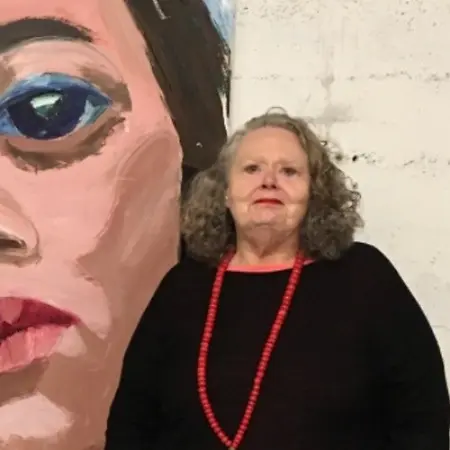
Leslie Plato Smith is a San Francisco–based artist whose work merges expressive figurative painting with themes of public consciousness, emotion, and social reflection. Working primarily in bold forms, rich texture, and gestural scale, she uses color and composition to evoke an intuitive emotional response before inviting deeper analytical interpretation. Her paintings often explore the tension between power and vulnerability, presenting human figures in ways that emphasize inner truth, political context, and shared humanity. Working with painting knives and dynamic surfaces, she focuses on distilling “essence” in each work, treating every new piece as an opportunity to re-examine truth through visual expression.
Alongside her artistic practice, Smith has had a long career in public education advocacy and institutional leadership, particularly at City College of San Francisco, where she worked for decades in roles connected to governmental relations and teaching. She became widely recognized for integrating public art into activism, including large-scale projects such as multi-campus sculpture installations and the “Missing Student” initiative, which used life-size figures to highlight the human impact of budget cuts in higher education. Through marches, installations, and community engagement projects, she has consistently worked to defend access to affordable education and elevate student voices within policy debates.
Smith holds academic training from institutions including the University of California, Berkeley’s Haas School of Business and the University of California, Santa Barbara. Her work has been exhibited in galleries and academic settings, earning awards and recognition for both artistic innovation and advocacy impact. Her practice is grounded in the belief that art can function as a civic force—bridging personal narrative, political reality, and collective responsibility—while her current projects continue to explore themes of equity, Indigenous memory, and interconnection between humans, animals, and the natural world.
Her Interview
Ten minutes with Leslie
01What do you attribute your success to?
I attribute my success to a strong foundation built on family values and a deep belief in equity and fairness, particularly the equality of women, which was instilled in me from an early age by my parents and extended family. I was also shaped by a pivotal and life-altering experience as a graduate student, when I survived a violent attack by a serial predator; through presence of mind, communication, and intuition, I was able to escape, and with the support of others and law enforcement—especially two women detectives in New Orleans—the case was successfully prosecuted, resulting in his conviction and life sentence. That experience reinforced my commitment to resilience, truth, and intuition, and it continues to guide how I move through the world, reminding me that living authentically, standing up for what is right, and trusting one’s inner voice are essential to both personal strength and meaningful impact.
02What’s the best career advice you’ve ever received?
The best career advice I ever received came from my mom, and it's two stunning pieces of advice. One is, don't ever be afraid of making mistakes. That's what erasers are for. And number two is always draw off the edge of the paper. I'm telling you, that changes a life when your mom tells you to do all that stuff. I put it in all my artist statements, and I tell people. I was at a studio yesterday and I told that story because I think too many times moms are scared and they try to pass that fear on to their kids, so it's important to not be afraid and to pursue your dreams.
03What advice would you give to young women entering your industry?
I would give advice to really not be conservative. Really put your heart in it. Don't be afraid to share who you are. Don't hide. Throw everything that you are and your values into your work. Women need to be powerful. I think it's important to remember our history. When the Choctaw first met the Europeans in 1535, the Europeans said, where are your women? The Choctaw had brought their women to the center for negotiations because they thought the Europeans were missing half of their world when they didn't bring their women. We need to stand in that truth, that we are part of everything. We are there. Bring yourself forward, put your heart in it, and don't hide who you are.
04What are the biggest challenges or opportunities in your field right now?
Right now, I'm trying to get my World of We project funded, which would create large-scale sculptures inspired by the Olmec culture addressing the homicides happening to Indigenous women and men. But there's also something really overwhelming to me right now. I taught at City College of San Francisco for 30 years, and we always used to outreach to all adults, but the current leadership for about a decade has been closing the door. We've lost almost half of our enrollment, and they're proposing to close the downtown center at 4th and Mission in San Francisco. The downtown sector has 40% of the small businesses, 40% of the population, and produces 60% of the income, so that's where you need to provide an open door. It was a global campus where people from around the world went when they arrived in the United States. We have a campus that is mainly Asian, a mission campus that is mainly Latino, but we've been closing campuses. We closed our campus in the southeast sector which is the African American community, we closed the LGBTQ community campus, we closed our art campus, we closed our older adult program, and we closed our Civic Center campus which is now empty and has become the fentanyl capital of San Francisco. The downtown campus offered almost everything for free with no fees. They provided ESL, and when you got to about Level 3 you could start taking business classes, at Level 4 you could start taking computer classes. They had a culinary program, all free in downtown San Francisco. And then at night you could take the beginning of your credit program to go for your degree. They've closed all of that. They ended up having the campus open from 8 to 3 and lost all of the ability for the working poor to access higher education. I've been spending so much of my time fighting to keep educational opportunity or lifelong learning, because life, liberty, and the pursuit of happiness means life, liberty, and lifelong learning. It's fundamental to our democracy, it's fundamental to equity, it's fundamental to creating a society that is just, and it also teaches everybody in the same room, that's how we understand each other. I have been putting together what I think are legal arguments and now I'm looking for a lawyer to help keep that door open.
05What values are most important to you in your work and personal life?
My middle name is Plato, P-L-A-T-O. It comes from my grandfather who was born on the Choctaw Reservation, so I'm an enrolled and voting member of the Choctaw Nation. I do hold truth, justice, and equity as my deep values. I shared that with someone recently and they asked me about humor, so I think I'm going to add humor to it, because I think being able to laugh is fundamentally important to getting a good perspective and balance in what we're doing when we're fighting.
Join Influential Women and start making an impact. Register now.