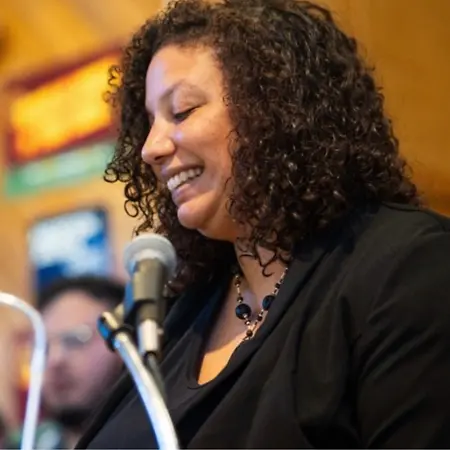
Her Story
About Lexi
Lexi J. White is a public policy and movement-building leader with approximately 12 years of experience advancing reproductive and social justice, gender equity, and racial justice through policy, advocacy, and strategic political engagement. She currently serves as Director of State Strategies at All* Above All, where she leads state-level policy and political strategy to expand access to the full range of reproductive healthcare, including abortion care. Lexi’s work is grounded in empowering state lawmakers, advocates, and community partners with the tools and resources needed to advance proactive policy strategies that protect bodily autonomy and reproductive freedom. She earned her Bachelor of Arts in Political Science and Gender, Sexuality, and Women’s Studies from the University of Pennsylvania and holds a Master’s degree in Public Policy from Temple University.
Lexi began her career as a grassroots organizer and advocate in Philadelphia, where she worked with New Voices for Reproductive Justice and participated in statewide reproductive justice leadership networks focused on addressing health disparities impacting marginalized communities. Through this work, she developed a deep understanding of how structural racism, gender discrimination, and social inequities shape health outcomes, particularly for Black women, women of color, and queer and trans communities of color. She later transitioned into national advocacy roles with In Our Own Voice: National Black Women’s Reproductive Justice Agenda, where she worked with a network of 12 state-based organizations to advance signature campaigns, policy initiatives, and voter engagement strategies. In this role, she led state policy, partnership development, and program strategies to support legislative and administrative advocacy while strengthening the capacity of grassroots and state-based movement leaders navigating complex policy environments.
Lexi most recently contributed to state-level reproductive freedom efforts in Virginia, where she spent nearly two years helping lay the groundwork for the state’s inaugural constitutional amendment for reproductive freedom in the post-Dobbs policy landscape. Following the U.S. Supreme Court’s Dobbs decision, which led to widespread abortion restrictions nationwide, Virginia remained one of the only states in the South where abortion care remained legal, making the constitutional amendment campaign a critical multi-year effort involving coalition partners and legislative stakeholders. The amendment successfully advanced through the Virginia General Assembly and will now go before voters on the November ballot. She also serves in public service as an appointed member of the Alexandria Commission for Women, where she is currently serving her second term, and maintains connections to professional networks such as Q Street. Lexi is deeply committed to building sustainable partnerships, elevating community voices, and advancing human rights while strengthening collective care and resilience in the face of rising threats to democracy, healthcare access, and bodily autonomy.
Her Interview
Ten minutes with Lexi
01What do you attribute your success to?
I would attribute my success to my commitment to shifting and deepening power within the movement ecosystem by centering the voices of organizations led by Black women, women of color, and queer and trans people of color who are often marginalized yet directly impacted by the reproductive justice issues we are working to address. One of my most meaningful achievements has been helping to lay the groundwork for the constitutional amendment for reproductive freedom in Virginia and supporting a multi-year campaign to protect and expand access to reproductive healthcare in the post-Dobbs era. Through this work, I have gained a deep appreciation for what it takes to build strong, lasting partnerships, elevate the voices of communities most affected by reproductive oppression, and sustain the stamina and collective care required to show up for communities during challenging political times. I am especially grateful to the Black feminist foremothers of our movement, including leaders such as Representative Mays of Pennsylvania, Jasmine Burnett, Norbert my current president and CEO—as well as visionary leaders like Dazon Dixon Diallo, Loretta Ross, and Marcella Howell, whose mentorship and leadership helped shape my understanding of building leadership pipelines, advancing human rights work for the long term, and fostering communities grounded in care and resilience.
02What’s the best career advice you’ve ever received?
The best career advice I've ever received is to trust yourself and trust your community. Keep showing up, keep bringing your full self to the work that you do, and believe in the power of your voice. I think the beautiful thing about reproductive justice is it's for all of us, and our lived experiences equip us with what we need to advocate for what we need. The advice to trust the expertise that is our own lived experience and that of the communities we are a part of, that expertise is powerful, and when paired with community and collective action, we can really make a change.
03What values are most important to you in your work and personal life?
The values most important to me in my work and personal life center around how I approach this work from a values perspective. It remains critical to me that we keep the fight going to protect bodily autonomy, to protect healthcare, and to protect our fundamental human rights, our right to have children, to not have children, to live and build family in communities that are free from violence and oppression, and where we have the basic healthcare resources that we need to thrive. I believe it's going to take all of us to win. My work has always centered the intersections of access and equity for Black women and women of color, and also for queer and trans people of color, which has been really important to me as someone who is a member of the LGBTQ plus community. I'm reminded every day of what it takes to build strong and lasting partnerships in this work, what it takes to lift up and center the voices of communities that are most impacted by reproductive oppression, and also the stamina and collective care that it takes to show up in community with each other through hard political times. Outside of work, I love nature and being outside hiking, as nature is something that's always helped to ground me, being by the ocean or being on a beautiful trail. I'm also really interested in creative writing and music, and I'm a long-time sports fan, especially women's sports.
Join Influential Women and start making an impact. Register now.