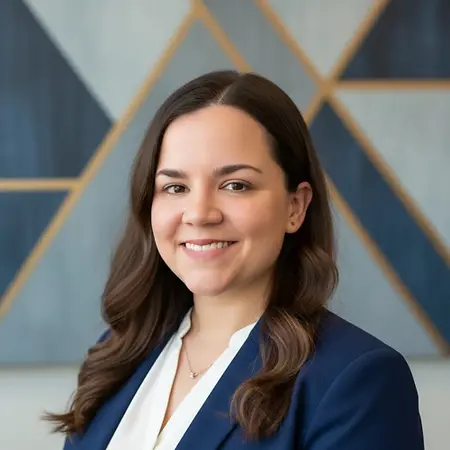
Often the youngest and only woman in the room, yet the one running it; not from confidence, but from a decision to trust the process and refuse to shrink.
Lilian Ray · In Her Own Words
Her Story
About Lilian
I began in the dirt. Field technician work in 2019, foundations, physical labor, learning construction from the bottom up in the most literal sense. That apprenticeship never leaves you. You develop a feel for what holds and what doesn't, and you start to notice something that stays with you: how many companies in this industry are building remarkable things with almost none of the tools that could make that work easier, faster, or smarter.
From there I moved through precast concrete, estimating, scheduling, purchasing, and continuous improvement before arriving at Southland Concrete, where I now price large-scale data centers, logistics facilities, and major commercial developments across the DC metro region. I am heading into my third year in estimating and still finding new dimensions in the work.
The achievement I am most proud of had nothing to do with a spreadsheet. My previous company was drowning in unstructured feedback, resources scattered, priorities invisible, no clear place to begin. I built a defect-tracking application from scratch with no coding background, not by mastering a language but by doing what most people in my position never do: walking out to the floor and asking the people closest to the work what they actually saw. What came back transformed how multiple departments understood their own operations. Waste fell. Clarity followed. We won a best practice award for it, but the more durable result was something harder to quantify. People finally held data that confirmed what their hands had always known.
That is the territory that compels me. Construction resists technology with a stubbornness that is almost institutional. That resistance is not a barrier. It is precisely where the work gets interesting.
Her Interview
Ten minutes with Lilian
01What do you attribute your success to?
I talk to people. Not just the ones at the top of the org chart, but anyone who has something worth knowing, and in construction that usually means the person closest to the work, not the furthest from it. I have never had any ego about being the one asking questions. That posture puts people at ease in a way that actually matters. When someone feels genuinely heard rather than interviewed, they tell you things that never make it into any report, any meeting, or any manual.
That instinct has been more valuable to me than any credential I hold. It is how I have gotten data that was not being tracked, built trust across teams that rarely speak to each other, and understood problems that looked completely different on paper than they did in person. Some of the most important things I know about this industry I learned by showing up somewhere I was not expected and simply paying attention.
I also think there is something specific to construction that makes this approach particularly powerful. This is an industry full of people with deep, hard-won expertise who are almost never asked for their opinion. That is an enormous amount of knowledge sitting uncaptured. I find that gap fascinating, and I have spent most of my career figuring out how to close it.
02What’s the best career advice you’ve ever received?
Stop waiting to feel ready.
Someone told me that early on and I have never been able to unhear it. There is no version of this career, or any career worth having, where the ground feels completely solid before you take the next step. You build the confidence by doing the thing, not before it. The doing is what qualifies you, and it always has been.
I have lived that out more times than I can count. I took on roles I had no business being in on paper. I built things I did not know how to build. I walked into rooms where I was clearly the least experienced person and stayed anyway. Every single time, the gap between what I knew and what the work required turned out to be exactly the right size to grow into.
I think women in particular are conditioned to wait. To prepare one more time, earn one more credential, make sure the case is airtight before they raise their hand. I understand that impulse. I have felt it. But the people who shaped my career most were the ones who moved before they were certain, and figured it out on the way.
The dirt under my boots in 2019 was not a starting point I planned. It was a door I walked through before I knew where it led. I am glad I did not wait to feel ready for it.
03What advice would you give to young women entering your industry?
Construction is not an easy industry to walk into as a woman, and pretending otherwise does not help anyone.
What does help is this: build your support system before you need it. Do not wait until you are struggling to start building relationships, because there will be moments in this industry where you feel completely alone in the room, and that feeling is much harder to carry without someone in your corner. Seek out other women. Bond with the people around you. Network even when it feels forced, because the alternative is isolation, and isolation in this industry is not a small thing. It is a career risk.
But here is something I want to say plainly, because I think it gets lost in the conversation about women in construction: you cannot predict who will show up for you. Some of the most important people in my career have been men. Mentors who made time they did not have to make, who advocated in rooms I was not in, who held the door open and then told me to stop waiting at the threshold. Allyship does not have a gender, and going into this industry with a narrow idea of where your support will come from means you might walk right past it.
Stay open. The person willing to invest in you might not look like what you expected, and that is not something to be suspicious of. It is something to be grateful for, and then to pay forward to whoever comes next.
04What are the biggest challenges or opportunities in your field right now?
Construction is at an inflection point, and I do not think the industry has fully reckoned with how many forces are converging at once.
The pace of technology is the most visible pressure. Construction has historically been one of the slowest industries to adopt new tools, and that is starting to flip. AI, automation, estimating software, data platforms: it is all accelerating, and most teams are still catching up to the last wave while the next one is already here. For people in my position the opportunity is real, but so is the pressure. You have to stay current, learn things that did not exist two years ago, and do all of that while still executing on the day to day work.
But technology is only part of the picture. The financial climate is reshaping how projects get funded, how risk gets priced, and how quickly decisions get made at every level of the industry. Those shifts have downstream effects that reach all the way into the estimating room, and the companies that understand that connection will have a serious edge over the ones that do not.
Then there is the workforce question, which I think is the most underexamined challenge of all. The young professionals entering construction right now spent their high school years in isolation. Their social development, their experience of collaboration, of conflict, of navigating institutions, all of it was interrupted at a formative moment. That has real implications for how we onboard, mentor, and retain people. It changes what good management looks like. It demands more patience, more intentionality, and more creativity from the people already in the room.
Construction has always asked a lot of the people who choose it. What this moment asks, specifically, is that we think seriously about who we are building this industry for next, and whether the way we have always done things is actually designed to welcome them. I do not think we can afford to assume it is.
05What values are most important to you in your work and personal life?
Honesty and proximity.
Honesty because the work demands it. In estimating, a number that is not right does not stay wrong quietly. It compounds. I have never been interested in telling people what they want to hear, in the field, in the bid room, or in any other room, and I think that reputation is worth more than almost anything else you can build in this industry.
Proximity because I believe the most important things happen closest to the work, and most people never go there. The best data I have ever gotten came from a conversation on a plant floor. The best decisions I have seen made were made by people who understood what was actually happening, not what was being reported about it. I try to be that kind of person in everything I do, professionally and personally. Present. Paying attention. Willing to close the distance between where the decisions get made and where the work actually lives.
Those two things together are how I try to move through the world. Get close to what is real, and be honest about what you find there.
Join Influential Women and start making an impact. Register now.