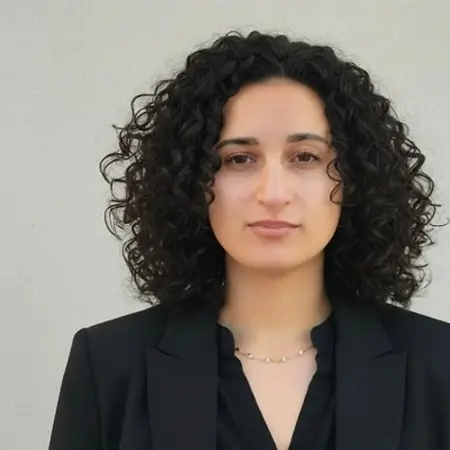
Her Story
About Liliana
Liliana Glancy, SCRM, Lean Six Sigma Black Belt, is a results-driven government contractor specializing in records management, business operations, and process improvement. A dual citizen of the USA and UK, she has built her career in federal logistics and operational support, combining her expertise in workflow optimization with a strong commitment to organizational efficiency. Currently, she serves as Records Manager and Business Operations Lead at the Department of War, where she oversees complex logistical records, schedules high-level joint boards, and manages cross-service and international coordination to ensure mission readiness.
A graduate of the United States Air Force Academy with a Bachelor of Science in Humanities, Liliana began her professional journey at the Department of State’s records department, gaining in-depth insight into government operations. She then progressed to the Department of the Navy, where she managed the full lifecycle of records, including disposition and destruction, handling historical records dating back to the 1900s and overseeing the disposition of approximately 20,000 records. Her commitment to modernizing processes and bridging legacy systems with automated solutions has consistently driven operational improvements and client satisfaction. She is currently completing a Bachelor of Science in Business Administration and Management at Purdue University while holding certifications in SCRM, Lean Six Sigma Black Belt, and Agile methodologies.
Beyond her technical expertise, Liliana is recognized for her integrity, humility, and dedication to empowering others. She attributes her success to the agility and discipline cultivated at the Air Force Academy, combined with proactive learning, networking, and continuous skill development. A strong advocate for women entering government contracting, she emphasizes starting with roles that value individual contributions, building relationships, and pursuing continuous professional growth. Liliana is an active member of Jewish War Veterans and the Association of Graduates from the Air Force Academy, reflecting her ongoing commitment to service, leadership, and community engagement.
Her Interview
Ten minutes with Liliana
01What do you attribute your success to?
I attribute my success to the agility and dedication I learned at the Air Force Academy. While I've always had ambitions, my time at the Academy taught me how to use that ambition in a very real way that lends itself to results. I had to manage multiple projects simultaneously and be agile and dedicated to each of them all at the same time to be successful. The Academy gave me the foundational skills in research, networking, and being proactive. I know how to find the resources to get answers to my questions and get the results I need. For example, I don't know any of my friends right now that have their Scrum Masters or Lean Six Sigma certifications, but I knew these are things I can do right now, today, to get ahead. The Academy really taught me to just keep pushing like that, to be proactive and continuously develop new skills to make myself valuable.
02What’s the best career advice you’ve ever received?
The best advice I ever received came from Master Sergeant Rhiann Caldwell, who retired as a Senior Master Sergeant. During my first year at the Air Force Academy, I was going through a really tough time, and she pulled me aside into her office one day. She told me, 'It doesn't matter what anybody else thinks about you. The only person who's gonna get it done is you. No one can do it for you.' I hated her when she said it. I hated her a month after she said it. But that advice is what's kept me going. Years later, right as I began my senior year in 2023, I met up with her as she was retiring, and I told her that she had literally said something that changed my life. I said, 'You told me this back in freshman year, and I hated when you said it, but I've never heard something more true in that statement.' My dad also gave me great advice: you just gotta keep your doors open. Every time you close a door, you should be opening two more in front of you. So when I left the Department of Navy and gave up getting my top secret clearance to maintain just my secret clearance, I did that because I opened two doors by maintaining my relationships with the government staff there and making sure the work I was moving into was more fulfilling and impactful. For every trade down, you should have two trade-ups.
03What advice would you give to young women entering your industry?
First of all, trying to aim at the very beginning for a Big Four contracting firm is just unrealistic unless you have this insanely diverse portfolio already. And if you do, you probably shouldn't be a contractor, you should be starting your own company. I think you need to start small. Start with a small contractor where they're really gonna value you as a person. That was really great for me. Then, once you get that first role, do everything you can to network with the offices and organizational structure around you. All going well, I think those kinds of things are what's gonna get me into one of the Big Four. Maybe I don't want to stay with contracting forever, but having those connections and doing the work I'm doing right now, I work with people at SPA, Deloitte, and LMI. Even though I'm not one of those Big Four or Big Ten, there is nothing more valuable than interpersonal relationships in an office. I could not know something, I could not know how to send an email or who to send that email to, but because I've made that relationship with the person next to me, I can ask them and leverage their knowledge, and we're all better for it.
04What are the biggest challenges or opportunities in your field right now?
The biggest challenge in my field right now is defunding, and it's affecting everybody. There is not a single firm in the industry who isn't feeling that, and there's not a single government employee who isn't seeing that right now. In my office, I have GS12s through SES2s, contractors like me who've been doing it for 2 years, and other people who've been doing it for the last 30 years. I have civilian employees who've been doing this for the last 15 years after a 25-year-long military career. It's affected everybody. One person being taken off the team affects the entire office. As a contractor, the best thing you can do to not be at the receiving end of a defund is be proactive in your contributions for the government's mission. You always have to connect it back to the current priorities and mission, but good work is still good work at the end of the day. Make yourself valuable through the work you do and be prepared to open two more doors. What I do right now is make sure I go through my skills trainings outside of my organization if I need to, so that if I'm on the receiving end, especially so young in my career, I can still be responsive to that change. A lot of us are feeling the need to continuously develop new skills to make ourselves continuously valuable to the mission.
05What values are most important to you in your work and personal life?
Integrity is the most important value to me in my work and personal life. I think there isn't anything that I do that I'm not proud of, and that includes the bad decisions or the decisions I made that didn't have the most ideal outcomes. Part of it is the confidence of me knowing that I'm making decisions to the best of my ability, even if I don't have all of the foresight. Integrity is doing the right thing when nobody's watching, as the very basic definition, but it's also about standing by the person that you were when you made those decisions. That doesn't mean thinking everything I do is perfect. It's about having the personal integrity to recognize in yourself that you can make mistakes, and at the same time having the humility that it takes to then move forward. That's also part of integrity to me. I pursue this in my relationships with other people and in any of my projects. I can stand by that work and say, 'I made a mistake. I sent out the deliverable a little too early, and I should have double-checked that part. But knowing what I knew, this was the right decision. Knowing what I know now, I can improve upon that.'
Join Influential Women and start making an impact. Register now.