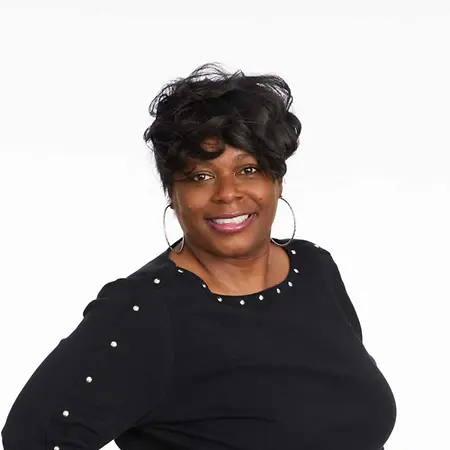
Her Story
About Linda
Linda Weatherspoon is a nonprofit executive, community researcher, published research co-author, and social impact professional who has dedicated her career to supporting justice-involved youth and adults, at-risk youth, and underserved communities. She serves as Executive Director and Co-Founder of Roll Call, a nonprofit organization established in 2006 as a grassroots initiative centered on empowering formerly incarcerated individuals in order to prevent future involvement in the justice system. Under her leadership, Roll Call has expanded its work to include justice-involved youth and emerging adults in high-risk communities, with programs and initiatives focused on reentry services, family engagement, entrepreneurship, workforce development, and violence prevention.
Weatherspoon brings extensive experience in nonprofit leadership, community engagement, higher education, administration, residential services, and senior care. Her professional background includes six years supporting student residential operations at the University of Chicago and nearly two decades with the Healthcare Consortium of Illinois, where she served in a supervisory and event coordination capacity and helped seniors access essential services designed to support independent living. Her work also includes community-based research examining the experiences of communities affected by violence and policing. She is a published co-author of research featured in the *Community Mental Health Journal*, including the article “Dual Burden of Community Violence and Policing in a Large Urban City.” She holds a Bachelor of Arts from Northeastern Illinois University and has completed professional training in Youth Mental Health First Aid, Trauma-Informed Care, Research Ethics, Interdisciplinary Research, Grant Writing, and Addiction Awareness.
Grounded in lived experience, service, mentorship, and community engagement, Weatherspoon is committed to creating opportunities and developing solutions that respond to the needs and experiences of underserved communities. She has served for approximately three years on the Illinois Justice Reform Committee and is an AmeriCorps alum. Her professional interests include community-based research, violence prevention, reentry and justice reform, youth and emerging adults, workforce development, entrepreneurship, nonprofit leadership, and community partnerships. She emphasizes integrity, self-care, perseverance, and the importance of ensuring that women's voices are represented and heard across all areas of society.
Her Interview
Ten minutes with Linda
01What do you attribute your success to?
I attribute my success to my lived experiences and to the mentors who have influenced and guided me throughout my life. I have had several mentors, including my teachers and what I consider my “life teachers,” who provided me with valuable lessons, perspective, and encouragement. Those experiences and relationships have shaped who I am and the work I do today.
02What’s the best career advice you’ve ever received?
The best career advice I have received is to practice self-care and make time for yourself. Self-care is not an option; it is necessary. In work that involves serving communities and supporting others, it is important to recognize that burnout is real and to take the time needed to care for yourself so that you can continue showing up effectively for others.
03What advice would you give to young women entering your industry?
My advice to young women is to keep going. We need women's voices represented in every area of life, and too often those voices have been minimized. I believe the world would be better if women's voices were heard and amplified. Continue to use your voice, remain persistent, and recognize the value you bring to the table.
04What are the biggest challenges or opportunities in your field right now?
One of the significant challenges I see is transitioning into a new field, particularly for professionals later in their careers. Age discrimination is a very real concern, and I have experienced situations where there was a preference for having a predominantly younger group at the table, even when those who came before them helped build and establish that table. Navigating these perceptions and creating meaningful opportunities for professionals at different stages of their careers remains an important challenge.
05What values are most important to you in your work and personal life?
Integrity is one of the most important values to me, both professionally and personally. I believe in treating people the way I want to be treated. Those principles guide how I interact with others, approach my work, and serve the communities I care about.
Join Influential Women and start making an impact. Register now.