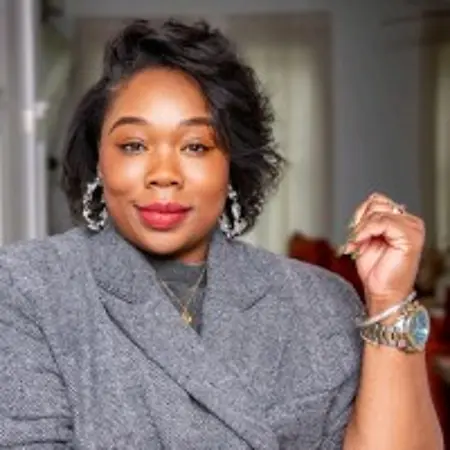
Influential Woman · Technology
Lindiwe Davis
Founder, Media Tech Consultant, FutureState Collective Group
Atlanta, GA 30344
Her Story
About Lindiwe
Lindiwe Davis is the Founder of FutureState Collective and an award-winning global leader, media interviewer, speaker, executive producer, and executive coach with nearly 30 years of experience across marketing, media, finance, and tech. Her work sits at the intersection of culture, communication, leadership, and storytelling—helping individuals and organizations build environments where people can actually thrive, not just perform. She entered the tech industry in 2018 during a pivotal shift in workplace culture, leading diversity, equity, and inclusion efforts ahead of and throughout major global moments of reckoning and change. Her experience spans the evolution of talent pipelines, the rapid expansion and scrutiny of DEI, the normalization of hybrid work during COVID-19, and today’s landscape shaped by AI, restructuring, and shifting workforce expectations.
What sets Lindiwe apart is her ability to connect strategy with storytelling. As a media interviewer and executive producer, she brings a distinct lens to her work—centering voice, narrative, and visibility in conversations around culture and leadership. She doesn’t just talk about culture—she captures it, challenges it, and translates it into something people can actually use.
Currently, she works in sustainability, focusing on community engagement through volunteer management, strategic programming, and event development—bringing a more intentional and people-centered pace to her work.
Beyond her corporate role, Lindiwe is also known as "The COuch Coach" and hosts They Tried It, a podcast that unpacks workplace culture through real stories—particularly the experiences of Black and Brown women navigating adversity, bias, and power dynamics at work. She's also the creator of "Couch Coach Fridays," a short-form coaching & cultural commentary video series.
As a speaker, moderator, and advisor, she is also known for her directness, cultural fluency, and ability to create space for honest conversation. She doesn’t perform professionalism—she challenges it. And she’s built a reputation for saying what others won’t, while helping people find the clarity and courage to advocate for themselves.
Her Interview
Ten minutes with Lindiwe
01What do you attribute your success to?
I attribute my success to tenacity, hard work, and consistency, especially in environments where outcomes are uncertain and the path forward is not always clearly defined. Across nearly three decades of experience spanning multiple industries, including my work in tech since 2018, I have consistently shown up with a commitment to learning, execution, and impact, even during periods of significant cultural and organizational change. From leading diversity, equity, and inclusion work during a pivotal moment in the industry, to navigating global shifts such as COVID-19, the rise of AI, and ongoing workforce transformations, I have remained focused on adapting, building, and delivering meaningful results. My success has been shaped by a willingness to stay the course through complexity, to remain disciplined in my efforts over time, and to continue evolving while staying grounded in purpose, authenticity, and a commitment to creating spaces where people and ideas can thrive.
02What’s the best career advice you’ve ever received?
I've received a lot of delicious pieces of advice and gems over the years. One thing I remember when I was younger - my mom, she was a career professional as well, and she told me, you need to remember that you don't ever let people put you in the box to make themselves feel comfortable about who they think you are. For me, all that really means is, first of all, you can't tell me what my story is, I have to tell you what it is. And furthermore, I'm not bending over backwards because it makes you feel more comfortable. I don't know how to be anything else but me. And if that's not good enough, then this is probably not the place for me, or I just need to switch people altogether. You're not going to make me become something that you need me to be so that I'm more digestible to you. No, that's not real.
03What advice would you give to young women entering your industry?
If you're trying to get into tech, don't allow this idea of, oh no, I don't have an engineering past, or oh no, I don't have said certificate in this very specific UX design, coding, etc. Tech is one of those spaces that all of your experiences are relevant. You just have to find the right people and the right community. And sometimes that is very hard, because across any industry, it doesn't matter if it's tech, the financial industry, marketing - people are lazy. They don't really read resumes the way that they're supposed to. They don't really review and research your profile. People make a lot of assumptions about you right off the bat. My advice here is that don't let what you perceive an industry to be stop you. In fact, you should just jump out there. And that experience is going to take you far. In tech specifically, there's all kinds of people that are former military, former nurses, hell, former first grade teachers, former party planners. I've met a lot of different kinds of people who had another life before they entered into the tech space.
04What are the biggest challenges or opportunities in your field right now?
The thing right now is there's so many layoffs going on, and we don't have clarity on why those layoffs are continuously happening. I'm actually saying this on purpose - for all the layoffs that we've seen from various companies, particularly in the tech space, we understand that those things weren't actually necessary. These companies have the money to pay people, and they have money to ensure that people's roles are sustained. From the numbers that we have seen, we still don't have clarification on why so many people are being laid off. More specifically, we don't have clarification on why 600,000 plus Black women have been laid off from their jobs. For me, the thought process is, what is my next step? What am I going to do next? Not because I don't know what my dreams are, or what my path is - I actually know what my path is, I know what my purpose is, I've known since I was 13 years old. But how am I going to maintain the drive that I have right now, and any resources I may have my hands on right now, because when this job is over and I'm laid off, or I leave tech, or what have you, how am I going to sustain these things that I've been driving on my own for my business? I think thinking more broadly about what does it mean from a cultural standpoint within companies - there's things like, oh yes, we're looking to be more efficient and aligned as a direct result of AI. But now there's more talk about, well, we don't have any real proof that companies have actually been more efficient by letting go as many people as they've let go in the name of AI. I think even just that conversation is something that I want to lean more into, the business of AI and culture and how that actually impacts organizations and the people within those organizations who are meant to execute that work, do that work, have excellent expertise, but then also who have unceremoniously been let go and will probably end up being hired back within a year or a year and a half, which is my prediction.
05What values are most important to you in your work and personal life?
There are a few values that are most important to me. First is support. I think a lot of times we hear that word, but people don't actually know what it means. I think it's because they have relationships, but they're not as practiced as they could be in those relationships and understanding support and what that looks like in an active state, versus just saying, I support you. I'll give you a perfect example - I've seen many things happen in workspaces where it just wasn't right. If it wasn't right, then I'm going to speak up on the thing. If I see that something's happening to someone else, I'm not going to just let them fall by the wayside. No, I'm going to give them whatever advice I can give them. I'm not going to give them some templatized response. I'm going to support them in every way that I can, in every way that I have access to. The second thing is this business of thinking that once you reach a certain state in your organization or your company, that you can just hold the playbook to yourself versus sharing it out. I think a lot of times people miss the point, or forget the plot, or lose the plot, that the playbook that you use to get from point A to point B, it doesn't cost you anything to share it for free. It also doesn't mean that someone else is going to necessarily take those same steps. But the whole idea of paying it forward, that's what it means. It means to give something to someone or to a group of people without any expectation that you're going to get anything in return, and you're doing it because you want to see others succeed. And also, I care very, very much about competence. In fact, it's probably one of my favorite things to land on. I care so much more about someone's character and their character than their skill set. I would rather have the person whose character is in a good place, I can tell that they've done some work on themselves, they're self-aware, they've got just enough emotional intelligence that they're continuing to learn more about themselves. I will take that person over the person that I know is highly skilled for this job, but their character is not in place. Because that means I can't trust you.
Join Influential Women and start making an impact. Register now.