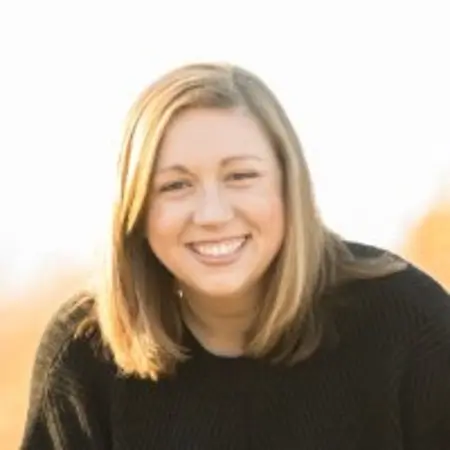
Her Story
About Lindsay
Lindsay Sabey is a seasoned manufacturing professional and Production Manager at L’Oréal, with over a decade of experience in chemical engineering and industrial operations. She has been working in manufacturing since 2013, beginning with a co-op program at Eastman Chemical Company during her final college years, where she alternated between work and school semesters. After earning her bachelor’s degree in Chemical Engineering and Marketing from the University of Arkansas at Fayetteville in 2014, Lindsay continued at Eastman as a production engineer, supporting day-to-day operations and process optimization. She later spent a year with a consulting firm focused on maintenance optimization, which strengthened her leadership skills and operational perspective. In 2019, Lindsay transitioned to L’Oréal, a meaningful move that connected her professional path with her family history—her father worked at the company during her childhood, and her stepmother enjoyed a remarkable 40-year career there. At L’Oréal’s North Little Rock facility, she has held roles including Production Manager and Quality Manager overseeing high-volume mascara production. Her day-to-day responsibilities have combined strategic planning, resource optimization, and team engagement, ensuring operational objectives are met while fostering a safe, collaborative, and high-performing work environment. Beyond her operational responsibilities, Lindsay is committed to mentoring and supporting the next generation of engineers, volunteering with programs mentoring the next generation of Chemical Engineers at the University of Arkansas and Engineers Without Borders. Looking ahead, she aspires to transition into longer-term strategic roles at the plant focusing on production optimization, process improvement, or unit-level production leadership while balancing the demands of a high-performing manufacturing career with raising her three children. Her approach to leadership emphasizes courage, collaboration, and sustainable success for both her team and the organization.
Her Interview
Ten minutes with Lindsay
01What do you attribute your success to?
I attribute much of my success to having a very supportive partner. My husband’s flexibility and willingness to step in—especially during demanding periods at work—make it possible for me to fully show up when needed. We’re grateful that, together, we can make it work.
I also think my mindset plays a big role. I’m driven by a clear vision of what’s possible and a strong desire to make things better, but I balance that with an honest understanding of our current reality. For me, success comes from consistently working to bridge the gap between where we are and where we can be.
02What’s the best career advice you’ve ever received?
The best career advice I ever received came from my dad. When I went to find my first job, when I was young and single, he told me to make sure I find something beyond myself to give to. He said if all your time is just at work, your life is not going to be fulfilled. He told me to find something else, to find another way to give back to my community in some form or fashion, and on a regular basis. He said your life can get swept up into what your job is, but there's so much more than that. You are so much more than that. Being an active part of your community is just as important. When I was at Eastman, I took his advice and did Big Brothers Big Sisters and Engineers Without Borders, and both of those different structures to allow me to spend time in my community or helping another community really is just good for the soul.
03What advice would you give to young women entering your industry?
From a career perspective, I would say know your end user. Know who you're working with and what they need. Don't be afraid to talk to them and get their input on any kind of solutions you're trying to put in place. In my career, I've seen a lot of people think about things on paper or on the carpet - we call them carpet walkers at our plant - not getting out there in the actual thick of the production area and really learning those people and what they need to be successful. I've seen that both in my chemical engineering experience and at L'Oreal. I would also add that something I've gotten passionate about in my career is change management. I see so often that people don't value the impact on just getting a person to change how they work every day, and the leadership that is required to make that successful. So make sure that when you're making changes to your workplace, which we're all doing to make it better, take the time to help lead your people through that change in a way that is effective for them. Don't just say, hey, we're doing this today, do it differently. Follow some of those principles that can really help people adapt to change better. Personally, I would say, and I'll take this from my dad, when you go find your first job, find another way to give back to your community in some form or fashion. Your life can get swept up into what your job is, but there's so much more than that. You are so much more than that, and being an active part of your community is just as important.
04What are the biggest challenges or opportunities in your field right now?
I think the biggest challenge facing young women today is maybe just the archetype in our brain that we've built up of being good at everything. There's this necessity to feel like you have to be good at everything - you have to be good at work, you have to be a good cook, you have to be good with your health, you have to be a good spouse. There's a lot of pressure there to be good at all these things, and figuring out the balance is one of the hardest things for moms right now. We feel like we need to be perfect in all things, and trying to balance life and work is really challenging.
05What values are most important to you in your work and personal life?
My faith is foundational for me. I am a Christian, and I don't know if I could be where I am without it. I think being patient with people and kind with people is very important. I believe in realizing that people with different backgrounds can come and do anything. Both of my parents are felons - they both went to prison for DUIs. I've seen my dad come out of it and be great. He goes back and he mentors men in prison, and he's really recovered. My mom actually passed away, but she was not able to recover. So I've seen it kind of both ways. For me, foundationally, understanding that people from different backgrounds can really have anything and do anything, whether it be good or bad. People from my production floor bring different values or different perspectives day in and day out with what they may be carrying at home based off of maybe their educational backgrounds and that kind of thing. Just being able to see value in everybody, and that anything can happen to anybody and having that perspective is important to me. I've gotten the privilege of being able to see different worlds. In college, I took a summer and went to Cambodia and lived with missionaries who were helping people in the sex trade. I got to really see humanitarian problem solving - how do we help solve this problem, help people not get human trafficked. Understanding that problems are a lot more complex than sometimes you understand, and you can't just fix it one way. You really have to look at it end-to-end.
Join Influential Women and start making an impact. Register now.