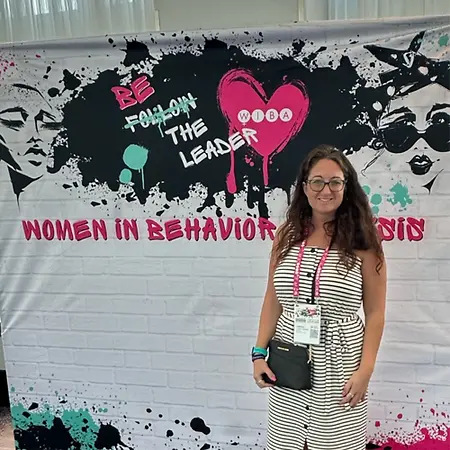
My ambition evolved from becoming an excellent clinician to building systems that support others and create sustainable, responsible growth.
Lindsay Schmelzel · In Her Own Words
Her Story
About Lindsay
Lindsay Schmelzel is a Board Certified Behavior Analyst (BCBA) and Founder & CEO of Mighty Kidz Services, a rapidly scaling, Medicaid-accessible autism services organization redefining trauma-informed care in the Southeast.
In under two years, Lindsay expanded her flagship clinic in Columbia, South Carolina, from 5,000 to 26,000 square feet, growing her workforce to more than 75 professionals while preparing for multi-state expansion into North Carolina Spring of 2026. Her leadership demonstrates that operational scale and human-centered care are not mutually exclusive. By pairing disciplined infrastructure with a culture rooted in regulation, dignity, and relational trust, she has built a model designed for both sustainability and impact.
Lindsay specializes in applied behavior analysis therapy delivered across clinic, home, and school settings, with a focus on culturally responsive, dignity-centered services for neurodivergent children. She is equally recognized for leading a comprehensive workforce development strategy in collaboration with a strong executive and clinical leadership team — mentoring future behavior analysts, designing structured training infrastructures, and formalizing leadership pathways for Registered Behavior Technicians, who are regarded as the backbone of high-quality care.
Her background spans Montessori education, Child Life programs, and nine years of progressive ABA experience, beginning as a Registered Behavior Technician and advancing into clinical training and supervisory leadership roles. She holds a Master’s degree in Psychology with a concentration in Applied Behavior Analysis from Purdue University Global, dual Bachelor’s degrees in Psychology and Sociology from Wingate University, and a Child Life Certificate from the University of California, Santa Barbara.
Beyond her organization, Lindsay serves on the South Carolina Advisory Council for Educating Students with Disabilities, advocating for inclusive education policy and equitable access to services. Through innovative community programming, caregiver education initiatives, and strategic expansion efforts, she is building a scalable ecosystem of support that extends beyond therapy and into long-term community transformation.
Her Interview
Ten minutes with Lindsay
01What do you attribute your success to?
I attribute my success to courage — the willingness to build differently, grow strategically, and prioritize culture over speed. Sustainable success comes from strong foundations, empowered teams, and an unwavering commitment to doing what’s right for children and families.
At the same time, my journey has been shaped by hard work, self-belief, and the encouragement of those who have supported me along the way. I’ve never been afraid to take calculated risks or reinvent myself when growth required it. I prioritize continual skill-building and view mistakes not as failures, but as data — opportunities to refine, strengthen, and evolve.
02What’s the best career advice you’ve ever received?
The best career advice I’ve ever received was to go to the beat of my own drum — to trust my instincts and not allow others to dictate what I can or cannot do.
There will always be opinions, limitations, and traditional paths laid out for you. But real growth happens when you’re willing to think independently, trust your preparation, and build in a way that aligns with your values — even if it looks different from what others expect.
03What advice would you give to young women entering your industry?
I would advise young women entering my industry to take a chance on themselves, trust in their abilities, and have the courage to follow their own path. Don’t let others define your journey or limit your potential — go to the beat of your own drum.
At the same time, master your craft first. Competence builds confidence, and confidence builds credibility. Learn every layer of the work. Ask questions. Stay teachable. Don’t rush the foundation — the experience you gain early on will become the authority you lead with later.
Don’t shrink yourself to fit into spaces that weren’t built with you in mind. Healthcare needs strong, ethical, visionary women who lead with both intelligence and integrity. Advocate for your worth, surround yourself with mentors who elevate you, and build with courage.
There will always be opinions about how you should grow. Stay grounded in your values, invest in your skills, and build in a way that aligns with who you are. The most powerful leadership comes from authenticity, not imitation.
04What are the biggest challenges or opportunities in your field right now?
One of the biggest challenges in our field right now is workforce sustainability. Demand for autism services continues to grow rapidly, yet the industry struggles with burnout, turnover, and inconsistent training standards. If we want better outcomes for children and families, we must invest just as deeply in the clinicians delivering care as we do in clinical protocols. Workforce development, structured mentorship, competitive compensation, and sustainable scheduling are no longer optional — they are essential.
At the same time, the field faces systemic barriers, including lingering negative perceptions of ABA, low Medicaid reimbursement rates that limit provider participation, and the ongoing complexity of insurance authorizations and claim denials. These pressures impact provider stability, operational scalability, and ultimately access to care for families who depend on these services.
Another major challenge is maintaining clinical integrity while scaling. As organizations grow, there is pressure to expand quickly. The real opportunity lies in proving that you can scale responsibly — building strong infrastructure, compliance systems, and leadership pipelines without compromising culture, ethics, or dignity-centered care.
Despite these challenges, this is also a transformative moment for the industry. There is growing momentum toward trauma-informed, compassionate, and culturally responsive practices. We are seeing increased demand for integrated service models that extend beyond traditional therapy — incorporating speech services, adaptive programming, community initiatives, and interdisciplinary collaboration.
The future of this field will belong to organizations that prioritize both people and performance — those willing to innovate, advocate, and expand strategically while protecting the foundation of trust, clinical excellence, and family partnership.
05What values are most important to you in your work and personal life?
The values most important to me — in both my work and personal life — are integrity, courage, compassion, growth, and advocacy.
Integrity guides every decision I make. Whether it involves clinical care, business strategy, or personal relationships, I believe in doing what is right — even when it is difficult or unpopular. Long-term trust is built through consistency, transparency, and ethical leadership.
Courage has shaped my journey as an entrepreneur. Building something meaningful requires risk, resilience, and the willingness to trust your instincts. I believe in going to the beat of my own drum and not allowing external expectations to dictate my direction. Meaningful impact comes from showing up consistently, investing in your craft, and committing to lifelong learning. Growth isn’t optional — it’s a responsibility.
Compassion is the foundation of my work. In healthcare, we are entrusted with people’s children, their vulnerabilities, and their hopes. Leading with empathy, dignity, and regulation first is non-negotiable. Advocacy is central to everything I do — ensuring staff and families are treated with respect and that the environments we build are safe, empowering, and grounded in integrity. Strong communities are built through collaboration, trust, and shared purpose.
At my core, I strive to build a life and an organization where people feel safe, valued, and empowered to become their best selves.
Outside of work, I prioritize joy and balance. I enjoy line dancing — which I also teach — exploring art, and spending time with my loved ones and my dog, Dolly. Those moments keep me grounded and remind me that leadership is strongest when it is rooted in connection and authenticity.
Join Influential Women and start making an impact. Register now.