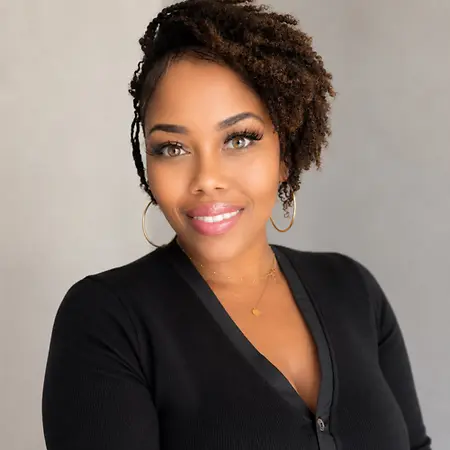
A reflective exploration of intentional purpose and strategic growth as a woman transitions into a new life season, balancing motherhood, career, ministry, and personal becoming with faith-centered alignment.
In Conversation
Lisa James for Bold. Brilliant. Unstoppable.
Read the transcript
Lisa Ann James: Speaker: Lisa James, Process Improvement Analyst V, Global Payments Inc.Lisa James: Understand the definition of done. And then be OK with progress over perfection.What does being an Influential Woman mean to you?Lisa James: I believe myself to be a very gifted helper and motivator, so in that way I show up as a servant leader. I really become influential when I'm honest with myself about that role. So I don't need to be the leader on a team or the innovator. I'm very comfortable with helping others implement, have important conversations, remove blockers or impediments. I really thrive when I am supporting the team. And moving things forward in a positive and productive way, and that way I'm very influential to myself and to others.What's one piece of advice you would give to younger women chasing their dreams?Lisa James: This is a good one. Not just something I would say to young women in pursuit of their dreams, but this is something I remind myself on regularly. Understand the definition of done. And then be OK with progress over perfection. Be OK with doing your best and moving forward. So progress over perfection is just basically saying, you are going to make some mistakes, you're not going to make everyone happy. But if that you give your best effort, then it's really up to you to remind yourself to keep enjoying the journey on the way to pursuing your dreams.
Full transcript available
Her Story
About Lisa
My professional journey began nearly 20 years ago in general office administration, where I learned the foundational rhythms of workplace operations, communication, organization, and support. From there, I moved into executive administration, and over time, my ability to organize work, manage details, support leaders, and bring structure to moving parts naturally evolved into project management.
Before I had the formal language for it, I was already drawn to helping people feel seen, supported, and more effective in the workplace. I have always cared about how people experience work — how they learn, how they communicate, how they respond to change, and how systems can either support or frustrate them.
That interest led me to earn my Bachelor of Science in Psychology, with a focus on psychology applied in everyday life. That foundation still influences the way I work today. I use it to help people understand not only what they are doing, but why they think, respond, or hesitate the way they do when learning something new or adapting to a process or technology change.
I later earned my MBA with a specialization in Project Management, which helped me connect the people side of work with the structure, governance, and discipline needed to move initiatives forward. I also earned my CAPM, Certified Associate in Project Management, followed by ITIL certification to strengthen my understanding of service management, process structure, and the way technical documentation and training materials should support operational excellence.
Most recently, I earned my PMP certification, which represents a major milestone in my professional development and validates the experience I have built over the past decade in project management, training, implementation support, and organizational enablement.
Today, I bring together nearly 20 years of administrative, project, training, and leadership support experience, including about 10 years in the project management and enablement space. I have also applied for a doctoral program, with the long-term goal of becoming a Doctor of Education focused on human experience, learning, and development.
At the center of my journey is a consistent purpose: helping people understand systems, navigate change, work more confidently, and feel seen in the process.
Her Interview
Ten minutes with Lisa
01What do you attribute your success to?
The first thing that comes to mind is God.
For me, this season is about obedience, surrender, and learning how to be led. It is the daily reminder that I am not in control of every situation, every outcome, or every next step — and that my strength is not found in trying to be.
Right now, I am studying and reflecting on the relationship between a shepherd and a sheep. I have never naturally thought of myself as a sheep, but the more I sit with that image, the more I realize how much I need God’s shepherding. I have places in me that wander, worry, resist, overthink, and try to protect myself. I also have places that need guidance, covering, correction, rest, and reassurance.
I am learning that being sheep-like is not weakness; it is an invitation to trust. It is recognizing that I need a Shepherd who sees farther than I do, knows what I cannot know, and leads me with both protection and love.
02What’s the best career advice you’ve ever received?
One of the most impactful pieces of advice I ever received from a leader was, “Learn how to have a difficult conversation.”
At the time, I was a young executive assistant, still learning how to navigate workplace relationships, professional discomfort, and my own emotions. When I felt offended by something or knew an uncomfortable conversation needed to happen, my instinct was often to shut down. I would retreat inward, sit behind my desk, and avoid addressing what needed to be said.
A leader I deeply respected, who is still a close friend today, saw that pattern in me and cared enough to challenge it. She told me, “That is going to impact you. You have to learn how to have difficult conversations. You have to learn how to take your emotions out of the driver’s seat and still communicate when things are uncomfortable.”
That advice has stayed with me for years.
It helped me grow professionally, emotionally, and as a leader. It taught me that avoiding hard conversations does not protect relationships; often, it delays clarity, creates distance, or allows misunderstanding to grow. I learned that difficult conversations can be handled with respect, humility, and maturity. They do not have to be combative to be honest, and they do not have to be emotional to be meaningful.
That lesson has carried into the way I lead, coach, train, and build community. It has helped me create spaces where people can speak honestly, address challenges, and move forward with greater understanding. I believe everyone can benefit from learning how to have difficult conversations because so much of our growth, leadership, and healing depends on our willingness to communicate with courage and care.
03What advice would you give to young women entering your industry?
I would say, “Be the change you want to see.”
That phrase means a lot to me because it connects directly to the heart of who I am and the work I have been building for years. A long time ago, I started a business called Focus Haven, and the foundation of that work was rooted in one truth: I cannot produce, create, or thrive if I do not feel safe.
For me, safety has always been connected to productivity. I cannot fully show up, think clearly, or operate in purpose when I feel unsupported, unseen, or emotionally unsettled. As I have grown, that truth has not changed. If anything, I understand it even more deeply now.
That is why I want to create the kind of space I needed when I was younger. I think about the younger version of myself — the single parent, the woman trying to figure out who she was, the one who did not always have everything she needed, but still had purpose inside of her. I want to be a resource, a safe place, and a kind of one-stop shop for that young woman who is trying to build, heal, learn, and become.
When you are trying to determine who you are and what you are called to do, it is easy to get distracted by comparison, recognition, or the pressure to be seen. But I believe alignment comes from paying attention to what consistently stirs you, burdens you, or moves you to action. The things that uniquely agitate your spirit are often connected to the places where you are called to make a difference.
When you keep showing up for that, you stay aligned. You find yourself positioned exactly where God needs you to be so that your life, your work, and your experiences can have impact.
So my advice would be this: be the change you want to see. Do not get derailed from that. Stay close to what matters, stay faithful to what God keeps placing on your heart, and keep building the spaces you once needed.
04What are the biggest challenges or opportunities in your field right now?
In my field right now, I believe one of the biggest challenges is the confusion around the value AI actually brings. We are all approaching it from different generations, backgrounds, industries, and levels of comfort with technology, so the conversation can easily become divided between excitement and fear.
The reality, as I see it, is that AI is only as effective as the person prompting it. We can become so fascinated by how quickly AI produces content, ideas, summaries, and technical solutions that we forget it is still responding to the thinking, context, judgment, and creativity we bring to it. AI may generate the output, but human intelligence shapes the input.
That is where I believe people are beginning to lose themselves. Some are becoming so overwhelmed by what AI can produce in seconds that they are backing away from their own critical thinking. Others are using it recklessly, without slowing down to evaluate accuracy, ethics, context, or impact. To me, that is a real threat — not because AI exists, but because people may stop trusting or developing their own ability to think, discern, create, and lead.
In a field that is constantly changing, there is always a next tool, next system, next best idea, or next innovation. AI has only accelerated that pace. But I believe the opportunity is for leaders to become more collaborative, not less human. With so much power being placed in everyone’s hands, leaders have a responsibility to create environments where people are not devalued, dismissed, or replaced in spirit simply because a tool can produce faster outputs.
I think part of what we are seeing in the job market is fear — fear about how people are being treated, fear about being replaced, and fear about whether human contribution is still valued. Organizations can invest billions of dollars into AI, but without people, wisdom, intuition, judgment, creativity, empathy, and lived experience, they are still operating at a loss.
For me, the opportunity in this moment is to become more human, not less. AI should support our thinking, not replace it. It should help us work with more clarity, not disconnect us from the people and purpose behind the work. The leaders and organizations that will thrive are the ones that learn how to use AI responsibly while still honoring the intangible human qualities that technology cannot duplicate.
05What values are most important to you in your work and personal life?
I would say integrity is one of the qualities I value most.
I deeply respect people who do what they say they are going to do. And when they are not able to follow through, I value the maturity and accountability it takes to come back and say, “This is what happened, and this is why I was not able to do it.” To me, that kind of honesty speaks volumes about a person’s character.
I also value people who maintain their strength of character as they grow. As they climb the corporate ladder or gain more responsibility, they do not lose themselves, compromise their values, or become disconnected from the people around them. Instead, they become a better, wiser, and more grounded version of themselves.
Servant leadership also resonates deeply with me. I consider myself a servant leader, and I value leaders who understand that they do not have to be the smartest person in the room. They recognize the importance of the team, they make space for other people’s strengths, and they lead in a way that builds trust rather than fear.
Integrity, accountability, and servant leadership are the qualities I connect with most because they reflect both character and impact. They show up not only in what a person accomplishes, but in how they treat people while they are accomplishing it.
Her Content Hub
Articles by Lisa
Moving Strategy, Not Pieces
From Empty Nester to Purposeful Leader: Embracing the Next Chapter of Your Divine Assignment
There comes a point in a woman’s life when movement is no longer enough. She has worked, built, served, sacrificed, adjusted, recovered, and kept going. She has carried responsibilities that were both visible and invisible. She has made a way when there was no obvious way. Then, somewhere between maturity and revelation, she realizes she does not simply want to stay busy—she wants to be purposeful.
That is the season I am in now.
I am very close to becoming an empty nester. My children are growing into the lives I prayed over, prepared for, worried about, and labored to support. As they step forward, I am learning how to step forward too—not as a woman who is losing her role, but as a woman whose role is expanding. I still want to be an asset to my children, but I also want to be an asset to God. I want the next version of my life to reflect stewardship, wisdom, discipline, and divine order.
I have been working since I was five years old. My siblings and I had a newspaper route, and one of my first responsibilities was organizing the Sunday paper. Even then, I was paying attention to what needed to go where, what had to happen first, and how the pieces should come together. Forty years later, I am still organizing. I am still looking at systems, processes, people, responsibilities, and outcomes. I am still asking, “What belongs where, and what order will help this work?”
Only now, I understand that those early instincts were not random. They were part of my design.
As I mature in my career and emotional intelligence, I see that our gifts are rarely accidental. The qualities that follow us through life—the ability to organize, lead, encourage, analyze, write, teach, build, discern, or serve—are often clues. They are evidence of what God placed in us long before we had titles, résumés, platforms, or credentials.
That understanding is shaping how I approach this next chapter.
Professionally, I am not simply looking for a job. I am looking for alignment. I want work that enhances my career, honors my experience, and allows me to contribute at a higher level. I am passionate about process improvement, project and portfolio management, training, adoption, and helping teams understand how strategy becomes execution. I am building myself into the kind of consultant who brings clarity, structure, and value into complex environments.
At this stage, I do not want to simply move pieces—I want to move the strategy across the board.
That requires intentionality. It requires financial discipline. It requires continued learning, and I am considering doctoral-level study because I still believe in becoming. It requires patience in a difficult job market, where I must be careful not to accept movement that looks productive but leads me away from purpose. It requires courage to wait for opportunities that match the weight of what I have carried and the value of what I bring.
It also requires me to keep writing.
I am currently working on my fifth book, and I do not want to rush it simply to say it is done. I want to stay on schedule, but I also want to produce work with substance. I want my books to mean something to present and future generations. I want them to carry faith, reflection, healing, and truth. I want them to reach women, mothers, families, and readers who are trying to make sense of their own becoming.
For me, authorship is not separate from leadership. Consulting is not separate from ministry. Motherhood is not separate from legacy. Volunteering is not separate from purpose. Every part of my life is teaching me how to be a pillar—not only in my community, but in my morals, beliefs, and principles.
I enjoy volunteering. I enjoy reaching back. I enjoy helping develop future generations. But I also believe that service should not require a woman to disappear from her own assignment. We can pour into others while still preparing for where God is taking us. We can be generous and strategic. We can be humble and confident. We can carry faith into professional spaces without shrinking it to make other people comfortable.
God is not a side note in my story. He is the source of it.
That is why I am being more intentional about my next moves. I want to land well. I want to build well. I want to serve well. I want to make decisions that reflect not just ambition, but assignment. I want my children to see that purpose does not expire when one season changes. I want other women to know that growth can be both spiritual and strategic.
There is power in recognizing that nothing has been wasted. The childhood organizer, the working mother, the author, the volunteer, the trainer, the consultant, the student, the woman of faith—they are not separate versions of me. They are chapters in the same divinely ordered story.
And now, I am learning to move with that understanding.
I am not just preparing for what is next.
I am preparing to be useful, excellent, grounded, and fully aligned when I arrive.
Join Influential Women and start making an impact. Register now.