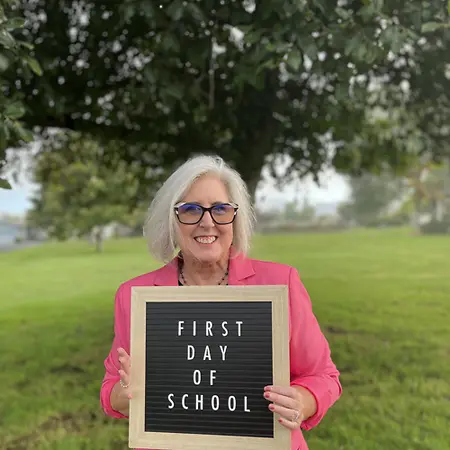
Her Story
About Liz
In my role, I spend a significant amount of time engaging with a wide range of stakeholders, including district office staff, teachers, principals, students, parents, and members of the community. As part of a small school district, much of the responsibility for reporting also falls to me and a small team, so report writing is a substantial component of my work.
One of the greatest challenges is balancing multiple responsibilities. Like the rest of my team, I wear many hats, which requires careful time management to ensure we meet deadlines, fulfill the needs of our students and families, and remain compliant with all requirements.
My work is grounded in the core values of integrity and transparency, with a strong commitment to ensuring that people feel prioritized and respected in every interaction. I believe that our shared goal is to support students—this is not an “us versus them” dynamic, but a collaborative effort. Families entrust us with what matters most to them, and just as they deeply care about their children, so do we. Our responsibility is to find common ground and work together to best support every child.
Her Interview
Ten minutes with Liz
01What do you attribute your success to?
I strongly believe that my success is rooted in the inspiration I received from my maternal grandmother and my mother. Both are remarkable educators who sustained their passion for teaching even as their lives evolved through motherhood and retirement.
My grandmother instilled in me a strong sense of confidence and determination. She often reminded me that I was capable of achieving anything, encouraged me to stay focused, and, with a touch of humor, always emphasized the importance of presenting oneself well. She was truly ahead of her time and never hesitated to stand up for what she believed in.
My mother reinforced the importance of authenticity and perseverance. She taught me to remain true to myself and to give my very best effort each and every day.
Their guidance, patience, and unwavering support have been instrumental in shaping who I am today. Without their influence, I would not be where I am now.
02What’s the best career advice you’ve ever received?
The most impactful career advice I received came from a mentor who consistently encouraged me to continue growing professionally. I truly loved teaching and was initially reluctant to leave the classroom. I pursued my first administrative interview somewhat tentatively, viewing it as an opportunity to apply what I had learned through my master’s program.
As I transitioned into leadership roles, I found great fulfillment as both an assistant principal and a principal. At that point, I believed I had reached the extent of my professional aspirations, as I was hesitant to move further away from direct work with students. However, my mentor continued to challenge and encourage me to take the next step, expressing confidence in my ability to lead at a higher level.
Ultimately, I chose to trust that guidance and step outside of my comfort zone by pursuing the superintendent role. That experience reinforced an important lesson: being open to the encouragement of others and willing to take risks—even when they feel uncomfortable—can lead to meaningful growth and new opportunities.
03What advice would you give to young women entering your industry?
The advice I would give to young women entering my industry is to recognize the importance of being present and intentionally engaging with all stakeholders connected to the role. While my work has always centered on students—and continues to do so—it also requires meaningful communication with families and the broader community.
Early in my career, I was confident working one-on-one with parents, but found larger group settings, such as back-to-school nights, intimidating. Over time, I have grown more comfortable speaking with larger audiences and have learned the value of authenticity in building trust and connection.
At the heart of this work is the understanding that we are all working toward the same goal: supporting students. It is not an “us versus them” dynamic, but a shared partnership. Families entrust us with their children, and just as they care deeply about them, so do we. Our responsibility is to find common ground and work collaboratively in the best interest of each child.
In my experience, when challenges arise—particularly when a parent comes in frustrated—it is often due to a breakdown in communication rather than a specific action taken by staff. Frequently, the issue stems from not establishing a strong connection early on or not keeping families informed. Proactive, transparent communication is essential to building trust and preventing misunderstandings.
04What are the biggest challenges or opportunities in your field right now?
One of the greatest challenges we face today is competing with the constant presence of technology. This makes it essential to ensure that our curriculum feels relevant and meaningful to students, so they understand its value and are motivated to engage deeply and think critically.
From there, the focus shifts to access and learning—ensuring that all students are able to engage with and successfully understand the curriculum. When students are not invested, it often leads to disengagement and, at times, behavioral challenges.
This underscores the importance of building strong relationships with students. When meaningful connections are in place, students are more likely to remain engaged and less likely to exhibit disruptive behaviors. All of these elements—relevance, engagement, access, and relationships—are interconnected and must be addressed holistically to support student success.
05What values are most important to you in your work and personal life?
The values that guide both my professional and personal life are integrity, transparency, and a commitment to putting people first in every interaction. I believe it is essential that others feel respected, heard, and valued in every conversation.
In my work, this is especially important because everything we do is centered on supporting students. I approach this with the understanding that we are all working toward the same goal—there is no “us versus them,” but rather a shared responsibility.
Families entrust us with their children, and they care deeply about their well-being, just as we do. By recognizing this common purpose, we can build strong partnerships, find common ground, and work collaboratively to ensure the best outcomes for every child.
Join Influential Women and start making an impact. Register now.