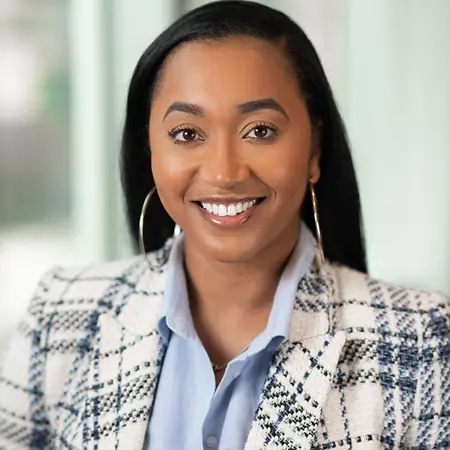
Her Story
About Loni
My journey into communications started in high school when a teacher recognized that I loved to talk and engage with other students in a valuable way. She suggested I'd be great for the morning news, and we created almost like a TV station for the high school. I was the lead anchor in the first class to do it, and I immediately fell in love with the camera and journalism. Even though I was reporting the smallest things, high school stuff, I knew this is what I wanted to do with my life. I went to Hampton University and studied journalism, where I learned that I don't have to have such a linear path in journalism - that journalism can look very many different ways. That's what made me first fall in love with the career field, and I've just been passionate about it ever since. Today, I manage corporate communications for a Fortune 50 company, where I focus on media relations, corporate storytelling, and stakeholder engagement. Corporate storytelling is basically everything that a company cannot sell - the people, the people you serve, whether it's your team members or the guests who come into your stores, the public's perception of you, your reputation. All the things that you cannot buy, but are equally as important for a company's success. You earn people's respect, you earn people's kindness and likeness and support.
Her Interview
Ten minutes with Loni
01What do you attribute your success to?
I would say just my faith. My faith and my hard work, which is instilled by my faith. I recognize through my faith that all good things come from hard work, and people who do right, and who do diligently, and those are things I just try to stay and abide by, even in a professional setting. Just remembering whose I am, and who I am, and all the things that come with that. My parents also played a huge role - they did quite a bit of sacrifices for me when it comes to my education, ensuring I had the best school system possible, making sure learning didn't stop after 3 o'clock. My parents definitely emphasized the importance of education, but also just doing your very best. I can't say that I might have been a straight-A student, but I can say that every day I showed up and did my very best, because I knew that's what was expected of me, and I appreciate my parents instilling that in me.
02What’s the best career advice you’ve ever received?
The best career advice I've ever received is that the rules don't exist. Live your life, do whatever feels good for you. There is no perfect plan, there is no exact way you have to do things - you just figure out what works for you. The rules don't exist.
03What advice would you give to young women entering your industry?
I would say learn everything you can, and that's not just in books, that's just in life. People talk bad about social media and technology and TV, but there's so much you can learn from that, too. Just constantly be soaking and saturating everything you can, because eventually it's all going to come back to you at some point. You'll have a conversation about something you saw on TV, and that'll click for you. I would say just be a student of life, continuously soak up knowledge, never stop learning, because everything evolves. The way we were doing media relations communications 15 years ago is not the same today. I'm having to constantly evolve and make myself stronger as a communications professional, so I would just say always be a student of life, for sure.
04What are the biggest challenges or opportunities in your field right now?
I would say the biggest challenge is just being adaptable. Things change constantly in this industry - how people are receiving their information changes, how people want to receive their information and their interests change, so you always have to find ways to stay relevant. If you're not staying on top of those trends and ways to navigate, you really can get left behind. You think you know something, and then it changes, and you have to learn it all over again. As for opportunities, I would say the biggest opportunity is to have more diversity and more inclusion in these spaces. I work at a company and I can probably count on my hand how many women of color are on that team. To have that seat in there makes a big difference, because that person is speaking and coming from real-life experiences, and just has a little bit more expert opinion on something, because it is directly affecting them as well. It's bigger than just race - it's gender, sexual preferences, life differences, financial differences, classism. There's just so many things that make us all unique and separate us a little bit. A lot of times we can be in these spaces and not have that expert opinion, because it's not included for everyone.
05What values are most important to you in your work and personal life?
I would say just to be enriched - physically, mentally, emotionally. Work and be aligned with things that drive you back to your purpose and your passion. Even if it's not necessarily your 9 to 5, still do work that's purposeful for you, and you have to carve out time for that. Obviously we work to have financial means and live your life - you cannot live without money, unfortunately, and you have to work. But at some point in your day, do at least something that's going to fulfill your purpose and your passion and make you richer mentally, because you're already doing something that's going to make you richer physically.
Join Influential Women and start making an impact. Register now.