Her Story
About Louise
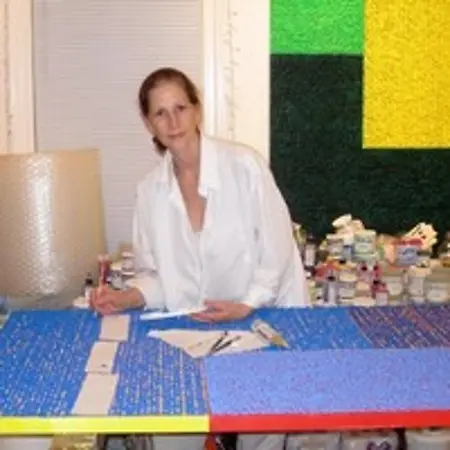
I've been a professional full-time visual artist since 1974, when I graduated from the School of Visual Arts. I was a Lower Manhattan loft pioneer and had my eyes set on the now-defunct O.K. Harris Works of Art, where Ivan C. Karp was the director. He was a bit of a rogue and a loner, like I am, and I was associated with him until he died in 2009, so I had a very nice jumpstart with my career there at a young age. I had my first commercial exhibition at Semaphore Gallery on West Broadway in SoHo in 1980. From there, I've had representation pretty much non-stop. I don't do commerce from my studio - I have gallery representation, and they're the ones that take care of all sales, shipping, advertising, promotion. They do that all. I spend my time creating beautiful work. That's my job. I paint every day, I'm in my studio every single day, and the work evolves continuously because of that process. Currently, I'm creating a series of works in my dream format, which is a 50 by 46 inch painting, and each painting takes me around 8 to 10 weeks, so I can only make around maybe 8 to 10 paintings a year. My current signature style, which I've been doing now for over 20 years, is optically charged bright colors with texture that's all writing - not legible, but personally meaningful to me. This change came after talking to Richard Aniskevich, one of the pioneers of the op art movement. He looked me up and down and said, 'you're not getting any younger, what the fuck are you waiting for?' And I came home and changed my style. I've been successful painting in a different mode before, but this is more fun because it's joyous and popping and resonates with the public. Nobody's making artwork like this. It's very unique.
Her Interview
Ten minutes with Louise
01What do you attribute your success to?
I attribute my success to maintaining gallery representation pretty much from the beginning of my career. Most artists, not because their work is unworthy, don't have representation. They don't have gallery exposure. I have had the luxury of being represented pretty much my entire career. But nobody opened up any doors for me, nobody helped me. It was all from my own perseverance and being present, and going places where people would get to know me, and finally take an interest enough in me to want to find out what I do. I was at the right place at the right time for a number of opportunities, and I never say no to anything. I never wavered from my path. I never taught, I never had a job in the arts. I was a waitress, a barmaid, anything that I could get that part-time would pay all of my bills for a living and give me enough money to run my studio. I'm hardcore. I'm the real deal. I'm an artist.
02What’s the best career advice you’ve ever received?
The best career advice I ever received came from Richard Aniskevich, one of the pioneers of the op art movement. I told him one day that I was so rocked to my soul in 1965 when I saw his work when I was a kid, and that I've always wanted to paint in optically charged bright colors. He looked me up and down and said, 'you know, you're not getting any younger, what the fuck are you waiting for?' And I came home and I changed my style. I had been successful painting in a different mode, but I changed, and that's now my signature style. I've been doing that now for over 20 years, and I'm having more fun. I was always a serious artist, but this is fun, because it's joyous and popping and resonates with the public.
03What advice would you give to young women entering your industry?
Be present. You have to go out there. Nobody can open a door for you. You have to show up, you have to support other artists, you have to be there. And at some point, if you make an impression, someone might take an interest in you and then want to do something for you. Go to museums, go to galleries - galleries don't cost anything. Get together with other people, drive into Manhattan together, park your car someplace for free on a weekend, and walk around Chelsea or the Lower East Side. Go in and out of galleries. You're gonna get to see what gallerists are showing, and it'll give you an idea of maybe where you might fit into the picture. You have to do that work, and I don't care what business it is. You don't just pick a corporation and decide that you're gonna be their CEO. And for women, it's harder. It's even harder. I don't have any patience for people that don't want to do something for themselves, that want something handed to them. You gotta do that work.
04What are the biggest challenges or opportunities in your field right now?
The market has kind of fallen through. Many galleries in New York City are closing their doors. My main gallery, Spaniardman Modern, closed its doors in April of 2025, like many galleries in New York City. They're no longer brick and mortar, but they do move stuff online. Now that the arts have been slashed, I'm giving money to all of the public radio stations and public television stations and to arts institutions and to different museums and art institutions that are nonprofits that had all of their money taken away. I will contribute work for them to auction at galas to try to raise money, and I don't take any money back for that.
05What values are most important to you in your work and personal life?
I value authenticity and independence above all. I'm a stand-alone person. I don't like clubs or cliques or organized religion or private clubs because that's kind of 'we're better than you were.' I don't want to be involved in a group show where you're showing the same people all the time because you're part of that club. When I get curated into something, it's because a curator reached out to me and saw the work, and they wanted it to be part of their vision, not a limited vision made by somebody else. I also believe you can't measure your value by a money symbol. You have to measure the value of making art by what it does for you internally. That goes for music, dance, script writing, writing a novel. Not everybody's novel gets published, not everybody's great script ends up on the screen, but that doesn't make them less valuable. Does it make you feel good? Does it give you a spiritual satisfaction to make something? Then it's great. As long as I'm alive, I want to make art every day. I'm selfish - I like my time, my solitude.
Join Influential Women and start making an impact. Register now.