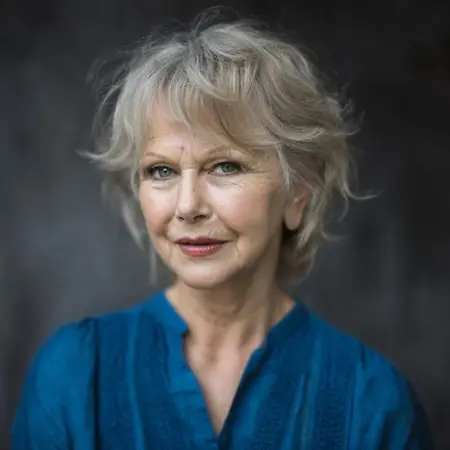
Her Story
About Ludmila
Ludmila Vucolova is an independent research scholar based in Hackensack, New Jersey, who has spent more than two decades investigating some of science's most complex questions without institutional funding or support. Since 2000, she has pursued original, self-directed research across an unusually wide range of disciplines, including evolutionary anthropology, neuroscience, cognitive science, quantum physics, and linguistics, in order to develop and defend her central hypothesis on how conscious experience arises from a purely physical universe. Her most notable achievements include a June publication on the emergence of consciousness and a widely discussed case in which she reversed the motor symptoms of Parkinson's disease in a patient who had lived with the disease for 13 years, work she presented at a Harvard conference in 2015. She has also developed copyrighted theories on the evolution of language, functional brain asymmetry, and mirror neuron activity, drawing recognition from two Nobel Prize laureates, Roger Sperry in 1981 and Rogers Fieri more recently.
Vucolova's path to research was shaped by an unconventional and often difficult personal history. Born and educated in the former Soviet Union, she earned her degree in Automatics and Telemechanics from the Electrotechnical University in St. Petersburg before facing persecution that eventually led her to emigrate to the United States, where she learned English largely through independent study after just two years of formal instruction. Her early career included work as an electrical engineer and technical consultant, notably collaborating with a nuclear physicist connected to the Manhattan Project, before she shifted her focus entirely toward independent scientific inquiry. For fifteen years, she also worked as a physical therapy assistant and yoga instructor, experience that directly informed her later hypotheses on the progression of Parkinson's disease symptoms through the lens of the mind-body connection.
Despite working without financial compensation and navigating personal setbacks, including periods of depression that slowed her progress, Vucolova has remained committed to advancing her research and sharing it publicly. Her guiding motivation is not personal recognition but the belief that her findings, spanning consciousness, neuroscience, and human evolution, can meaningfully improve the lives of others. Today, she continues to develop her theories at the intersection of neuroscience and quantum mechanics, standing as an example of how sustained curiosity and personal resilience can drive scientific contribution outside traditional academic or institutional structures.
Her Interview
Ten minutes with Ludmila
01What do you attribute your success to?
I attribute my success to the 26 years I have dedicated to independent research since 2000. My recent work on the emergence of consciousness was published in June, and one of my proudest achievements was reversing the motor symptoms of Parkinson's disease in a patient who had lived with the condition for 13 years, which I presented at a Harvard conference in 2015. I also credit the years I spent living as though I were blind and deaf, which gave me a deeper understanding of how consciousness is formed. My resilience, shaped by the persecution I experienced in the former Soviet Union before coming to the United States, has also played a significant role in my journey.
02What’s the best career advice you’ve ever received?
The best guidance I've carried with me is to follow my passion, which for me has been Parkinson's disease research, and to have the courage to present my theories at conferences, even as an independent researcher without institutional backing.
03What advice would you give to young women entering your industry?
I would tell them that they can make a meaningful difference in the lives of others simply by using their skills and knowledge as researchers.
04What are the biggest challenges or opportunities in your field right now?
One of the biggest challenges I've faced has been building my career in the United States while having only two years of formal English education to rely on.
05What values are most important to you in your work and personal life?
What matters most to me is being able to share my story and the full body of my work in a way that can truly make a difference in others' lives, even though I have not received financial compensation for my research.
Join Influential Women and start making an impact. Register now.