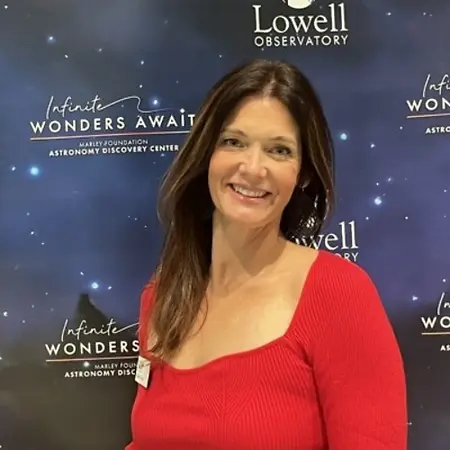
Her Story
About Magan
I've been in my current position for less than a year, but I've been in the material science and MedTech industry for over 10 years. This represents a career change for me at an earlier point in my life. I transitioned to the company I work for now, which is a materials polymer science medtech company, about 11 years ago. Before my current role and career, I owned an adventure travel company in Patagonia, Chile, for 10 years. Now I lead a team of associates, change managers, and change leaders who support the delivery of new applications within the company. We work on training, communications, leadership support, and change leadership, understanding how associates use tools on a daily basis and how our matrixed organization is connected. We're constantly confronting new technologies, and we need to get ahead of that to bridge technology with our customers to increase adoption. We're in this constant growth mindset learning state. I work in a medical device manufacturing company that's relatively large, and the products we make save lives every day. A lot of them are in clinical trials, and we're constantly seeking to evolve and develop new therapies for patients. That brings a lot of purpose to what I do every day, and having that connection to purpose is essential because we spend so much time at work.
Her Interview
Ten minutes with Magan
01What’s the best career advice you’ve ever received?
The best career advice I've received came from my mentor Mary Tilly, who just retired from my company. She had been through so many different roles, starting as a female engineer in the 70s or 80s when it was really hard to break through in those professions. What stood out most was when I heard her say to a young engineer joining a meeting, 'Tell us who you are, or tell us who you want to be.' The way she opened that up was so powerful, especially for women supporting women. There's vulnerability in recognizing we're not maybe where we want to be, but that's okay. You can still express that, it can be made known, it's safe to say you want to grow into certain things. When you start speaking about who you want to be rather than who you are, you start becoming who you want to be. That really stuck with me. It was such an interesting way to begin a conversation with someone and break through barriers, leave a safe space, and recognize that we all have growth and development that we want. We should be hearing about each other's growth and dreams and growth trajectories, and talk a little bit more freely about that.
02What advice would you give to young women entering your industry?
What I tell those that I mentor, my children, and other young professionals is to believe in yourself, though it's not always easy. But most importantly, have courage. Have courage and know that you are capable of moving through many, many things. There's an evolution to our lives and our professions, and where you start is not necessarily where you're going to finish at the end of your career. There's some patience required, but also the courage to begin, to step into new spaces, to bring your ideas to the table, to learn, and to engage. All of that takes some belief in oneself and also the courage to step forward. We want those voices to be heard. We want to bring in all of our generations and all of the thoughts and ideas to end up with a greater product at the end, to develop something even more beautiful, more impactful, more meaningful than we could have started with before. Your voices need to be heard, and have the courage to use it.
03What are the biggest challenges or opportunities in your field right now?
There are challenges on multiple planes. One is my own capacity and risk of burnout, balancing long hours with work, life, family, and all the other responsibilities I have outside of work. Leading has its own inherent challenges, supporting others who are also oftentimes feeling burned out, tired, stuck, or facing roadblocks. Sometimes team dynamics present challenges in creating a strong, inclusive, and fair environment where people on my team feel like they can voice issues or concerns, different perspectives, bring new ideas, and ensuring we all are behaving and representing those beliefs of having a strong and inclusive team. Leading with integrity day-to-day is challenging when we have very challenging deadlines. We're confronting new technologies all the time, so it's new for us and new for end users, and we need to get ahead of that to bridge technology with our customers to increase adoption. We're in this constant growth mindset learning state, and for some people that's really exciting, and for other people it can be very exhausting being new to something all the time. There's the emotional support of my team members, understanding the intricacies and nuances of new applications and tools, voicing concerns or raising risks when we believe our business may be at risk for certain decisions. Making decisions on a daily basis and keeping pace with all those different layers of thought processes involved in playing all those roles all the time can be a little bit challenging. It's invigorating, and at the same time, it can be a bit challenging.
04What values are most important to you in your work and personal life?
My top three values professionally are integrity, creativity, and purpose. With professional integrity, you can stimulate or create environments that stimulate creativity. We need to continually pull in creative areas of our brain and aspects of our life to what we do every day. Balancing some of the confines of a profession and pulling in the creativity that can make us really unique, think differently and out of the box, and develop things that we become very proud of or attached to, that have purpose. Creativity is very important to me. I work in a medical device manufacturing company, and the products that we make save lives every day. A lot of them are in clinical trials, and we're constantly seeking to evolve and develop new therapies for patients. That brings a lot of purpose to what I do every day. Whatever is important to you in life, for me it's well-being and health. I know that I'm contributing to the well-being of my communities and the population at large every day by supporting this business that's developing life-saving therapies. Having that purpose and that connection to purpose is essential, because we spend so much time at work. If we lack that connection to purpose, then I think it can become really challenging and create some disconnect inside of us.
Join Influential Women and start making an impact. Register now.