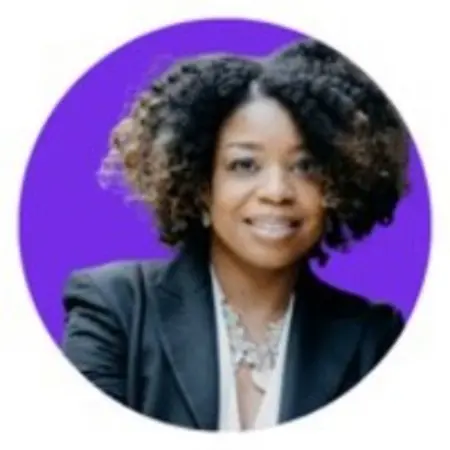
Influential Woman · Professional Training and Coaching
Malaika Simmons
Founder and CEO, Momentology Media
Ashburn, VA 20148
I recommended my top employee for another role because people aren't resources to be possessed, they're potential to be developed. When you choose alignment over attachment, everyone flourishes.
Malaika Simmons · In Her Own Words
Her Story
About Malaika
Malaika Simmons has spent much of her career doing something she once thought she had avoided entirely: teaching.
Born into a family of educators, Malaika initially resisted following the family path. Yet across more than two decades of leadership, research, strategy, facilitation, coaching, and human-centered design, a clear pattern continued to emerge. Regardless of her title or industry, she found herself helping people discover what they already possessed, see challenges differently, and translate insight into action.
That throughline led Malaika to describe herself as a “facilitator of discovery,” an identity that continues to shape how she approaches her work today. Rather than positioning herself as the person with all the answers, she creates the conditions for individuals, teams, organizations, and communities to uncover better questions, recognize possibilities, and design solutions grounded in the experiences of the people they are intended to serve.
Her career has spanned healthcare, government, technology, product and service development, organizational development, and community-centered research. Across those environments, Malaika has remained deeply interested in the relationship between people and the systems around them: how we design workplaces, policies, services, and expectations that enable people to perform at a high level without requiring them to sacrifice themselves in the process.
That same curiosity gave rise to The Momentology Method™, a human operating system rooted in Awareness, Gratitude, and Expectance. Developed through years of research, reflection, leadership experience, and observation of human behavior, the Method is grounded in a simple idea: our lives are ultimately experienced in moments, and we can become more intentional about how we recognize, navigate, and design the moments that matter.
Malaika founded Momentology Media, LLC in 2017 as a home for this work. Since then, her work has expanded across speaking, coaching, organizational strategy, facilitation, research, and human-centered design. She has contributed to initiatives involving maternal health, workforce development, technology and AI, community engagement, and health innovation, while working with leaders, organizations, and communities across sectors and geographic boundaries.
Her commitment to women is especially personal. Malaika’s mission is to empower 1,000 women to empower 1,000 women, rooted in her belief that expanding what is possible for one woman rarely ends with her. The impact travels through families, organizations, communities, and generations.
Malaika is also an author, researcher, international TEDx speaker, and mother of six. She considers motherhood among her greatest accomplishments and sees many of the principles behind her work reflected in the experience of raising children to recognize their own strengths, trust who they are becoming, and make meaningful contributions to the world.
Whether working with one woman, an executive team, or an entire organization, Malaika’s work ultimately returns to the same idea: meaningful change begins with recognizing what is already there, getting clear about what actually matters, and intentionally designing what comes next.
Her Interview
Ten minutes with Malaika
01What do you attribute your success to?
Malaika Simmons attributes her success less to following a prescribed path and more to learning to recognize the throughline in her own life. Born into a family of teachers, she initially resisted the idea that teaching would be part of her future. Yet across industries, roles, and leadership positions, she continually found herself doing exactly that: developing people, asking questions that shifted perspectives, and helping others see possibilities they had not yet recognized for themselves.
“I spent a long time thinking success meant figuring out what I was supposed to do next. What I eventually realized was that the clues were already there. I had been teaching, coaching, designing experiences, and helping people move from where they were to what was possible throughout my entire career. I just hadn’t put a name to it yet.
A large part of my success has come from learning to pay attention to those patterns and trust them. The principles that eventually became the foundation of The Momentology Method™—Awareness, Gratitude, and Expectance—were things I had been practicing long before I formalized them. Awareness helps me see what is actually happening. Gratitude keeps me connected to what is already available. The power of Expectance is that it allows me to move forward believing there is more possible than what I can currently see. What you focus on expands.
I’ve also benefited tremendously from people who could see more in me than I could see in myself at the time. One of those people was an early mentor, Maureen Power, who consistently challenged me beyond my comfort zone and expanded my sense of what was possible. That experience shaped the way I lead and the way I work with others today.
Ultimately, I think my success comes from being willing to keep becoming. I don’t believe we have to sacrifice who we are in order to become who we are capable of being. My work, whether I’m speaking, coaching, facilitating, or advising an organization, is about helping people recognize what is already within them and design what comes next from that place.
That is also what sits behind my larger mission: to empower 1,000 women to empower 1,000 women. Because when one woman expands what she believes is possible for herself, she rarely keeps that possibility to herself. She changes what becomes possible for the people around her, too.”
02What’s the best career advice you’ve ever received?
Some of the best career advice I ever received was never actually spoken to me. I learned it by watching a leader I deeply respected.
I once worked for a vice president who had been a Marine lieutenant, and he embodied servant leadership before I had language for what I was witnessing. He always put his “unit,” our team, first, but never at the expense of the mission. He cared deeply about people and equally about execution. There was no ego about who got credit, whose idea won, or who needed to be out front. The goal was to accomplish the mission and make sure the people responsible for accomplishing it had what they needed to succeed.
Years later, he wrote a recommendation for me that said, “I would work with or FOR Malaika at any opportunity.” That remains one of the greatest professional compliments I’ve ever received because I knew what leadership meant to him.
He never sat me down and told me how to lead. He showed me. And his example taught me something I carry into every room today: putting people first and delivering exceptional results are not competing priorities. Great leadership requires both.
03What advice would you give to young women entering your industry?
Trust the still, small voice that led you here.
You belong in every room you enter, even when you are still figuring out how you belong in it. The question isn’t whether you have something valuable to contribute. The question is how you will contribute it in a way that is uniquely yours.
Don’t let fear convince you to make yourself smaller, and don’t let ego convince you that you already have to know everything. Both can keep you from the experiences, relationships, questions, and even failures that are trying to shape you.
Give yourself permission to become. Pay attention to what energizes you, what keeps calling you forward, and the throughlines that continue to show up in your life. Sometimes the thing you think is a detour is actually directing you toward work you don’t have language for yet.
You do not have to have your entire path figured out. You just have to be willing to recognize yourself as you meet her along the way.
04What are the biggest challenges or opportunities in your field right now?
I think one of our biggest challenges right now is hopelessness, compounded by a growing sense of disconnection from what actually matters. We are surrounded by more information, more content, more opinions, more tools, and more supposed answers than ever before, yet people are increasingly unsure what deserves their attention.
When everything starts to look and sound the same, it becomes very easy to disengage. We dial it in. We follow the template. We automate the interaction. We optimize for efficiency and risk automating away the very human qualities that create meaning, trust, creativity, and connection. In the process, we can lose sight of the moments that matter.
But I also think that is one of our greatest opportunities.
The more technology can replicate what is predictable, the more valuable our distinctly human capabilities become: curiosity, discernment, empathy, imagination, lived experience, and the ability to make meaning from complexity. The answer isn’t to reject technology. It’s to become much more intentional about what we delegate to it and what we refuse to surrender.
Whether I’m working with an individual or an organization, I keep coming back to the same question: What actually matters here? I believe our ability to answer that question, and then design around the moments that matter, will be one of the defining leadership skills of this era.
05What values are most important to you in your work and personal life?
Alignment is probably the value that sits underneath everything else for me.
I think there is a throughline running through who we are, what we value, what we’re good at, what brings us alive, and the impact we are here to make. My work and my life have become an ongoing practice of exposing that throughline, honoring it, and noticing when the way I am living or working has moved away from it.
For me, alignment doesn’t mean everything is easy or perfectly balanced. Sometimes the aligned choice is difficult. Sometimes it requires courage, sacrifice, or change. But there is a difference between making an intentional sacrifice in service of something that matters and living in a constant state of self-sacrifice because you believe that is the price of success.
That distinction has become increasingly important to me.
I want my decisions, relationships, leadership, and work to reflect what I say matters. And when they don’t, I want to be willing to notice, recalibrate, and choose again. To me, that is alignment: not achieving some permanent state of balance, but continually bringing who you are, what you believe, and how you live back into relationship with one another.
Join Influential Women and start making an impact. Register now.