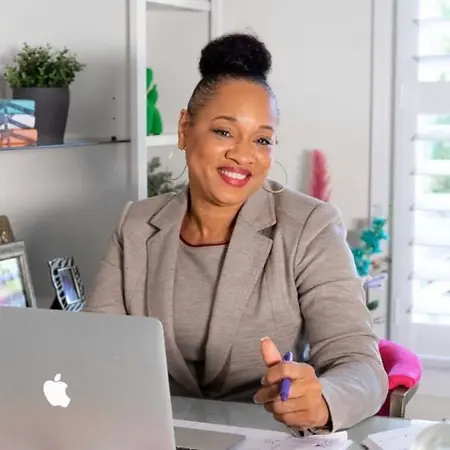
Her Story
About Mallery
My journey to becoming a therapist started in high school when my basketball coach, who was also the psychology teacher, introduced me to psychology. That's when I decided I wanted to be a therapist. I went on to run track at the University of Tennessee as a Lady Vol, and I've always been involved in mentoring and working with young people in the community. After graduating, I moved to Atlanta, got married, had kids, and continued coaching in the community. After going through a divorce, I went back and got my master's degree, finishing in 2013 and becoming fully licensed in 2016. During my career class in grad school, I was able to hone in specifically on wanting to work with athletes. My background as a former elite athlete who competed at a high level, combined with years of coaching track and working with organizations like Girls Club and Girls Inc. in Nebraska where I'm from, helped me recognize my population and my niche. I understand what athletes go through because I lived it - the pressure, the drive, the anxieties, the body image issues, learning how to focus and persevere through defeat. Being both a former athlete and a coach for so many years gives me a unique ability to help my clients see things through a coach's lens, not just an athlete's lens. I work with elite and professional athletes as well as high-performing individuals, whether academically or professionally, in the 14 to 35 age range. I've had my practice for about 5 years, and I took my first client 3 years ago. Since then, I've worked with over 223 clients. Everything I've done, all the time it took, it led up to where I am today, and I'm in my happy place helping people navigate this thing called life.
Her Interview
Ten minutes with Mallery
01What do you attribute your success to?
I would say passing my NCE exam was pivotal because it afforded me the opportunity to move towards my vision of having my private practice. Going to college, then going back after my divorce to get my master's degree, and passing that exam - that's what got me to this place right here. But beyond the credentials, I think my success comes from my lived experience. I'm strong in knowledge as far as being an athlete - I know about persevering, being driven and motivated, time management, the anxieties and depressions and body image issues that athletes go through, because I was there competing at a high level. I coached in the community for so many years, so I can think as a coach and help my athletes see things through a coach's lens, not just an athlete's lens. I can have conversations about pressure and persevering through tough times, and then we process it all together. Everything I've done in my life, all the time it took, it led up to where I am today. It's all worked out how it was supposed to work out.
02What’s the best career advice you’ve ever received?
Just two days ago, one of my interior design clients who has become a friend sent me a message that really resonated with me. She thanked me for always demonstrating how to figure out the messy, how to be unapologetic about who you are, and for living out loud. She sent me a song called 'Celebrate Me' by Inga Rose, and when I listened to it, it was my life - all the challenges of going through divorce, being a single mom, going back to get my master's degree, raising my kids as a single parent while they were extremely active, still being in the community, working in the community, and doing it all with a smile. Having those moments of complete meltdown but embracing every moment. The advice that stands out is about living out loud, being unapologetic, being transparent, and living life unconditionally, without conditions. The older I get, I'm learning to embrace that even more. I have an enormous support system between my family and friends who have poured tons of advice into me over the years.
03What advice would you give to young women entering your industry?
I would say it's important to live unapologetically and allow yourself to embrace who you are in your authentic self - being your most authentic. One of the things I talk about a lot with my clients, my friends, and myself is understanding and learning capacity. You need to learn and know your capacity, and learn and understand somebody else's capacity too. Understand that what you want from somebody, they may not have the capacity to give it to you. Learn to recognize that quickly, in real time, so that you're not expecting people to be there for you or in a space in which they don't have the capacity to be there. And vice versa - understand your own capacity as well. Be authentic, know your limits, and recognize others' limits too.
04What are the biggest challenges or opportunities in your field right now?
I don't know if I would say challenge - I think challenge is about your mindset. With anything we do, there's a learning curve. Once you identify the need, then you work towards learning what you need, and once you figure it out, it becomes easy. It's like riding a bike - when you first get on, you have training wheels, then you take them off and you're wobbling until you get stability. Once you learn to ride, even if you haven't ridden for 10 years, you still have to readjust. That's just life. So is it a challenge, or is it just learning how to adjust to things that are difficult? I think about what Kara Lawson, the Duke University women's head basketball coach who's also a Lady Vol, says in a video about handling hard. Learning how to handle hard - life is hard, you're going to go through ups and downs. If you have people in your life that support you, they're going to support you through hard, and they're also going to push you and give you more heart. Learning how to make those adjustments and understanding that if you're going to be successful, you're going to experience hard and you're going to have challenges, and you have to adapt.
05What values are most important to you in your work and personal life?
What's most important to me is that I maintain my purpose and my sense of who I am, and continue doing what I do - being a helper and helping people navigate this thing called life. I want to understand their challenges and help them embrace those challenges. The money is not what drives me and motivates me. Is it important? Absolutely. But it is not the driving and determining factor in what I do. I'm a helper, and I want to help people. I've been helping people, and I've been in my happy place. I'm a giver - I'm always giving. If I had to describe my day-to-day involvement in the community and giving back, that's every day for me. I want to maintain my purpose, continue being a helper, and empower people. I want to have impact and create a legacy, not just for me, but for my family. I'm in a space where between interior design and being a therapist, I'm always in my happy place because I love what I do.
Join Influential Women and start making an impact. Register now.