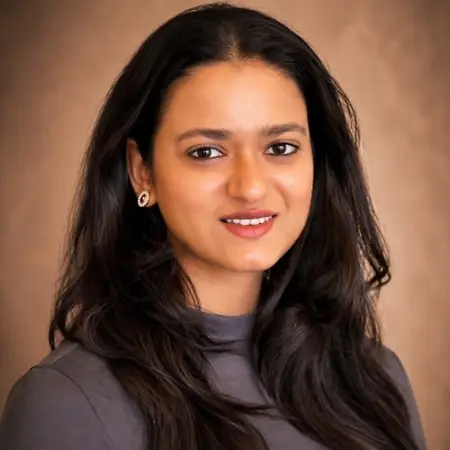
Her Story
About Mallika
I'm a safety scientist at Genetics Biotherapeutics, where I manage the safety profile for two gene therapy products. My day-to-day work involves looking at adverse events, making sure that the safety profile looks good, and reaching out to our medical director or CMO when there's any adverse event that requires their attention. I also manage a lot of pharmacovigilance operations activities, making sure that our department is functioning well when it comes to managing the vendors who are responsible for containing all the safety information for us. I work in the rare disease area space, and I get to work on CLAD, sickle cell anemia, and beta thalassemia - it's amazing the contribution we make to patients' lives. One of my most notable achievements was when I worked as a scientist at Amgen on a small molecule called AMG5N that got fast-track approval from FDA. That molecule went into the clinic, and Lumacras was created, which is a drug against non-small cell lung cancer. It's very rare in a scientist's lifetime that you work on a molecule in a lab that will go through the clinic and then patients would actually get treated - it's commercially available now. I'm doing both pharmacovigilance science and pharmacovigilance ops, which are two different umbrellas of teams, and I'm trying to keep both open based on career development discussions with my leadership team.
Her Interview
Ten minutes with Mallika
01What do you attribute your success to?
I attribute my success to just not being afraid of trying out new things and being willing to move away from the lab to explore what lab roles look like and what other sectors of biotech I can contribute to or might have interest in. I'm still exploring because I'm still doing my public health degree, so I never think that this is it for me. There's more that I can learn, and there is more that I can contribute towards, and I'm always striving for the next level. I keep asking myself, what else can I do? How else can I give my best and learn more? This is one life, one career, so you might as well do your best to reach your full potential.
02What’s the best career advice you’ve ever received?
The best career advice I've received is to keep yourself open to new opportunities, because the field that we work in, biotech, things are constantly evolving and changing. Company priorities are sometimes evolving, so it's important not to be too rigid and just go with the flow. If you get put on a new project, don't think of it as a realignment - think of it as an opportunity to learn new things and build your expertise in a new field or area. This is especially important because the work we do can be so siloed in our 9-to-5 roles. Just be flexible and absorb everything while you can in a particular role. That advice has been great because it does come in handy when you move to a different role or different company - having all those experiences means you can mix and match and use it for your career development.
03What advice would you give to young women entering your industry?
I've been very fortunate to have had a lot of female managers and influential female leadership throughout my career, and I see them constantly trying to empower young women. My advice is to have conversations with your manager or leadership team members about what else you can do - not asking for higher money or a higher position, but saying you want to feel prepared for the next level. Talk about what other skills you can develop that can help you later down the line. Don't be scared of exploring options, because I have consistently moved around - I started in neuroscience, ended up in PKDM, then started doing pharmacovigilance. It might take a few places to actually explore job roles and even different sectors before you land in a space where you feel your most confident self and find something highly interesting to you. Don't get discouraged if you're not finding something exciting or not performing your best in a role - maybe that's not the best role for you, and you should be exploring something else. I'm sure with hard work, if you find that right spot, you will do your best and see the results. And if you're a young woman starting out, perseverance is so important - just not giving up and having the drive, because it's hard.
04What are the biggest challenges or opportunities in your field right now?
In pharmacovigilance and biotech, there are more opportunities than challenges right now. The field is constantly evolving, so the biggest opportunity would be looking at how AI is helping in this field. Young people starting out should look at what different sectors AI can be used to improve the way we conduct our clinical trials, starting from clinical trials or even preclinical trials. How is AI being used in lab spaces to conduct experiments? Is there a way we can look at the molecule level when we are identifying different molecules to treat different diseases? And then from there to clinical to post-clinical in operational roles, whether it's clinical operations, pharmacovigilance, or regulatory - there's more and more conversation and guidance out there, including from the FDA, on how they would appreciate if AI is being used in some of these spaces to accelerate the way we bring these therapies or drugs out to our patients. The challenge is competition - something that was here 10 years ago, 20 years ago, and it's still going to be here, and it's only going to get harder. You really have to be passionate about what you want to do and knowledgeable, and that's going to take some time to build. When you're starting off, just show that drive that you're willing to learn new things - that helps you get your foot in the door.
05What values are most important to you in your work and personal life?
In an organization, being respectful towards their employees is the most important value to me, and also within the team - there has to be a respectful way of getting things done. I've been very fortunate that I've never worked for an organization where there was disrespect, but I've heard stories in the industry. Different organizations might have different priorities and the way they treat their employees is very important to me. Just having that open communication is crucial - feeling that you can talk to your manager, a skip-level person, whether it's your VP or the C-suite leadership team. Having that flexibility is very important, and not all organizations have that. The bigger the organization, the more siloed it is. It's important to know what leadership is thinking, so having that clear communication from leadership level to us, and also vice versa, is essential. If I have a question and only my higher leadership can answer it, I should feel comfortable enough that I can go and talk to them, and they won't feel like, why is this person coming and asking me this question? And kindness - I value kindness. Also, perseverance is so important, especially if you are a young woman starting out in this world. Just not giving up and having the drive, because it's hard.
Join Influential Women and start making an impact. Register now.