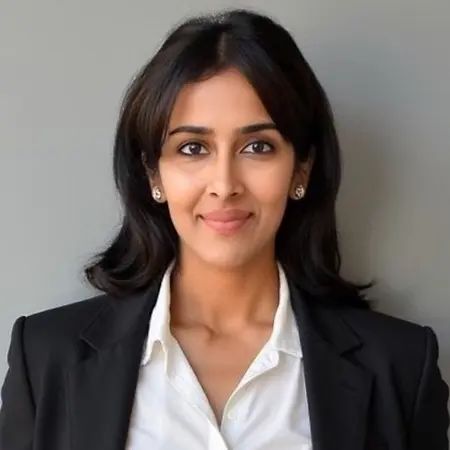
Her Story
About Manaswini
I sit right at the intersection of enterprise platforms, operational workflows, and real-world execution. For the past eight years, my career has been about leading high stakes business transformation. I built my foundation on the floor at Tesla, running the drive unit quality team for the Model 3 launch, and I’ve spent the years since directing global program deployments at Jabil and TeamViewer.
My actual sweet spot is cutting through chaos and bringing tight structure to massive, messy enterprise programs. I don't just look at a project timeline; I look at the end-to-end operational architecture. I know exactly how to align legacy systems like SAP with modern digital workflows to unlock capacity, clear out supply chain bottlenecks, and get cross-functional teams moving in lockstep. I love running toward complex, 'physical-meets-digital' scaling challenges, and I thrive when I'm pushing an organization to innovate rather than just settle into a comfort zone.
Her Interview
Ten minutes with Manaswini
01What do you attribute your success to?
For me, it comes down to a deliberate mix of structured execution, cross-functional collaboration, and an obsession with outcomes. I thrive in fast-moving, highly ambiguous environments because I don’t just manage a crisis,I break that ambiguity down into a systematic, data-backed plan and get everyone aligned early.
But beyond the technical and operational frameworks, my success belongs to the network of family, friends, and mentors who have supported me along the way. They’re the ones who give me the perspective, encouragement, and resilience needed to consistently run toward complex challenges instead of away from them.
02What’s the best career advice you’ve ever received?
The best advice I ever received was simple: always choose continuous learning over comfort. The moment a role stops stretching your capabilities or you find yourself on autopilot, that’s your signal to move on.
I’ve intentionally structured my career around that mindset. It’s why I transitioned from automotive quality engineering into the semiconductor space, and eventually into global enterprise platform deployments. I look for the friction points, the places where the scaling challenges are the steepest, because that is where the real professional velocity happens. If you aren't slightly uncomfortable, you aren't growing.
03What advice would you give to young women entering your industry?
First, build an unshakeable technical foundation and never wait until you feel 100% ready to take on a massive challenge. Growth doesn’t happen in a classroom; it happens when you step into a complex, messy operational problem and figure out how to solve it in real time. Own your space and trust your metrics.
Second, and just as importantly: understand that work should support your life, not consume it. Especially early in your career, it’s easy to think that burning the candle at both ends is the only way to prove yourself. It isn't. Protecting your physical, mental, and emotional well-being isn't a luxury, it’s a performance strategy. Set your boundaries early, stay disciplined about your balance, and you'll build a career that is both high-impact and sustainable.
04What are the biggest challenges or opportunities in your field right now?
Right now, the ultimate game-changer is how quickly we can integrate AI into global manufacturing and enterprise operations. When you do it right, you unlock incredible predictive visibility and autonomous decision-making at a massive scale.
But here’s the real challenge: the bottleneck isn't the AI model itself. It’s the integration. The hard part is taking these advanced, intelligent solutions and mapping them onto rigid, legacy enterprise structures without disrupting live production. Throughout my time at Tesla, Jabil, and TeamViewer, that’s exactly the friction point I’ve owned. I focus on architecting the underlying data pipelines and SAP integrations required to safely connect next-gen software with real-world physical execution. That’s where the actual transformation happens.
05What values are most important to you in your work and personal life?
It always loops back to three pillars: safety, value, and trust, in that exact order. It’s a framework my father taught me early on, and it guides how I evaluate every operational decision and personal commitment.
First, is it fundamentally safe? If we aren't protecting our people and our core infrastructure, nothing else matters. Second, does this drive real, measurable value, or are we just running a process for the sake of it? And finally, is there deep trust in the people, the data pipelines, and the execution? When you lead complex global programs, variables change constantly, but if you anchor your decisions in safety, value, and trust, you will always deliver the right outcome.
Join Influential Women and start making an impact. Register now.