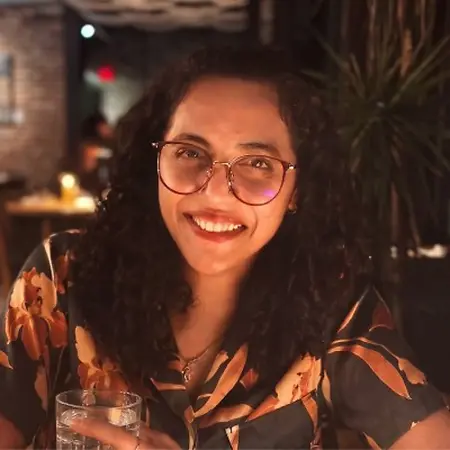
Her Story
About Manjushree B.
Manjushree B. Aithal, PhD, is a Postdoctoral Fellow and AI Expert at the Mitchell Lab at the University of Colorado Anschutz Medical Campus, where she joined specifically to bring her artificial intelligence background into the healthcare domain. Her central project involves building privacy-preserving natural language processing models capable of interpreting sensitive clinical notes entirely offline, addressing a persistent obstacle in medicine: regulatory frameworks such as HIPAA and GDPR often prevent hospitals from routing protected patient information through external, cloud-based AI systems. Rather than treating that restriction as a dead end, she repurposes smaller language models that operate locally on a device, pushing their performance toward that of far larger frontier systems while keeping every piece of patient data contained where it originated.
A significant portion of her research targets the disambiguation of abbreviations in medical documentation, where a single set of letters can carry conflicting meanings depending on the specialty reading it. Because even experienced clinicians and trainees occasionally misread these shorthand terms, the consequences can extend well past inconvenience to incorrect dosing and other dangerous outcomes. Earlier disambiguation tools tended to plateau rather than continue adapting, so her approach emphasizes systems that deliver near real-time interpretation without forcing clinicians to wait or compromise confidentiality. Her work extends beyond documentation into an agentic elicitation framework designed to interview patients ahead of their appointments, since broad questions typically produce vague answers and patients often spend much of their limited visit simply describing the problem. The resulting report gives the physician a clear picture of the primary concern before the patient walks in, freeing the appointment for discussion of treatment rather than background collection. Complementing this is her behavioral research into how people respond to such systems, which has revealed that users grow frustrated when asked too many questions, creating a design problem she considers as important as the engineering itself.
Her path to this work began with a Master of Engineering from Savitribai Phule Pune University and a doctorate in Electrical and Computer Engineering from Binghamton University, where she was recognized in the institution's 3 Minute Thesis Competition for distilling her dissertation on adversarial attack mitigation for a non-specialist audience. She holds credentials in Artificial Intelligence Privacy and Convenience from LearnQuest and in hands-on artificial neural networks from SuperDataScience. Aithal traces her trajectory to an appetite for understanding that she has never quite learned to switch off, describing an unplanned journey in which each completed milestone prompted her to ask what question came next. Looking ahead, she intends to stay on a research-driven path while expanding into teaching and mentorship, particularly for younger students who have been dropped into a technologically saturated world without the gradual adjustment period her own generation enjoyed; her aim is less to produce researchers than to spark genuine curiosity about science. Away from the lab she is an enthusiastic sourdough baker, an avid gardener and self-described plant person, and previously volunteered at a Chicago animal shelter where she fostered kittens.
Her Interview
Ten minutes with Manjushree B.
01What do you attribute your success to?
My success comes from what I can only describe as a greed to know more. I have never known when to stop learning; the more details I uncover, the more the rabbit hole opens up, and I keep diving deeper. There are always questions in my mind, and the biggest one is always "why." My academic journey was never planned years in advance. I would reach one milestone, ask myself what comes next, and follow that question wherever it led. Some people might call it over-fixation, but I see it differently. If something interests me, I would much rather understand it completely than accept a surface-level explanation. Research suits me because it continually opens new topics, and I have learned that stagnation makes me miserable.
02What advice would you give to young women entering your industry?
Do not question yourself, and keep going. If something comes in your way, there is a purpose behind it, so go with the flow rather than letting obstacles discourage you. Especially in research, there is no such thing as a stupid question, so always be vocal about your ideas. If someone tells you an idea is not worth pursuing, do not become demotivated by it. Work on it instead, strengthen it, and learn to communicate why it matters until it becomes fascinating to others as well. Not stopping yourself, before anyone else has even had the chance to understand what you are trying to accomplish, is how you progress in this field.
03What are the biggest challenges or opportunities in your field right now?
One of the most pressing challenges is that many healthcare environments simply cannot take advantage of large frontier AI models because of regulations and privacy obligations such as HIPAA and GDPR. That constraint is also the opportunity I am pursuing: repurposing smaller language models that run locally on a device, keeping sensitive clinical information contained while approaching the accuracy of much larger systems. Clinical abbreviations are a good example of why this matters, since the same abbreviation can carry entirely different meanings depending on the specialty or context, and a misreading can contribute to an incorrect medication dosage or another potentially life-threatening error. Earlier acronym-disambiguation systems tended to become stagnant rather than continuing to learn, so there is real room to build something that adapts and still delivers near real-time results. The other challenge is behavioral rather than technical. A great deal of technology is being built for physicians right now, and some of it unintentionally makes their work harder. Doctors already work long hours, and asking them to constantly learn new tools becomes another burden instead of a solution. Technology should reduce work, not add to it, and designing for that requires understanding how people actually behave when they use a system.
04What values are most important to you in your work and personal life?
Patient privacy and patient safety guide everything I build; if a tool cannot protect sensitive information, it does not belong in a clinical setting. I also believe technology has to genuinely serve the people using it, which is why my team pays close attention to whether a new AI tool actually makes a physician's workflow easier rather than simply adding another task. Curiosity matters more to me than titles, and I would rather keep asking the next question than settle into something comfortable. I value being open with ideas and encouraging others to do the same, particularly younger students and women in science, because hearing other women talk about their journeys and their persistence reinforces my own resolve to keep moving forward. Outside of work, giving my time to causes I care about has been important to me, including volunteering at an animal shelter and fostering kittens in Chicago, and I hope to return to that kind of work once I am more settled.
Join Influential Women and start making an impact. Register now.