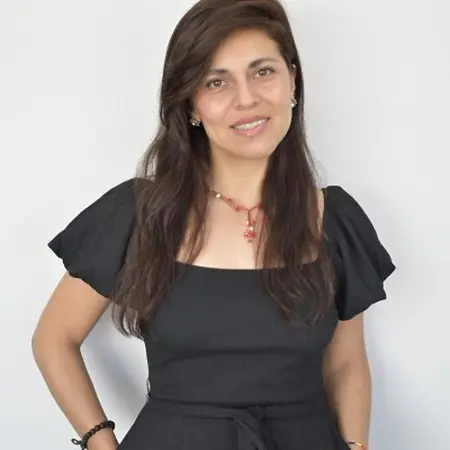
When we are young, life seems eternal; but as we realize life is ephemeral, we understand the moment to set all our dreams in motion is now.
Marcela Moyano · In Her Own Words
Her Story
About Marcela
I grew up within the classrooms as the daughter of parents who founded a university in Colombia, so education has been an intrinsical part of my life. It's just part of my genes. My father was a mathematician, and before he passed away, he wrote a model of holistic education, which is very important to me - not only teaching students how to do things in communication specifically, but also how to develop fully as holistic human beings. I graduated from my bachelor's degree in 2002 and then completed my master's in public relations in 2005, which is when I started teaching in higher education. I began teaching at community colleges while also teaching at our newly founded school in Florida after my parents founded Uni Latina here in Davie. I was then hired at St. Thomas University as a full-time professor and worked there for 10 years, starting when I was just 26 years old as the youngest professor at the university. During that time, I traveled, attended conferences, and completed my doctorate in educational leadership with an emphasis in electronic media. Now I serve as Director of Communications at United International College in Dania Beach, where I have administrative responsibilities in addition to teaching. My motto is how to use communications as a vehicle for social change, because I know that communications is such a power that you can give to your students. I've been in love with communications all my life. I create assignments where students develop projects that cannot be kept in their computers - the idea is for them to share these projects with the world. Right now, they're creating podcasts uploaded on Spotify, and I teach them how to use AI and embrace technology. I was the first professor using new media and blogging at St. Thomas University. I'm also an award-winning documentary filmmaker - I made a film in Haiti that won an award at the Miami International Film Festival. My research focuses on how to make documentaries for social change and how to use storytelling and narratives to create an impact in the world. I developed a model for teaching documentaries for social change called the Participatory Action-Based Learning model (PAP), which I implement in my documentaries course at United International College. We've produced five documentaries on important topics including pediatric cancer, autism, feeding impoverished communities, and the life of an international student in the United States. We started working with coffee farmers and Haitian women through the Cucano cooperative in 2007, and we're still working with them 20 years later - that's what true development and sustainable projects mean to me.
Her Interview
Ten minutes with Marcela
01What do you attribute your success to?
I think the importance of parenthood is huge. I'm really grateful to both of my parents, who were educators. I remember when my father noticed that I could write - I was maybe 10 or younger - I wrote a poem for my mother on Mother's Day, and he realized that I had a talent. When I was celebrating my quinceanera, he compiled all my poems that I had written throughout my childhood, and that was the souvenir or giveaway to all the guests at my quinceanera. That was so meaningful to me, because he noticed and he celebrated my talent. I was rewarded for that talent, and I think that was such a great push for me to acknowledge that I was talented in communicating. I never forget that. Growing up within the classrooms and seeing my parents teaching all the time made education an intrinsical part of my life. It's just part of my genes. Even when we faced challenges - we were persecuted by the guerrilla in Colombia and had security issues, so we moved to the United States in 1999 when I was 18 - we continued stronger. I think that when in life you have challenges, it's a push to come back. My father passed away four years after we moved to the United States of cancer, but before he died, he wrote the model of holistic education, which is the model that we implement here at United International College. My mother, Lydia Bautista Moeller, is the president of our college right now. I come from a family of very strong women - I have four other sisters. All of this shaped who I am and my commitment to using communications as a vehicle for social change.
02What advice would you give to young women entering your industry?
First of all, it's a true passion of mine to be in this industry. I love it, and if I could, it's just studying more, studying, being engaged and learning more every day. I think that for any woman who wants to be in the industry, you have to be ready to adapt to change, because it's definitely an industry that changes every single day. So you gotta be ready for change and accept change and adapt to it, because don't resist to change, but embrace it and enjoy it. I think that we've seen it throughout history - every time that we introduce a new technology, a new development, it will change the world. We need to adapt to it and embrace it and get the most benefit of it. Like, now we are going through this revolution of AI. So how can we embrace, use AI, and get the most of it? Because it's easy to resist to change. But why? Why resisting to it? It can just help us to better communicate, better reach larger groups of people. So that's what I would say to other women.
03What values are most important to you in your work and personal life?
Using communications as a vehicle for social change is my motto, because I know that communications is such a power that you can give to your students. As a society and as a community, when we know how to use this power, we can totally make a social change. I teach students how to develop fully as holistic human beings, not just how to do things in communication. In all my classes, I create assignments where students develop projects, but those projects cannot be kept in their computers - the idea is for them to share these projects with the world. What we want to teach the world is that companionship is super important, especially to the most vulnerable communities. We started working with the Cucano cooperative many years ago, and we are still working with them 20 years later. To me, true development means sustainable projects and long-term partnerships. As much as I love technology, I also know how distracting it can be, so I meditate, take long walks every morning and evening, and I think that these long walks are a way for me to root myself and be connected to myself. I love being connected to nature - I love gardening, cooking, and just being connected with my true self. I think that learning a new culture, meeting new people, eating new food is a way to discover the world. Our world is so big and so magic that it's such a great way to be exposed to new cultures and new people. Traveling is a way to see that reality that we have. I think that the magic of being connected to nature is that sometimes when I go through difficult days where I'm making a decision and I don't know what it is, I find the answer as I am pulling weeds or fixing my plants.
Join Influential Women and start making an impact. Register now.