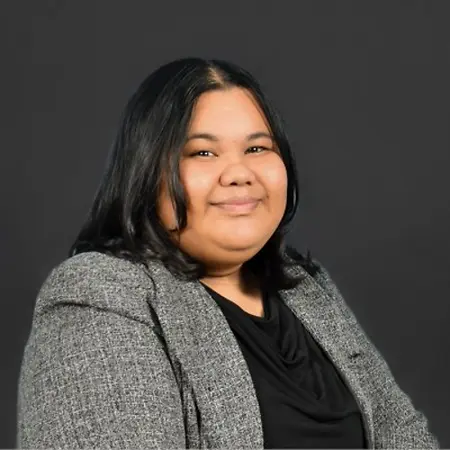
Community advocacy unexpectedly redirected my career from helping Marshallese families with daily systems to international advocacy, public speaking, and leadership that amplified my community's voice.
Marcina Langrine · In Her Own Words
Her Story
About Marcina
My name is Marcina Langrine, and I currently serve as the Operations Coordinator at the Marshallese Educational Initiative, a nonprofit organization based in Springdale, Arkansas. In this role, I oversee and support programs focused on education, women’s advocacy, cultural preservation, and community empowerment. For the past seven years, my work has been deeply rooted in serving Marshallese communities both locally and internationally. Interestingly, my journey into nonprofit and community work was unexpected. I was first introduced to MEI through community service hours and quickly discovered a passion for advocacy and service work. What began as a volunteer opportunity eventually grew into a meaningful career dedicated to uplifting and empowering Pacific Islander communities. Over the years, I have had the opportunity to lead outreach initiatives, mentor youth, support cultural programming, and engage in international advocacy efforts. This has included speaking opportunities connected to the United Nations and participating in global conversations surrounding nuclear legacy, climate justice, and human rights. Looking ahead, my long-term goal is to continue this work on a larger scale, ideally through the United Nations or UNICEF.
Her Interview
Ten minutes with Marcina
01What do you attribute your success to?
I really attribute my success to a combination of resilience, community, and purpose. I come from a culture where relationships, service, and taking care of one another are deeply valued, and those values shape the way I approach both life and work. I've been fortunate enough to have strong role models, mentors, family members, and community leaders who've poured into me, who've encouraged me and reminded me that my voice and experiences matter. At the same time, I've also had to learn how to really navigate challenges, adapt to different environments, and then continue pushing forward, even during difficult seasons. I would say that a lot of my growth really comes from stepping outside of my comfort zone and understanding that success is not just personal achievement, but it's about how many people you can uplift along the way. What continues to really drive me is purpose. Whether I'm working in advocacy, education, cultural preservation, or community work, I always remind myself that the work is bigger than me. I carry my community, my culture, and the next generation with me in every room I enter, and that responsibility really keeps me grounded and committed to continuing the work.
02What’s the best career advice you’ve ever received?
One of the best pieces of career advice I've ever received was to never underestimate the power of relationships and authenticity. Skills and experience are important, but the way you treat people, the integrity that you carry, and the consistency of your character will open doors that resumes alone cannot. I was also reminded early on that you do not have to have everything figured out immediately. Growth happens by being willing to learn, ask questions, take opportunities and trust the process, even when the path is unclear. And that piece of advice helped me stop chasing perfection and instead focus on impact, purpose, and continuous growth.
03What advice would you give to young women entering your industry?
I would tell young women entering this field, to never underestimate the value of their voice, their story, and the perspective they bring into the room. There will be moments where they may feel overlooked, inexperienced or intimidated, especially in spaces where leadership has historically not looked like them. And I speak from experience, but I also want to say that their lived experiences, their culture, their resilience, and their ideas are strengths, not limitations. I also want to encourage them to really lead with confidence, but remain open to learning. Ask questions, build relationships, and do not be afraid to take up space, because some of the most impactful leaders are not the loudest in the room, but the ones who stay grounded in purpose and service. Most importantly, protect your peace while pursuing your goals. Community work, advocacy, and leadership and service-oriented careers can be deeply rewarding, but they can also be emotionally heavy. Give yourself permission to rest, grow, make mistakes, evolve, because success is not about becoming perfect, but rather continuing to show up authentically, and then using your platform to create opportunities for others along the way.
04What are the biggest challenges or opportunities in your field right now?
One of the biggest challenges in my field right now is ensuring that underserved and historically overlooked communities have equitable access to education, healthcare, advocacy, and opportunities. Many communities still face barriers such as language access, cultural misunderstandings, lack of resources, and systemic inequities that make it difficult for families to fully navigate systems designed to support them. In advocacy and nonprofit work, there is also the challenge of balancing urgent community needs with limited funding, capacity, and emotional burnout among those doing the work.
At the same time, I believe there are incredible opportunities right now. There is a growing recognition of the importance of culturally informed programming, community-led solutions, and representation in leadership spaces. More organizations and institutions are beginning to understand the value of listening directly to the communities they serve rather than creating solutions without them. I also think younger generations are becoming more engaged, vocal, and passionate about issues surrounding identity, social justice, mental health, climate justice, and cultural preservation.
For me personally, that creates an opportunity to continue bridging cultures, uplifting underrepresented voices, and helping create pathways for future generations to feel empowered, supported, and seen
05What values are most important to you in your work and personal life?
The values that are most important to me are definitely integrity, compassion, and service. In both my work and personal life, I believe in showing up authentically, treating people with respect and leading with empathy. A big part of the work I do is really centered around community advocacy and creating opportunities for others, so staying grounded in purpose and compassion is very important to me. I also value resilience and cultural connection. No matter where life or work takes me, I always want to remain connected to who I am, where I come from, and the responsibility I have to uplift others along the way.
Join Influential Women and start making an impact. Register now.