Her Story
About Meg
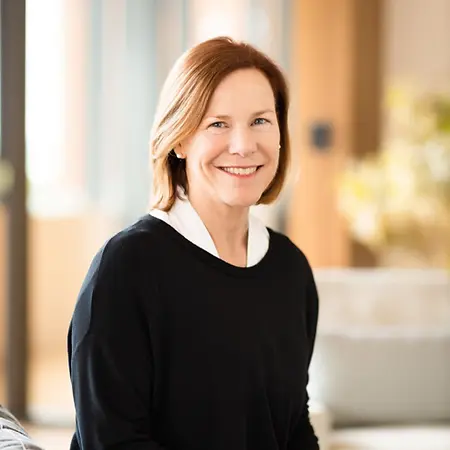
Margaret Caldwell (she/her), Retired – Interim Vice President, Environment & Science at the David & Lucile Packard Foundation, is a distinguished ocean conservation leader whose career has been dedicated to protecting the health of the global ocean, which covers approximately 70% of Earth’s surface and is essential to regulating climate, sustaining biodiversity, and supporting human well-being. A formative influence in her professional journey has been her mentor, Jane Lubchenco, whose pioneering work in marine science and environmental policy helped shape Caldwell’s commitment to integrating rigorous science with effective legal and governance frameworks. This mentorship reinforced her focus on translating scientific knowledge into practical, scalable solutions for ocean and climate challenges. After earning her J.D. from Stanford Law School in 1985, Caldwell began her career as an environmental attorney at a major San Francisco law firm, where she specialized in environmental compliance and regulatory law. She later transitioned into academia, teaching environmental law at San Jose State University before returning to Stanford University in 1994 as director of the Environmental and Natural Resources Law & Policy Program. In this role, she built an interdisciplinary program that connected law, science, and policy, helping to train future leaders in environmental governance and advancing innovative approaches to coastal and ocean management. During her more than two decades at Stanford, Caldwell further expanded her impact by co-founding the Stanford Center for Ocean Solutions in 2008, focused on bridging science and policy to improve ocean and coastal decision-making. Her public service includes serving as a Commissioner—and later Chair—of the California Coastal Commission, as well as contributing to the Blue Ribbon Task Force for California’s Marine Life Protection Act, which established the nation’s largest network of marine protected areas. She also served as a senior consultant following the Deepwater Horizon disaster, with many of her recommendations adopted at the federal level. Caldwell later joined the The David & Lucile Packard Foundation, where she led Ocean philanthropy and served as Interim Vice President for Environment and Science. Now retired from full-time leadership, she continues to advance ocean conservation through board service with leading environmental organizations, bringing deep expertise in ocean systems, climate policy, and the translation of science into long-term, impactful action.
Her Interview
Ten minutes with Meg
01What do you attribute your success to?
I attribute my success to consistently treating others with respect and approaching every role with collaboration, integrity, and a commitment to shared purpose. Throughout my career, I have found that meaningful progress in ocean conservation, environmental policy, and institutional leadership is only possible through strong relationships built on trust, active listening, and mutual respect. Whether working across government, academia, philanthropy, or the nonprofit sector, I have focused on fostering inclusive dialogue and valuing diverse perspectives, which has allowed me and those I am working with to help translate complex science and policy into effective, collaborative action for ocean protection and climate action.
02What’s the best career advice you’ve ever received?
The best career advice I've received, and that I also give, is to seek out mentors wherever you are and however senior you are in your career. I seek mentors out all the time and invite advice and reactions to things I'm thinking about or wanting to do. It's about being really intentional about growing as an individual and as a professional. One of my longtime mentors is Jane Lubchenco, an incredible marine scientist who headed up the National Oceanic and Atmospheric Agency under the Obama administration. She's been a really important person in my life personally and professionally for the last 30 years.
03What advice would you give to young women entering your industry?
I encourage women to seek out board positions because serving on boards is invaluable to personal and professional development. I share contacts and leads for board positions that can connect personal passions and skill sets with organizational needs. I also try to support other women in the field to ensure salary equity. Women don't talk enough about this. Women deserve encouragement from at least one other person who will say, "you absolutely deserve to ask these questions and ensure that you're compensated properly."
04What are the biggest challenges or opportunities in your field right now?
The biggest challenge is effectively addressing climate change to secure a safe climate future, and the greatest opportunity is securing the political will to sustain climate action.
05What values are most important to you in your work and personal life?
Values that are most important to me are also central values of the Packard Foundation: integrity, thinking big, respect, and equity. Having a strong moral compass and consistently acting with integrity is fundamental to effective leadership. And a beautiful side effect is that acting with integrity can be contagious! Thinking big and not being afraid to venture completely outside the box can help a team better articulate and understand the challenge they are trying to solve as well as embrace a much broader range of solutions. When dealing with a particular question, challenge, or conundrum, I ask how we could enlarge our approach to take a more systems or comprehensive approach, rather than just tackling one small piece of it at a time. I believe in treating people and our planet with respect, and spend a lot of time thinking about intergenerational equity. Equity between generations means working to ensure that current and future generations can live and thrive on a healthy and safe planet Earth.
Join Influential Women and start making an impact. Register now.